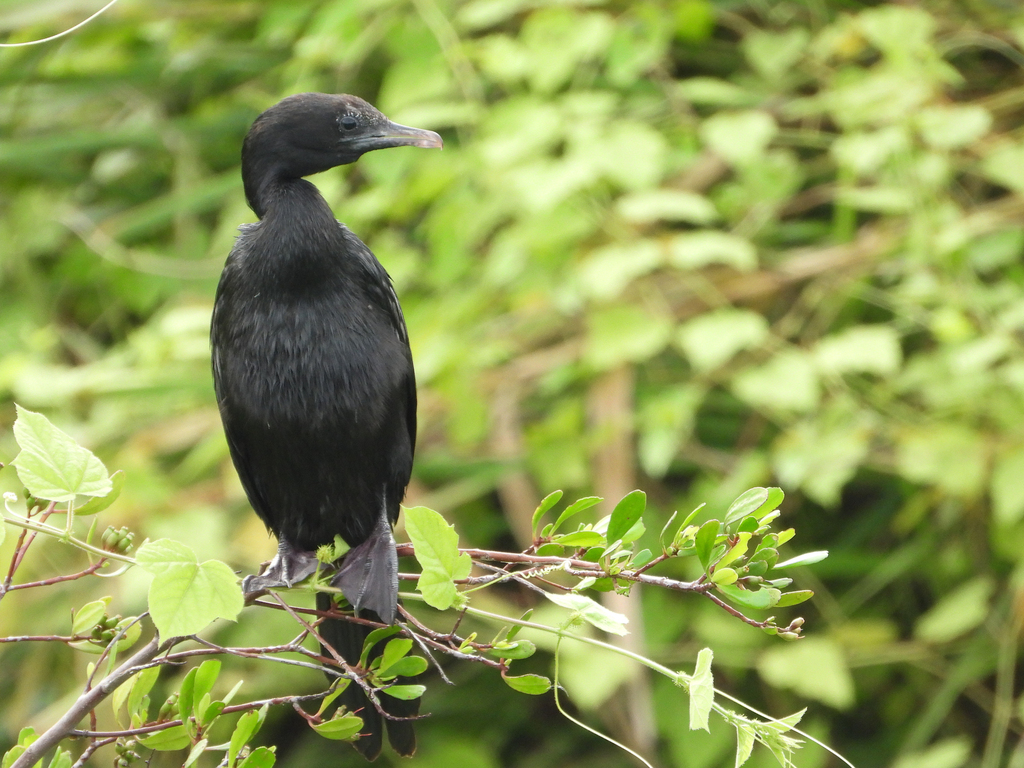
Little Cormorant
Photo © James M. Maley
Photo © James M. Maley — CC BY 4.0 — Source: iNaturalist photo #441232143Identification
The little cormorant is a compact waterbird measuring about 50 centimetres in length, making it only slightly smaller than the Indian cormorant. The key distinction from its larger relative lies in its shorter bill, which lacks the prominent hook tip, and its rounder head profile without the peaked appearance. During the breeding season, the bird displays striking glossy black plumage adorned with white spots and filoplumes on the face, along with a short crest on the back of the head. The eyes, gular skin, and face are dark in this plumage. Non-breeding birds and juveniles present a notably different appearance, with brownish plumage, a more fleshy-coloured bill and gular skin, an inconspicuous crest, and a distinctive small white patch on the throat. In the field, the sexes are indistinguishable, though males tend to be slightly larger.
Range & Habitat
This species is widely distributed across the Indian subcontinent, found throughout India, Sri Lanka, Bangladesh, Pakistan, and lowland Nepal. Its range extends eastward to Java, where it is sometimes called the Javanese cormorant. The little cormorant is absent from mountainous regions such as the Himalayas, though vagrants have occasionally been recorded in Ladakh. It inhabits a diverse range of freshwater wetlands, from small village ponds and streams to large lakes, and can occasionally be encountered in tidal estuaries. The species favours lowland freshwater bodies where it can pursue its aquatic lifestyle.
Behaviour & Diet
These cormorants are skilled underwater hunters that propel themselves using their webbed feet to capture small fish, typically 2–8 centimetres in length, from shallow waters less than a metre deep. They forage singly or in loose groups—a notably more solitary strategy than their larger cousins, the Indian cormorants, which fish communally in larger assemblies. When prey is captured, little cormorants often bring fish to the surface to swallow them, creating opportunities for other waterbirds to attempt theft. After emerging from the water, the birds characteristically hold their wings outstretched and remain immobile, a behaviour linked to drying their plumage. The breeding season varies geographically: July to September in Pakistan and northern India, November to February in southern India, December to May in Sri Lanka, and May to October in Bangladesh. These birds breed gregariously in trees, often joining mixed colonies with Indian pond herons and little egrets at heronries. Both parents construct stick-platform nests, typically within two weeks, and clutches of two to six eggs hatch asynchronously after 15 to 21 days. Young birds fledge after about one month. Little cormorants are vocal near nests and roosts, producing low roaring sounds, grunts, groans, and characteristic kok-kok-kok calls. They roost communally, frequently alongside other waterbirds.
Best Time & Places to See It
The best viewing opportunities depend on your location within the species' range. In Pakistan and northern India, visit during the breeding season from July to September for the most active birds. In southern India and Sri Lanka, November to February and December to May respectively offer the most reliable sightings. Look for little cormorants on small to large freshwater lakes, village ponds, and wetland areas throughout the lowlands. Heronries during breeding season provide excellent opportunities to observe nesting behaviour and family groups. Early morning and late afternoon are typically the most active periods for foraging.
Photography Tips
Capture the distinctive wing-spreading posture that occurs immediately after the birds emerge from water—this iconic behaviour is a signature moment for cormorant photography. The contrast between breeding plumage (glossy black with white facial markings) and non-breeding plumage (brownish with white throat patch) offers varied photographic subjects depending on season. Breeding birds with their short crest and facial ornamentation are particularly striking. Photograph from a distance to avoid disturbing foraging birds, and position yourself near known roosting or nesting sites where they gather communally. Overcast conditions help reduce harsh shadows on the dark plumage and reveal subtle details of white markings and facial features.
Lunugamvehera National Park
Sri Lanka
+204 birds+14 mammals
Dry scrubland and shallow wetlands converge in Sri Lanka's southeastern lowlands, where Lunugamvehera National Park anchors one of the island's most ecologically vital landscapes. The park's…
VIEW NATIONAL PARKMinneriya National Park
Sri Lanka
+158 birds+9 mammals
Across the dry zone of Sri Lanka's North Central Province spreads a landscape of shallow tanks, grassland margins, and scattered dry forest—a mosaic of water and…
VIEW NATIONAL PARKWasgamuwa National Park
Sri Lanka
+156 birds+8 mammals
Dry deciduous forest and open grassland sweep across the North Central lowlands where Wasgamuwa National Park protects one of Sri Lanka's largest remaining tracts of this…
VIEW NATIONAL PARKAngamedilla National Park
Polonnaruwa, Sri Lanka
+40 birds+2 mammals
Ancient tanks and sal forests define this water-rich sanctuary in Sri Lanka's North Central heartland, where seasonal wetlands and dry deciduous woodland create a mosaic of…
VIEW NATIONAL PARKOrang National Park
Rangagarapathar, India
+298 birds+1 mammals
Where the Brahmaputra's floodplains meet the foothills of Assam, Orang National Park unfolds across a mosaic of riverine grasslands, forests and wetlands that pulse with the…
VIEW NATIONAL PARKIndravati National Park
Bijapur, India
+41 birds
Where the Indravati River cuts through the elevated plateaus of central India, a landscape of deciduous forest and open woodland unfolds across Bijapur district in Chhattisgarh.…
VIEW NATIONAL PARKRanthambhore National Park
Sawai Madhopur, India
+294 birds+20 mammals
Granite ridges and ravines carved through the Aravalli Range frame this protected landscape in eastern Rajasthan, where deciduous forest mingles with open scrubland and seasonal water…
VIEW NATIONAL PARKEravikulam National Park
Devikulam, India
+192 birds+7 mammals
High in the Western Ghats of Kerala, where monsoon mists cling to slopes that rise above 2,000 metres, Eravikulam National Park preserves one of South India's…
VIEW NATIONAL PARKMu Ko Ang Thong National Park
Thailand
+47 birds+1 mammals
Forty-two limestone islands rise from the Gulf of Thailand, their weathered karst peaks piercing emerald waters in a landscape of stunning geological drama. Mu Ko Ang…
VIEW NATIONAL PARKHat Noppharat Thara-Mu Ko Phi Phi National Park
Ao Nang, Thailand
+253 birds+9 mammals
Where limestone karsts rise dramatically from turquoise waters, Hat Noppharat Thara-Mu Ko Phi Phi National Park unfolds across a mosaic of beach, mangrove forest, and island…
VIEW NATIONAL PARKKhao Yai National Park
Prachantakham District, Thailand
+377 birds+46 mammals
Evergreen dipterocarp forest blankets the rolling terrain of this national park in eastern Thailand, where limestone hills rise abruptly from the forest floor and seasonal streams…
VIEW NATIONAL PARKMu Ko Similan National Park
Lam Kaen, Thailand
+82 birds+1 mammals
Granite islands rise from the Andaman Sea in a scattered archipelago where limestone cliffs meet turquoise shallows, their steep faces weathered into caves and overhangs that…
VIEW NATIONAL PARKKhao Laem Ya-Mu Ko Samet National Park
Mueang Rayong District, Thailand
+159 birds+3 mammals
Where limestone hills meet the Gulf of Thailand, Khao Laem Ya–Mu Ko Samet National Park stitches together a mosaic of terrestrial and marine worlds that few…
VIEW NATIONAL PARKKhao Laem National Park
Sangkhla Buri District, Thailand
+197 birds
Where the Vajiralongkorn Reservoir sprawls across the forested valleys of Kanchanaburi's northern borderlands, Khao Laem National Park protects a landscape where limestone ridges rise dramatically from…
VIEW NATIONAL PARKKanha Tiger Reserve
Kanha Kisli F.V., India
+321 birds+23 mammals
Where sal forests give way to emerald meadows and crystalline streams carve through ancient valleys, one of India's finest wilderness reserves unfolds across the Maikal Range.…
VIEW NATIONAL PARKTadoba National Park
Palasgaon Singru, India
+270 birds+20 mammals
Where sal forests meet open grasslands and rocky outcrops rise from red laterite soil, central India's landscape unfolds in raw, untamed beauty. Ancient teak woodlands and…
VIEW NATIONAL PARKBandhavgarh National Park
Garhpuri, India
+285 birds+17 mammals
Where granite ridges rise dramatically above sal and bamboo forests, one of India's most pristine tiger reserves unfolds across the Vindhyan plateau. Ancient rock formations tower…
VIEW NATIONAL PARKPanna National Park
Badgadi Kalan, India
+271 birds+17 mammals
Where granite gorges slice through central India's Vindhyan plateau, a landscape of stark beauty unfolds across nearly six hundred square kilometers. The Ken River carves through…
VIEW NATIONAL PARKKaziranga National Park
Kohora, India
+422 birds+26 mammals
Dawn breaks over the floodplains of the Brahmaputra, where tall grasslands stretch endlessly beneath monsoon-heavy skies. This sprawling wilderness of northeastern Assam is a mosaic of…
VIEW NATIONAL PARKKeoladeo National Park
Shreenagar Rural, India
+326 birds+14 mammals
Where shallow wetlands shimmer beneath vast Rajasthani skies, one of Asia's finest bird sanctuaries pulses with extraordinary life. This former maharaja's hunting reserve, now spanning 29…
VIEW NATIONAL PARKPeriyar National Park
Mlappara, India
+232 birds+4 mammals
Dawn breaks over mist-shrouded ridges where the Western Ghats tumble toward Kerala's spice-scented lowlands. Here, ancient tropical forests envelope a glittering artificial lake, creating a mosaic…
VIEW NATIONAL PARKPampadum Shola National Park
Vattavada, India
+258 birds+14 mammals
Where misty shola forests cling to the high plateaus of the Nilgiri Mountains, ancient evergreen remnants create a world apart. This 2,316-hectare reserve protects one of…
VIEW NATIONAL PARKBandipur National Park
Hirehalli, India
+302 birds+19 mammals
Where the Western Ghats descend into the Deccan plateau, ancient deciduous forests blanket a landscape carved by the Nugu River. Bandipur unfolds across 880 square kilometres…
VIEW NATIONAL PARKNagarahole Tiger Reserve
Nalkeri Forest, India
+323 birds+23 mammals
Where granite escarpments rise above dense deciduous forests and the Kabini River carves through pristine wilderness, one of India's most biodiverse landscapes unfolds across the Western…
VIEW NATIONAL PARKWest Bali National Park
Gerokgak, Indonesia
+240 birds+8 mammals
Across West Bali's northwestern reaches, where the Indian Ocean meets volcanic slopes and limestone cliffs plunge toward turquoise shallows, sprawls a protected realm of roughly 325…
VIEW NATIONAL PARKWay Kambas National Park
Lampung Timur, Indonesia
+237 birds+20 mammals
Across the low swamplands of eastern Lampung, where freshwater wetlands merge into tidal mangrove forests along the Sunda Strait, sprawls one of Sumatra's most vital sanctuaries.…
VIEW NATIONAL PARKGir National Park
Asundrali, India
+258 birds+13 mammals
Dry deciduous forests cloak the rolling hills of western Gujarat where the Gir landscape rises as a final sanctuary for one of the world's rarest felids:…
VIEW NATIONAL PARKNo community photos yet. Log in to add the first one.
No community observations of this species yet.