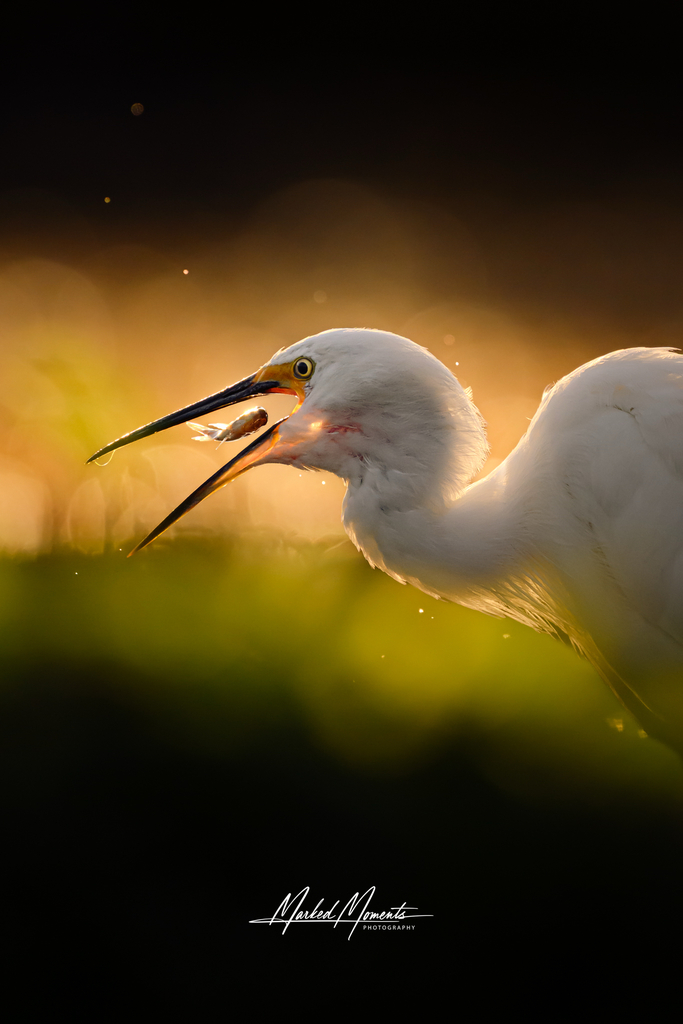
Little Egret
Photo © Mark Kriedemann
Photo © Mark Kriedemann — CC BY 4.0 — Source: iNaturalist photo #572203031Identification
The Little Egret is a small heron measuring 55–65 cm in length with a wingspan of 88–106 cm. Its most distinctive feature is pristine white plumage, though dark forms with bluish-grey colouring do occur. The bird has a long, slender black bill and characteristically black legs paired with yellow feet—though the eastern subspecies has blackish feet instead. During breeding season, adults develop elegant elongated plumes: two long, narrow crests on the nape and similar feathering on the breast and scapulars, making them particularly striking in the field. The eye is yellow with greenish-grey bare skin at the base of the lower mandible. Juveniles resemble non-breeding adults but have greenish-black legs and duller yellow feet, with some greyish or brownish feathers mixed into their otherwise white plumage. During intense courtship displays, the lores briefly turn red and yellow feet may flush red as well.
Range & Habitat
The Little Egret breeds across warm temperate to tropical wetlands spanning Europe, Africa, Asia, and Australia. The western race occurs from southern Europe through the Middle East, much of Africa, and southern Asia, while the eastern race inhabits Indonesia, New Guinea, Australia, and New Zealand. The species has experienced a remarkable range expansion, particularly northward in Europe and into the New World, with breeding populations now established as far north as the United Kingdom, France, the Netherlands, and Ireland—regions where it had become locally extinct during the nineteenth century. It has even colonised the Caribbean, breeding in Barbados since 1994, and has appeared on the Atlantic coast of the United States and in South America.
Little Egrets favour open locations including lake shores, rivers, canals, ponds, lagoons, marshes, and flooded lands. They feed in shallow water and on land, exploiting diverse aquatic habitats across their expanding range.
Behaviour & Diet
These herons are mostly silent birds, though at breeding colonies they produce various croaking and bubbling calls, and deliver harsh alarm calls when disturbed—sounds that are indistinguishable to human ears from the Black-crowned Night Heron and Western Cattle Egret, with which they sometimes associate. Little Egrets are versatile hunters, consuming a variety of small aquatic and terrestrial creatures in shallow waters and on land. They breed colonially, often alongside other waterbird species, constructing platform nests of sticks in trees, bushes, or reed beds. Pairs lay clutches of three to five bluish-green eggs, incubated by both parents for approximately three weeks. Young fledge at about six weeks of age.
Best Time & Places to See It
In warmer locations, Little Egrets are permanent residents, making them viewable year-round. Northern European populations migrate to Africa and southern Asia to overwinter, though some remain in southern Europe. Birds may wander northward in late summer after breeding, so late-summer sightings in unexpected locations are possible. The species's ongoing range expansion means it continues to colonise new areas, particularly northward in Europe and westward into the New World. Seek them in open wetland habitats—lake shores, marshes, lagoons, and flooded lands—where they forage in shallow water.
Photography Tips
The Little Egret's contrasting white plumage against darker water or vegetation provides excellent photographic subjects. Breeding birds are particularly photogenic, displaying their distinctive head and body plumes that add elegance and dimension to images. Early morning and late afternoon light enhances the texture of their breeding plumage. Photograph them in their preferred open habitats where they hunt in shallow water, allowing clear sightlines and natural backgrounds. Colonial breeding sites offer opportunities to capture multiple birds and their interactions, though exercise caution to avoid disturbing nesting colonies. The bright yellow feet and eye, along with the black bill and legs, provide striking colour contrast worth emphasising in your compositions.
Delta de l’Ebre Natural Park
Parque del Centenario
Bwindi Impenetrable National Park
Kanha Tiger Reserve
Lake Mburo National Park
Mabamba Swamp
Minneriya National Park
Murchison Falls National Park
Queen Elizabeth National Park
Nothing matches these filters.
No community photos yet. Log in to add the first one.