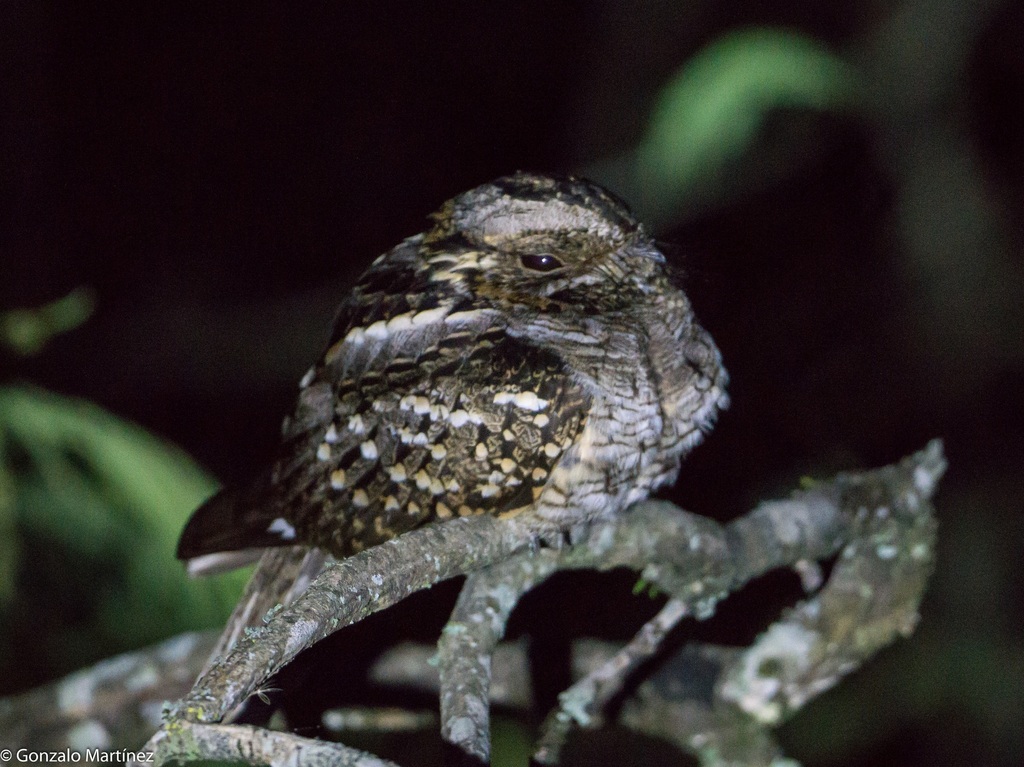
Little Nightjar
Photo © Gonzalo Martinez
Photo © Gonzalo Martinez — CC BY 4.0 — Source: iNaturalist photo #455574032Identification
The little nightjar is a small member of the nightjar family, measuring just 19 to 21 cm in length and weighing between 25 and 46.5 grams—making it a genuinely diminutive species. Males are generally grayish brown with buff, brown, and blackish-brown spots and streaks throughout their plumage. They feature a broad but indistinct buff collar on the hindneck, a buffy chin, and a distinctive white throat. A characteristic broad white band crosses each wing, and the outer tail feathers display white tips. Females are similar in overall appearance but lack the white wing and tail markings, and their throat is buff rather than white, making them slightly more subtle in the field.
Range & Habitat
This species is found across much of central and eastern South America, occurring in Argentina, Bolivia, Brazil, Paraguay, Peru, and Uruguay. Its range extends from eastern Peru across Bolivia and central and northeastern Brazil to the Atlantic coast, then southward through southern Brazil, Paraguay, and Uruguay to central Argentina. In the southern portions of its range and possibly Peru, the little nightjar is believed to be migratory, shifting north and east during the austral winter months.
The little nightjar favors brushy savanna, open woodland, and forest interiors and edges. It readily adapts to plantations of non-native Eucalyptus trees. Elevationally, the species occurs from sea level in eastern regions up to approximately 1,500 meters in Bolivia, demonstrating considerable vertical range flexibility.
Behaviour & Diet
As a strictly nocturnal species, the little nightjar becomes active after dark, foraging for insects by sallying from the ground or low perches and possibly during continuous flight, as is typical of many nightjars. While a detailed dietary breakdown is lacking, insects from at least five different orders have been documented in its diet.
Breeding activity occurs variably across the species' range between August and January. The little nightjar lays a clutch of two eggs directly on the ground, with both parents sharing incubation duties. The species produces a distinctive vocalization described as "a rattling, clacking, flat, unbirdlike sound" with a pattern of hurr-ee followed by rapid repeated quick notes—an unmistakable call for nocturnal identification.
Best Time & Places to See It
Since the little nightjar is nocturnal, your best opportunities come during night-time birding excursions. In the northern parts of its range (Peru and central Brazil), the species may be present year-round, while in the southern portions (southern Brazil, Paraguay, Argentina, and Uruguay), birds are best sought during the austral summer months from August to January when breeding birds are present and vocal. Listen for its distinctive rattling call from brushy savannas, open woodlands, and Eucalyptus plantations.
Photography Tips
Photographing this species presents significant challenges due to its small size, nocturnal habits, and cryptic coloration. Night-capable camera equipment with high ISO capability and fast lenses are essential. Focus on capturing the male's distinctive field marks—the white throat, white wing band, and white tail tips—which are diagnostic and absent in females. Ground-level positioning may be necessary given the species' habit of foraging from the ground or low perches. Recording its distinctive rattling call can complement photographic documentation of this cryptic species.
Tijuca National Park
Brazil
+317 birds+13 mammals
Where the Atlantic forest rises steeply from Rio de Janeiro's urban edge, Tijuca National Park encompasses a landscape of dramatic granite peaks, cascading waterfalls, and closed-canopy…
VIEW NATIONAL PARKEmas National Park
Brazil
+333 birds+23 mammals
Across the high plateaux of central Brazil, where the cerrado grasslands roll toward distant horizons under an immense sky, Emas National Park anchors one of South…
VIEW NATIONAL PARKSerra do Cipó National Park
Brazil
+379 birds+5 mammals
Where granite escarpments rise above the Atlantic Forest transition zone in southeastern Brazil, Serra do Cipó National Park unfolds across a landscape of dramatic ridges, cascading…
VIEW NATIONAL PARKItatiaia National Park
Brazil
+519 birds+12 mammals
Where granite peaks pierce the Atlantic rainforest canopy in southeastern Brazil, Itatiaia National Park rises as one of the country's oldest and most ecologically vital protected…
VIEW NATIONAL PARKIguaçu National Park
Brazil
+387 birds+17 mammals
Where the Paraná Plateau plunges toward the Atlantic watershed, six thousand square kilometers of subtropical rainforest cling to steep gorges and river valleys in this corner…
VIEW NATIONAL PARKIlha Grande National Park
Brazil
+233 birds
Across the subtropical plateaus and Atlantic forest remnants of southern Brazil, a vast protected landscape spanning nearly 4,600 square kilometers safeguards one of the continent's most…
VIEW NATIONAL PARKChapada dos Guimarães National Park
Brazil
+450 birds+1 mammals
Where weathered sandstone plateaus rise above the cerrado grasslands of central Brazil, Chapada dos Guimarães National Park protects 624 square kilometres of ecological transition zone that…
VIEW NATIONAL PARKChapada dos Veadeiros National Park
Brazil
+324 birds+6 mammals
Where granite plateaus rise above the cerrado savanna in central Brazil, Chapada dos Veadeiros National Park unfolds across 6,665 square kilometres of some of the world's…
VIEW NATIONAL PARKPantanal Matogrossense National Park
Brazil
+322 birds+17 mammals
Where the flooded forests of central Brazil meet vast seasonally inundated grasslands, Pantanal Matogrossense National Park sprawls across nearly 2,900 square kilometers of one of the…
VIEW NATIONAL PARKChapada Diamantina National Park
Brazil
+346 birds+5 mammals
Where granite peaks and sandstone cliffs rise abruptly from the Brazilian interior, Chapada Diamantina National Park sprawls across 4,215 square kilometers of some of Brazil's most…
VIEW NATIONAL PARKSerra do Gandarela National Park
Brazil
+333 birds+3 mammals
Where granite massifs rise through Atlantic Forest in southeastern Brazil's highlands, Serra do Gandarela National Park protects nearly 1,000 square kilometres of montane terrain that few…
VIEW NATIONAL PARKBrasília National Park
Plano Piloto, Brazil
+338 birds+15 mammals
Cerrado grassland and scattered woodland sweep across the central Brazilian plateau where this national park sprawls across more than a thousand square kilometres of the Federal…
VIEW NATIONAL PARKMapinguari National Park
Brazil
+354 birds
Vast tracts of western Amazonian rainforest blanket the remote terrain of this 56,827 square kilometre national park in Amazonas state, where seasonal rivers wind through dense…
VIEW NATIONAL PARKEl Palmar National Park
Distrito Sexto, Argentina
+244 birds+14 mammals
Across the Paraná River floodplain in northeastern Argentina, palms rise from wetland and grassland in a landscape shaped by water and time. El Palmar National Park…
VIEW NATIONAL PARKRío Pilcomayo National Park
Argentina
+271 birds+13 mammals
Where the Río Pilcomayo cuts through northeastern Argentina's subtropical lowlands, a sprawling mosaic of wetlands, grasslands, and seasonally flooded forests creates one of South America's most…
VIEW NATIONAL PARKIguazú National Park
Puerto Iguazú, Argentina
+346 birds+15 mammals
Where the Paraná Plateau plunges toward the Atlantic watershed, nearly 800 square kilometers of subtropical rainforest drape across Misiones Province in a landscape carved by millennia…
VIEW NATIONAL PARKEl Rey National Park
Municipio de Las Lajitas, Argentina
+317 birds+4 mammals
Where the eastern slopes of the Andes descend into northwestern Argentina's subtropical transition zone, El Rey National Park unfolds across 841 square kilometers of dramatically varied…
VIEW NATIONAL PARKCalilegua National Park
Municipio de Calilegua, Argentina
+288 birds+8 mammals
Where the eastern Andean slopes plunge into northwestern Argentina's humid subtropics, nearly 2,645 square kilometers of steep terrain and luxuriant forest compose one of South America's…
VIEW NATIONAL PARKSierra de las Quijadas National Park
Argentina
+168 birds+5 mammals
Sandstone cliffs and deeply incised canyons define this 1,137-square-kilometre expanse in San Luis Province, where the dry Chacoan landscape of central Argentina reveals an unexpected ecological…
VIEW NATIONAL PARKParque Provincial Pampa del Indio
Laguna Limpia, Argentina
+231 birds+4 mammals
Across the flat horizons of Chaco Province, where the Paraná River system spills into vast wetlands and grasslands, Parque Provincial Pampa del Indio protects one of…
VIEW NATURE RESERVEChaco National Park
Municipio de Presidencia de la Plaza, Argentina
+258 birds+7 mammals
Across the humid subtropical lowlands of northeastern Argentina, where the Paraná River basin feeds vast seasonal wetlands and gallery forests, Chaco National Park protects one of…
VIEW NATIONAL PARKNo community photos yet. Log in to add the first one.
No community observations of this species yet.