Little Penguin
Photo © John Barkla
Photo © John Barkla — CC BY 4.0 — Source: iNaturalist photo #1255163Identification
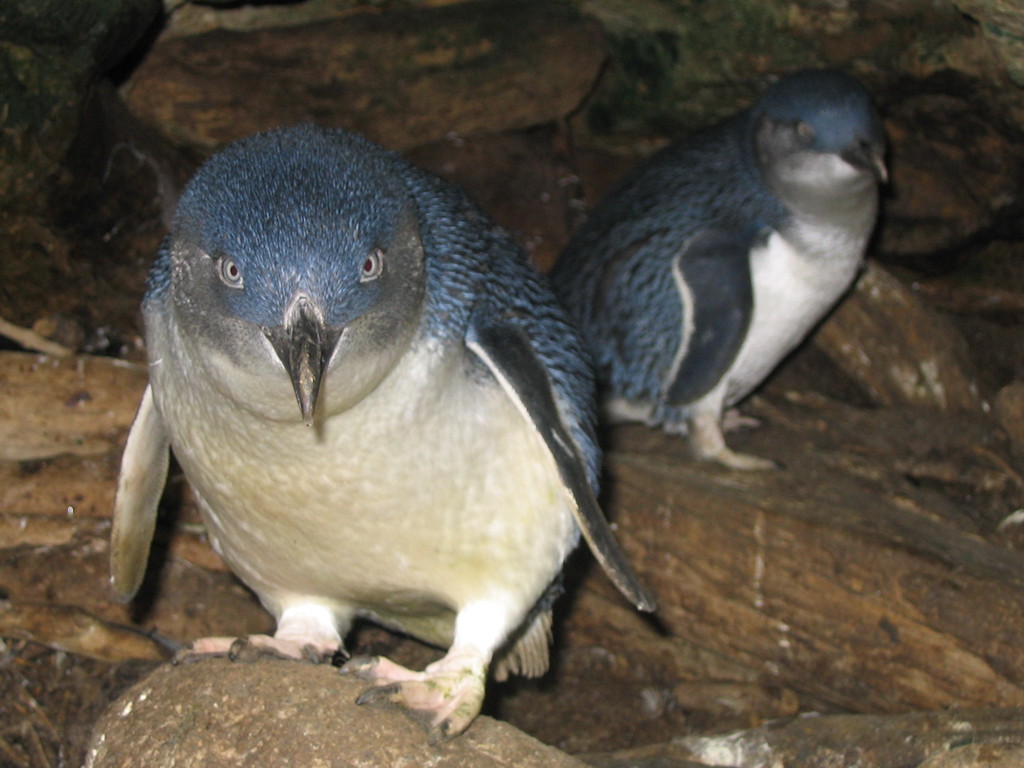
The little penguin is the world's smallest penguin species, typically standing between 30 and 33 centimetres tall and weighing around 1.5 kilograms. Its most distinctive feature is its slate-blue plumage on the head and upper parts, which gives rise to its common names: fairy penguin, little blue penguin, or blue penguin. The underparts fade from slate-grey ear coverts to white on the chin and belly, while the flippers are blue and the feet are pink above with black soles and webbing. The dark grey-black beak measures 3–4 centimetres long. Like all penguins, its wings have evolved into powerful flippers for swimming rather than flight. Immature individuals can be distinguished by their shorter bills and lighter upperparts. The species' distinctive blue colour comes from dense melanosomes in the feathers, which also increase water resistance.
Range & Habitat
The little penguin originates from New Zealand and Australia, though taxonomic analysis has revealed two genetically distinct populations. Eudyptula minor is endemic to New Zealand, while the Australian little penguin (Eudyptula novaehollandiae) is found across Southern Australia—including New South Wales, Victoria, Tasmania, South Australia, Western Australia, and Jervis Bay Territory—as well as in the Otago region of New Zealand. Colonies primarily exist on offshore islands, where they are protected from feral terrestrial predators and human disturbance.
The little penguin is a marine neritic species with a foraging range that is quite limited compared to flying seabirds. Tagged and banded birds have demonstrated that individual penguins can travel considerable distances during their lifetimes, with records showing movements between distant locations across southern waters.
Behaviour & Diet
Little penguins are diurnal divers, spending their days foraging for food in the ocean before returning to burrows on the shore at dusk. The Australian lineage exhibits distinctive group behaviour, swimming together in large groups after dusk and walking along the shore to reach their nesting sites—a strategy thought to provide protection from predators. This behaviour has not been observed in the New Zealand lineage. The two populations also differ vocally, with females of the New Zealand lineage preferring the local call patterns of their own population.
Reproductive strategies vary between populations. The Australian little penguin practises double brooding, laying a second clutch of eggs after the first has successfully fledged, possibly in response to changing sea surface temperatures and food availability. This behaviour has never been observed in the New Zealand population. Little penguins have a long lifespan, averaging 6.5 years, with exceptional individuals in captivity reaching up to 25 years.
Best Time & Places to See It
The best opportunities to observe little penguins occur at dusk, when they return from their daytime foraging to their burrows on shore. Offshore islands in southern Australia and New Zealand offer the most reliable viewing locations, as colonies congregate in these protected areas away from terrestrial predators. The Otago region of New Zealand and coastal colonies across Southern Australia, including Victoria, Tasmania, and South Australia, are known strongholds for the species.
Photography Tips
Photography should focus on the evening hours when penguins return from the sea, providing opportunities to capture their distinctive slate-blue plumage and small stature. The contrast between their blue upperparts and white underparts can be striking in good light. When photographing at colonies on offshore islands, maintain a respectful distance to avoid disturbing nesting birds and their burrows. The penguins' pink feet and pale eye-rings are distinctive details worth capturing in close-up shots. Early evening light during the return-to-shore period will provide optimal conditions for revealing the blue coloration that makes this species so visually distinctive.
Royal National Park
Sydney, Australia
+296 birds+46 mammals
Where sandstone ridges plunge toward the Tasman Sea, Royal National Park unfolds across 343 square kilometres of southeastern Australian coastal wilderness. The park's defining character emerges…
VIEW NATIONAL PARKLincoln National Park
Australia
+149 birds+5 mammals
Across the mid-north of South Australia, where the landscape transitions from coastal lowlands toward semi-arid interior plains, sprawls a wilderness of 2,671 square kilometres where red-earth…
VIEW NATIONAL PARKCoffin Bay National Park
Australia
+143 birds+5 mammals
Across South Australia's Eyre Peninsula, where limestone headlands rise above turquoise shallows and eucalypt woodland gives way to coastal heath, lies a 1,319-square-kilometre sanctuary shaped by…
VIEW NATIONAL PARKInnes National Park
Barcelona, Australia
+141 birds+10 mammals
Granite ridges and weathered stone outcrops rise across South Australia's Fleurieu Peninsula, defining a landscape where ancient rock formations meet open eucalypt woodland and heathland scrub.…
VIEW NATIONAL PARKMorton National Park
Australia
+253 birds+57 mammals
Across nearly 4,800 square kilometers of New South Wales's Southern Tablelands, rugged sandstone plateaus rise above sheltered valleys where cool-climate eucalypt woodland meets grassy heath and…
VIEW NATIONAL PARKFlinders Chase National Park
Australia
+142 birds+14 mammals
Granite ridges and windswept mallee scrubland define this 1,630-square-kilometre expanse on Kangaroo Island, where ancient rock formations rise abruptly from coastal heathland and woodland mosaics. The…
VIEW NATIONAL PARKWilsons Promontory National Park
Australia
+210 birds+21 mammals
Where granite headlands plunge toward Bass Strait, Wilson's Promontory National Park sprawls across nearly 1,300 square kilometers of southeastern Victoria's most rugged coastal wilderness. The park's…
VIEW NATIONAL PARKFitzgerald River National Park
Fitzgerald River National Park, Australia
+209 birds+11 mammals
Where granite peaks rise above windswept heathlands and pristine river systems carve through untamed wilderness, one of Australia's most biodiverse landscapes unfolds across the southwestern corner…
VIEW NATIONAL PARKBouddi National Park
Gosford, Australia
+147 birds+17 mammals
Sandstone ridges rise sharply from the Tasman Sea along the central New South Wales coast, their weathered faces etched by millennia of salt spray and storm…
VIEW NATIONAL PARKKu-ring-gai Chase National Park
Sydney, Australia
+216 birds+39 mammals
Where Hawkesbury sandstone cliffs plunge toward sheltered bays and creeks, Ku-ring-gai Chase National Park unfolds across rugged terrain just north of Sydney, a mosaic of eucalyptus…
VIEW NATIONAL PARKBen Boyd National Park
Eden, Australia
+255 birds+47 mammals
Where the temperate forests of the far south coast meet towering sea cliffs, Ben Boyd National Park unveils one of New South Wales' most dramatic coastal…
VIEW NATIONAL PARKGreat Otway National Park
Australia
+255 birds+42 mammals
Temperate rainforest and wet eucalyptus woodland cloak the ridges and gullies of Victoria's Great Otway National Park, where persistent moisture and mild year-round temperatures sustain a…
VIEW NATIONAL PARKPort Campbell National Park
Port Campbell, Australia
+170 birds+7 mammals
Dramatic sea cliffs rise from churning waters along Victoria's southwestern coast, where sandstone and limestone formations tower over a hundred metres above the Southern Ocean. Port…
VIEW NATIONAL PARKFreycinet National Park
Coles Bay, Australia
+115 birds+9 mammals
Granite peaks rise abruptly from the Tasmanian coast where Coles Bay opens into the Freycinet Peninsula, sculpting one of southeastern Australia's most dramatically vertical national parks.…
VIEW NATIONAL PARKNo community photos yet. Log in to add the first one.
No community observations of this species yet.