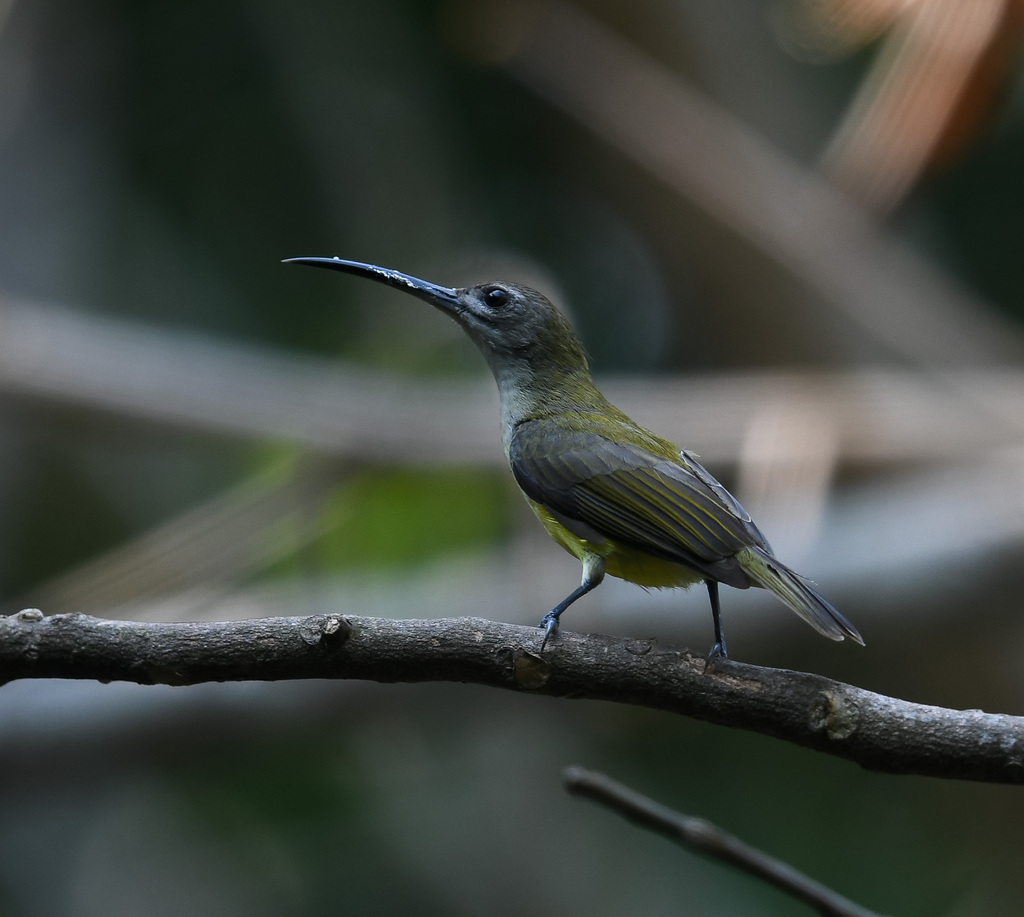
Little Spiderhunter
Photo © Rejoice Gassah
Photo © Rejoice Gassah — CC BY 4.0 — Source: iNaturalist #240886581Identification
The Little Spiderhunter is instantly recognizable by its distinctively long, slender beak—a feature that sets it apart from other sunbirds. Males and females are remarkably similar in plumage, a rarity among sunbirds, though females show a paler base on the lower mandible compared to the males' all-black beak. This small, energetic bird is typically found near flowering plants and often announces its presence with a characteristic buzzy "zick-zick" call, made regularly while foraging or when disturbed. Males also produce a rapid series of chipping notes that can continue for extended periods.
Range & Habitat
The Little Spiderhunter is found across South and Southeast Asia, ranging from southwestern and northeastern India through the Himalayan foothills into Thailand, China, and throughout Southeast Asia including Malaysia, Indonesia, and the Philippines. Approximately thirteen geographic races are recognized across this wide distribution. The species favours subtropical and tropical moist lowland forests, mangrove forests, and moist montane forests, where it typically forages below the canopy level. It has also adapted to secondary forests, forest clearings, plantations, and gardens—showing remarkable tolerance for human activities—though it has disappeared from some fragmented forest areas and even from Singapore's botanical gardens.
Behaviour & Diet
These birds are usually encountered singly or in pairs, moving actively through flowering vegetation in search of nectar. They play an important ecological role as pollinators of wild banana species and members of the ginger family, regularly visiting flowers such as Bombax malabaricum and Erythrina indica. The breeding season varies with latitude: in northeastern India it spans March to September (mainly May–August), while southern Indian populations breed from December to August. The species constructs a remarkable hammock-like nest suspended from the underside of broad leaves using approximately 150 "pop-rivets" made of cobweb and vegetable fibre—a unique architectural adaptation. Clutch size is typically two eggs.
Best Time & Places to See It
Look for Little Spiderhunters in flowering gardens and near fruiting trees throughout their range, particularly in areas with wild Musaceae (banana plants) and ginger species. They are most active during breeding season—May to August in the northeast, December to August in the south—when they are more vocal and visible near nesting sites. Secondary forests, forest edges, and cultivated areas offer good opportunities for observation, especially early in the morning when foraging activity is highest.
Photography Tips
The bird's small size and rapid, jerky movements present challenges, so a fast shutter speed and continuous autofocus are essential. Position yourself near flowering plants that attract the species, and remain patient—they will visit reliably if suitable nectar sources are present. Early morning light is ideal for capturing the plumage details and the distinctive long beak. The species' tolerance of gardens makes backyard flower feeders and flowering trees productive locations for photography, particularly during breeding season when birds are more frequent visitors.
Bako National Park
Bandipur National Park
Chitwan National Park
Doi Inthanon National Park
Gaoligong Mountain National Nature Reserve
Gunung Ciremai National Park
Gunung Mulu National Park
Hat Noppharat Thara-Mu Ko Phi Phi National Park
Kaeng Krachan National Park
Nothing matches these filters.
No community photos yet. Log in to add the first one.
No community observations of this species yet.