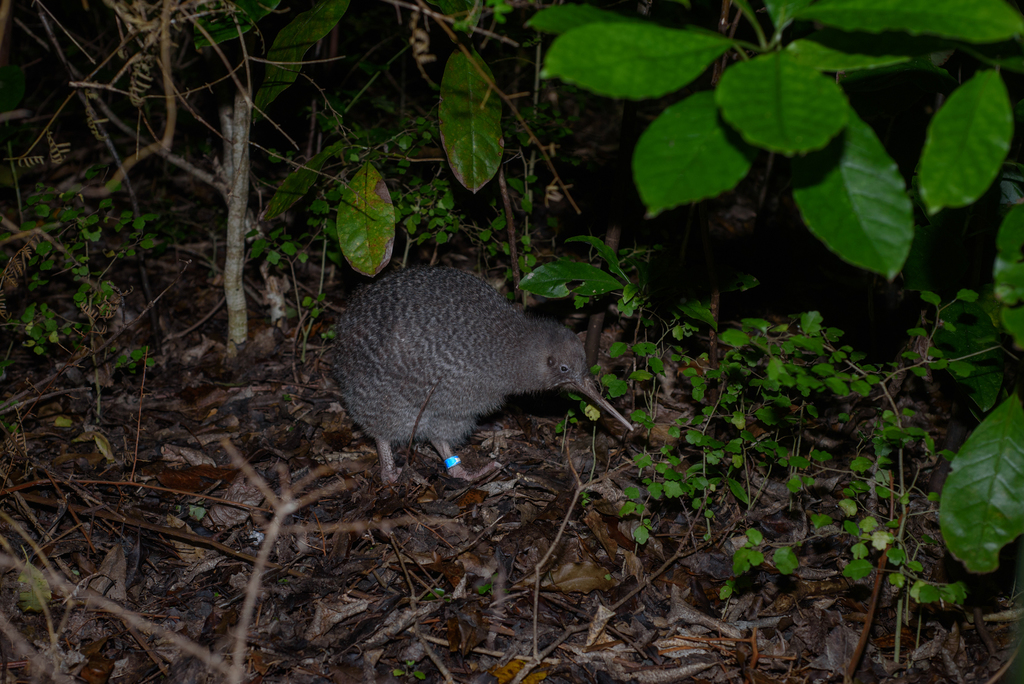
Little Spotted Kiwi
Photo © Peter de Lange
Photo © Peter de Lange — CC0 1.0 — Source: iNaturalist photo #7479771Identification
The little spotted kiwi is the smallest of the five kiwi species, weighing just 0.9 to 1.9 kg (2–4¼ lb)—about the size of a bantam chicken. It measures 35 to 45 cm (14–18 in) in length. The bird's most distinctive feature is its pale-mottled grey plumage with fine white mottling, giving it a shaggy appearance. It has an ivory-coloured, long bill and pale legs. Like all kiwis, it is flightless and lacks a tail, though it retains a small pygostyle. Large vibrissae feathers around the gape are characteristic. The little spotted kiwi is long-lived, with a mean life expectancy of 45 years.
Range & Habitat
The little spotted kiwi is endemic to New Zealand. Historically found across both main islands, the species was nearly driven to extinction but now survives mainly on small offshore islands and mainland reserves protected by pest-exclusion fences. A dramatic rediscovery in 2025 confirmed wild mainland populations, over 45 years after the last sighting in 1978. The Kapiti Island population, established from just five translocated birds a century ago, has grown to around 1,200 birds today.
On Kapiti Island, studies show the species prefers flax, seral, and older forest habitats. Lower numbers are found in rough grassland and scrub, suggesting these birds either favour woodlands or require larger territories in more open terrain.
Behaviour & Diet
Little spotted kiwis are strictly nocturnal, using their keen sense of smell, long beak, and sharp talons to locate food—compensating for their poor eyesight and flightlessness. They dig into the ground with their talons and probe with their long beak to extract grubs and other small insects. Their diet consists mainly of earthworms, cockchafer beetle larvae, caterpillars, cranefly larvae, and spiders, with annelids making up the largest portion. They occasionally consume berries, including fruit from the hinau tree.
These birds are highly territorial and vocal, calling occasionally each night to advertise territory and maintain contact with partners; pairs often duet. Territorial disputes with other kiwis are fierce, fought with sharp claws and typically leaving loose feathers scattered on the ground. They nest in excavated burrows, sometimes lined with plant material, and lay one to two eggs from July to January. The male incubates eggs for 63–76 days, after which chicks remain in the nest for 2–3 weeks and require feeding for four weeks.
Best Time & Places to See It
Since little spotted kiwis are nocturnal and have been nearly eliminated from the mainland, your best opportunity to encounter them is on Kapiti Island, where the thriving population of around 1,200 birds represents a remarkable conservation success. Visiting during the breeding season (July to January) may increase chances of hearing their distinctive territorial calls at night. Recent rediscoveries on the mainland in protected reserves also offer possibilities for dedicated birdwatchers, though sightings remain rare.
Photography Tips
Photographing little spotted kiwis presents significant challenges due to their nocturnal habits and preference for dense forest cover. Success requires night-vision equipment or infrared photography, as these birds are active only after dark. Their small size—the tiniest kiwi species—and cryptic grey-mottled plumage mean they blend seamlessly into forest vegetation. A macro or telephoto lens will be essential for capturing detail without disturbing these territorial birds. Patience and local guidance from reserves where they occur are crucial for any photography attempt.
Nothing matches these filters.
No community photos yet. Log in to add the first one.
No community observations of this species yet.