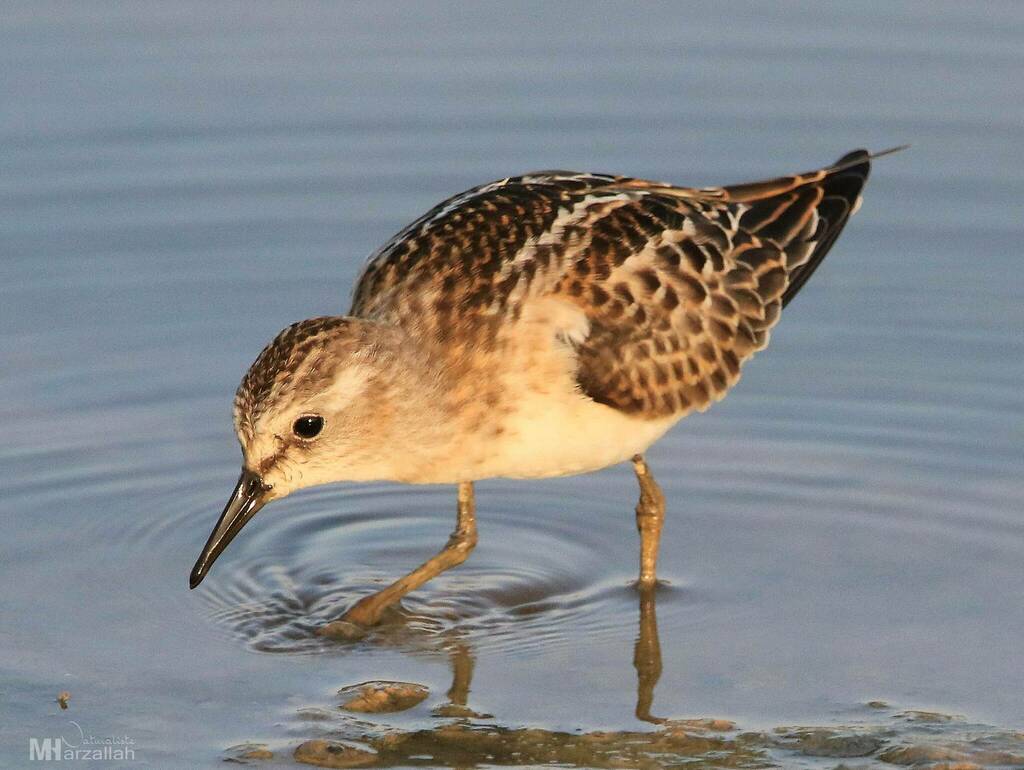
Little Stint
Photo © Mourad Harzallah
Photo © Mourad Harzallah — CC BY 4.0 — Source: iNaturalist photo #399520856Identification
The little stint is one of the smallest waders, instantly recognizable by its diminutive size and distinctive features. Its fine, dark bill, dark legs, and characteristically quick, energetic movements set it apart from most other shorebirds. Among similar species, the little stint can be reliably identified by its combination of a fine bill tip, unwebbed toes, and notably long primary projection. Its sharp "stit" call is also distinctive.
Plumage varies seasonally. Breeding adults display an attractive orange wash across the breast, contrasting with a white throat and a striking white V-shaped marking on the back. Winter plumage is considerably duller and can be challenging to identify in the field. Juveniles are more distinctive, featuring pale crown stripes and a pinkish breast that aid field identification during migration periods.
Range & Habitat
This arctic specialist breeds across arctic Europe and Asia, undertaking one of the most impressive long-distance migrations of any wader. Birds winter as far south as Africa and south Asia, though the species occasionally wanders as a vagrant to North America and Australia. The little stint is protected under the Agreement on the Conservation of African-Eurasian Migratory Waterbirds (AEWA), reflecting its importance as a transnational migrant.
During breeding season, little stints prefer low-lying areas within grassy tundra, often selecting sites near wetlands for nesting. In winter and during migration, they favor coastal mudflats and the edges of inland pools, where they often congregate in large flocks alongside other small waders, particularly dunlin and other Calidris species.
Behaviour & Diet
Little stints are highly gregarious outside the breeding season, sometimes forming impressive flocks with other small waders on suitable feeding grounds. This colonial behavior is particularly pronounced in winter. The species is polygamous, with an unusual breeding system in which males and females may incubate separate clutches, allowing pairs to raise multiple broods during the brief arctic summer.
Food consists of small invertebrates carefully picked from mud. During the arctic breeding season, growing chicks rely heavily on Diptera—particularly Chironomidae midges—which can comprise nearly half of their diet. Interestingly, the little stint's population numbers fluctuate in tandem with lemming populations, as poor lemming years force arctic predators such as skuas and snowy owls to hunt breeding waders instead.
Best Time & Places to See It
Little stints are best observed during migration periods and winter when they congregate at coastal mudflats and inland wetland margins across their wintering range in Africa and south Asia. Spring and autumn migrations offer excellent viewing opportunities as birds pass through staging areas. Within breeding range, they are restricted to arctic tundra habitats during summer months, making them less accessible to most birdwatchers.
Look for little stints on exposed mud and shallow water margins where they feed alongside larger wader flocks. Their small size and quick, restless movements make them stand out once you learn their characteristic silhouette. Early morning and late afternoon often provide the best viewing conditions.
Photography Tips
The little stint's small size presents both challenge and opportunity for wildlife photographers. Use a telephoto lens of at least 400mm to capture adequate detail, and employ a fast shutter speed to freeze their characteristically rapid, energetic movements. Photographing breeding plumage is rewarding, as the orange breast wash and white V-marking on the back are striking and diagnostic.
Coastal mudflats and shallow water edges provide ideal settings for photography, as birds often feed in accessible locations. The contrast between their dark legs and bill against lighter plumage helps define the image. Patience pays dividends when waiting for little stints to settle into feeding postures that reveal their distinctive field marks. Consider photography during migration, when larger flocks offer more opportunities for behavioral shots and flock dynamics.
Private Full-Day Birdwatching Tour from Lisbon to the Tagus Estuary
Week-long Birdwatching Programme in Northern & Central Portugal
Nothing matches these filters.
Kanha Tiger Reserve
Mabamba Swamp
Minneriya National Park
Murchison Falls National Park
Queen Elizabeth National Park
Aberdare National Park
Abijata-Shalla Lakes National Park
Addo Elephant National Park
Agulhas National Park
Nothing matches these filters.
No community photos yet. Log in to add the first one.
No community observations of this species yet.