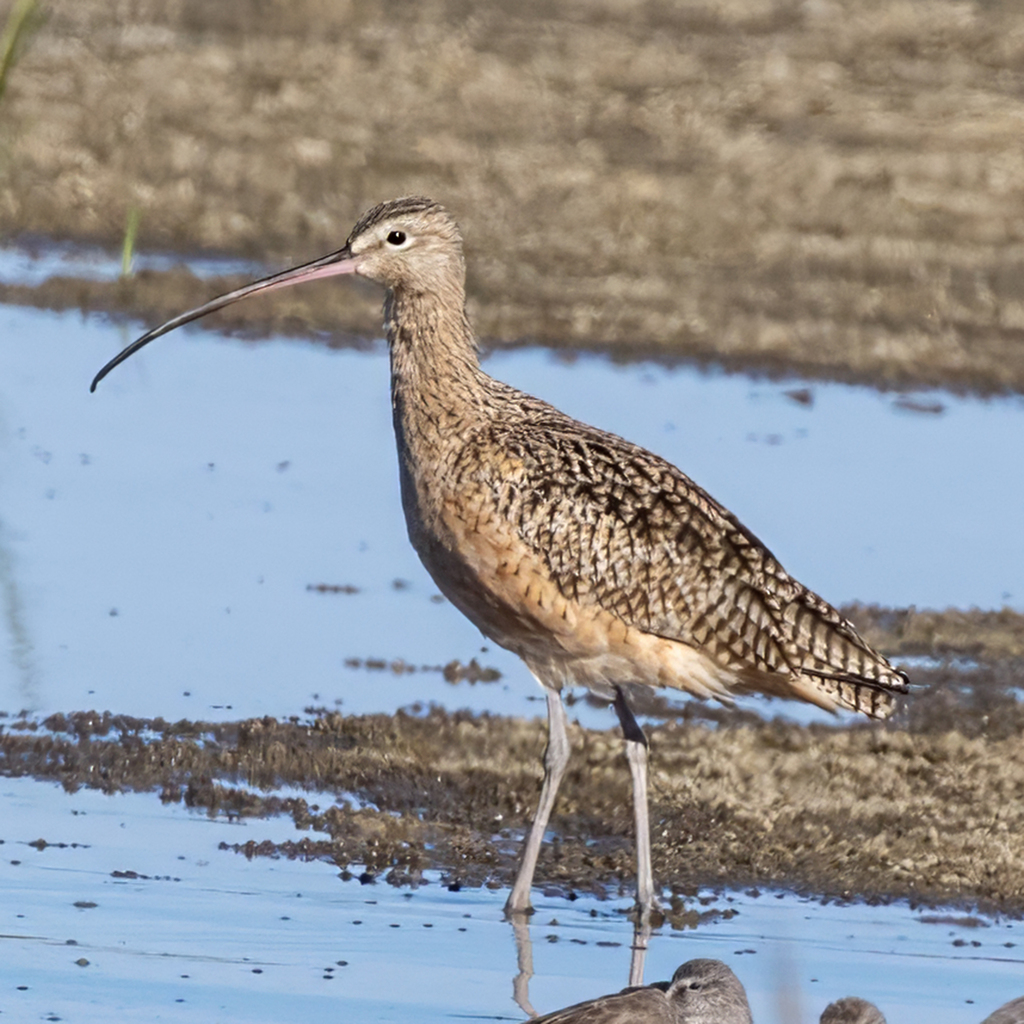
Long-billed Curlew
Photo © Dan Vickers
Photo © Dan Vickers — CC BY 4.0 — Source: iNaturalist #246710042Identification
The long-billed curlew is North America's largest sandpiper, unmistakable in the field. Adults measure 50–65 cm in length with a wingspan of 62–90 cm. Their most striking feature is the dramatically long, downward-curving bill, measuring 11.3–21.9 cm—rivalling even the larger Far Eastern curlew for the longest bill of any shorebird. The plumage is characterized by a light cinnamon neck and underparts, with the crown streaked in brown. They have a notably long neck relative to their small head. Females are larger than males and possess proportionally longer bills, a pattern of reversed sexual dimorphism common in sandpipers.
Range & Habitat
This species breeds in grasslands across west-central and central North America, then migrates southward and coastward for winter. Historically, long-billed curlews were common along the East Coast during winter, though populations there have been reduced to a small remnant of fewer than a hundred birds. The species was once abundant enough to lend its name to Candlestick Point in San Francisco, but local populations in California and elsewhere declined dramatically during the 20th century.
Behaviour & Diet
Long-billed curlews are gregarious, often feeding in flocks where they probe mud and other substrates with their specialized bills in search of food. Their diet consists primarily of crabs and small invertebrates, supplemented by grasshoppers, beetles, and other insects; they occasionally take the eggs of other birds. During breeding season, males perform elaborate courtship displays featuring fast, looping flight patterns. Females lay four eggs in a simple hollow lined with weeds and grasses. The chicks are precocial, leaving the nest soon after hatching. Notably, females typically abandon the brood to the male 1–3 weeks after hatching and depart for winter grounds, while males that experience breeding failure often leave immediately for their wintering areas.
Best Time & Places to See It
Breed-season sightings are best in the grassland breeding regions of west-central and central North America during spring and early summer. Winter birds concentrate in southern coastal areas. The small relict population on the East Coast offers a rare encounter for dedicated birders, though numbers there remain critically low. Western wintering grounds and migration stopover sites offer the most reliable viewing opportunities for this recovering species.
Photography Tips
The long-billed curlew's striking silhouette and prominent curved bill make it highly photogenic. Capture the bird's characteristic feeding posture—bent low with the bill probing into substrate—to showcase its specialized anatomy. Flock photos highlight their gregarious nature during migration and winter. The warm cinnamon tones of their plumage photograph beautifully in soft morning or evening light. Males during courtship display offer dramatic action sequences, while close-ups can reveal the crown's fine brown streaking and the bird's proportionally small head.
Badlands National Park
Bear River Migratory Bird Refuge
Big Bend National Park
Bitter Lake National Wildlife Refuge
Bosque del Apache National Wildlife Refuge
Bryce Canyon National Park
Carlsbad Caverns National Park
Cave Creek Canyon
Cedar Keys National Wildlife Refuge
Nothing matches these filters.
No community photos yet. Log in to add the first one.
No community observations of this species yet.