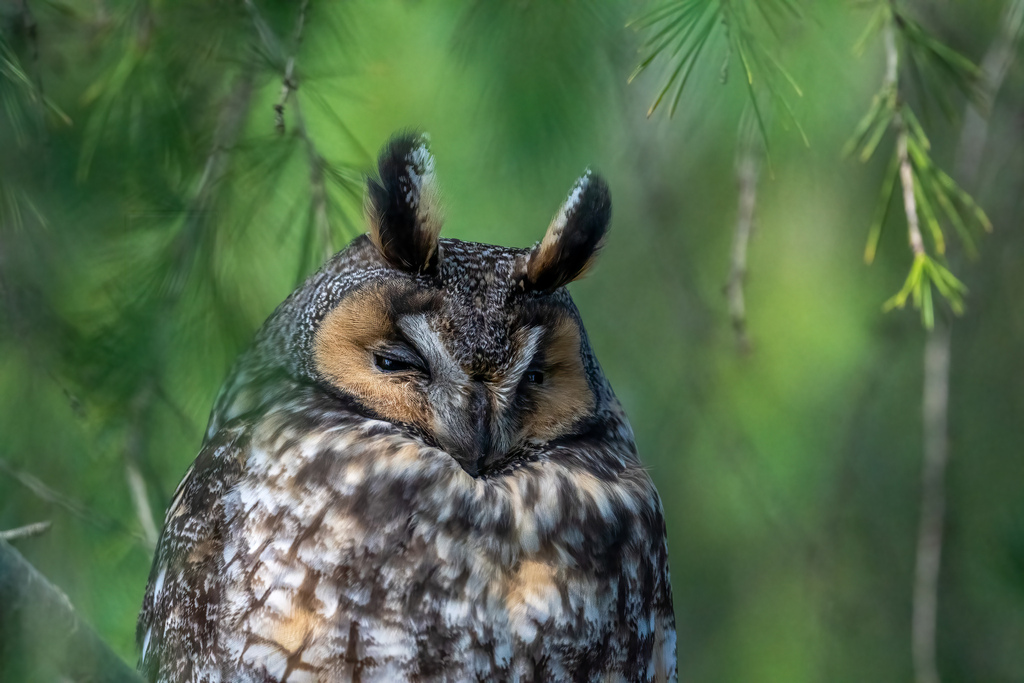
Long-eared Owl
Photo © Jonathan Eisen
Photo © Jonathan Eisen — CC BY 4.0 — Source: iNaturalist photo #254998752Identification
The long-eared owl is a medium-sized owl with distinctive erectile ear-tufts that give it its common name. The nominate subspecies found across the Palearctic displays a pale ochraceous-tawny facial disc rimmed with black, prominent blackish-brown ear-tufts with tawny edges, and finely mottled upperparts peppered with dusky spots and streaks. Wing chord measurements range from 263 to 313 mm, with subtle size variation across its range—eastern populations from China are approximately 4% larger-winged than their western European counterparts.
Range & Habitat
This species has an extensive breeding range spanning Europe, the Palearctic, and North America, making it one of the most widely distributed owl species globally. The nominate subspecies extends from the Azores and northwestern Africa through the British Isles eastward to Sakhalin, Japan, and northern China, with some populations wintering as far south as Egypt, Pakistan, northern India, and southern China. Long-eared owls prefer semi-open habitats, particularly woodland edges where they can roost and nest within dense stands of trees while hunting over open ground.
Behaviour & Diet
Unlike many owl species, long-eared owls are not strongly territorial or sedentary; they are partially migratory and sometimes described as nomadic. A distinctive behaviour is their partiality for communal roosts, where multiple individuals gather together. These specialized predators focus primarily on small rodents, especially voles, but can adapt to diverse prey including birds and insects when circumstances demand—such as during rodent population cycles or in arid or insular habitats. Long-eared owls characteristically utilize nests built by other animals, particularly corvids, rather than excavating their own.
Best Time & Places to See It
As a partially migratory species with nomadic tendencies, the best viewing opportunities depend on regional populations and seasonal movements. Breeding birds are present in woodland-edge habitats during breeding season, while winter visitors may appear in southern regions. Communal roost sites offer exceptional opportunities for observing multiple individuals, though specific locations vary regionally. The species' broad distribution and high population numbers increase chances of encounters across much of its range, though recent declines have been detected in several regions.
Photography Tips
The long-eared owl's prominent ear-tufts and distinctive facial disc make for compelling subjects. Early morning or late afternoon light during the breeding season will illuminate the intricate plumage patterns—the pale facial disc with black rim, dusky streaking on the crown and nape, and the characteristic whitish feather edges on the scapulars. Communal roost sites provide opportunities to photograph multiple individuals, though approach should be cautious to avoid disturbance. The species' medium size and preference for woodland edge habitats mean that perched birds in shadowed foliage can present focusing challenges; patience and careful positioning will yield the best results.
Abruzzo, Lazio and Molise National Park
Algonquin Provincial Park
Alpilles Regional Nature Park
Alta Murgia National Park
Appennino Lucano Val d’Agri Lagonegrese National Park
Arches National Park
Avesnois Regional Nature Park
Banff National Park
Bannau Brycheiniog National Park
Nothing matches these filters.
No community photos yet. Log in to add the first one.
No community observations of this species yet.