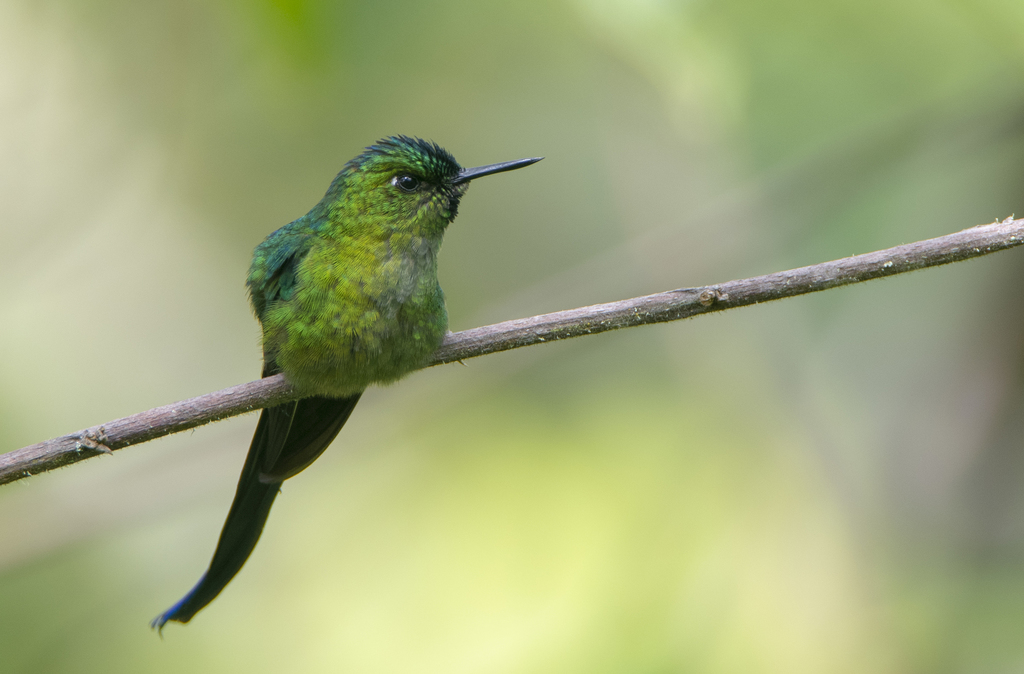
Long-tailed Sylph
Photo © David F. Belmonte
Photo © David F. Belmonte — CC BY 4.0 — Source: iNaturalist photo #116728564Identification
The long-tailed sylph is a striking small hummingbird with pronounced sexual dimorphism. Males measure 16 to 19 cm in length, with their distinctive appearance dominated by elongated outer tail feathers that comprise 12 cm of their total length. They display a shining emerald green crown, metallic bronzy green upperparts, and a characteristic colored throat that varies by subspecies—typically blue or violet in the nominate form. The tail's upper surface shimmers with iridescent blue, green, and violet hues, while the underside appears bluish black. Females are considerably smaller at 9.7 to 11.7 cm long, with metallic green upperparts, a short somewhat forked tail with dark blue outer feathers broadly tipped white, and cinnamon underparts. Both sexes possess the species' short black bill. Subspecific variation is notable: some populations show paler or duller green plumage, while throat colors range from bright green to sapphire blue depending on the subspecies.
The six recognized subspecies occupy different regions across the species' range, each with subtle plumage variations that reflect their specific mountain populations. These distinctions were historically debated, with some subspecies once considered separate species, but modern taxonomy has established the current three-species treatment for the genus Aglaiocercus.
Range & Habitat
The long-tailed sylph is found across a broad geographic range spanning Venezuela, Colombia, Ecuador, Peru, and Bolivia, with each of the six subspecies occupying specific Andean regions. A. k. margarethae inhabits north central and coastal Venezuela, while A. k. caudatus occurs in western Venezuela's Serranía del Perijá and northward into the Colombian Andes. Further south, A. k. emmae occupies the northern and western Andes of Colombia and northwestern Ecuador, A. k. kingii the eastern Andes of Colombia, A. k. mocoa the southern central Andes from Colombia through Ecuador to northern Peru, and A. k. smaragdinus the eastern Peruvian Andes extending into west-central Bolivia.
This hummingbird favors open mountain landscapes including scrublands, forest clearings and edges, gardens, secondary forest, and high-elevation grasslands—particularly elfin forest habitats. It occupies elevations between 900 and 3,000 meters, making it a characteristic bird of montane regions throughout its extensive range.
Behaviour & Diet
The long-tailed sylph exhibits complex movement patterns adapted to its mountain environment. Andean populations make seasonal elevational migrations, shifting between lower and higher elevations with changing conditions. A. k. caudatus is believed to migrate between Venezuela and Colombia, while A. k. emmae shows interesting seasonal replacement patterns on the Pacific slope of southwestern Colombia, present only during the wet season and replaced by the violet-tailed sylph between January and April.
This species feeds exclusively on nectar and insects, employing diverse foraging strategies. It practices trap-lining, flying around a regular circuit of flowering plants, but also defends specific feeding territories. While it typically hovers at flowers to feed, it occasionally clings to blooms and robbs nectar by piercing the flower's base. Insects are captured by hawking from perches. Feeding height varies with elevation: at lower elevations the bird hunts primarily in treetops, while in elfin forest and high grasslands it feeds closer to the ground. Males construct bulky dome-shaped nests from moss and plant fibers with a side entrance, attached to branches hidden by vegetation. Females incubate two white eggs for 15 to 17 days, with fledging occurring 21 to 24 days after hatching. Breeding occurs from February through October, though the species may breed year-round.
Best Time & Places to See It
The long-tailed sylph is common to abundant throughout much of its range and occurs in several protected areas, making it a reliable species for birders visiting the Andes. The extended breeding season from February through October provides multiple opportunities for observation. Seasonal elevational movements mean that populations shift with the months—visiting at different times may yield encounters with different subspecies or populations.
Target open montane habitats including scrubland, forest edges, secondary growth, and high-elevation grasslands between 900 and 3,000 meters. In regions where A. k. emmae occurs on the Pacific slope of southwestern Colombia, timing visits for the wet season improves your chances. Early morning hours are typically best for hummingbird activity, when flowering plants attract feeding birds.
Photography Tips
The long-tailed sylph's iridescent plumage and sexually dimorphic forms offer excellent photographic subjects. The males' shimmering crown and throat colors are particularly striking but require proper angle and lighting to render their true hues—position yourself with backlighting or sidelighting to capture the iridescence. The elongated tail feathers are diagnostic and should be included in identification shots, though they extend well beyond the body and require careful framing.
Work in open mountain habitats where flowers attract feeding birds, and position yourself near flowering plants that sylphs visit. Early morning light is ideal for capturing the iridescent throat and crown colors. The small size of females and their greenish coloration demands careful focus and adequate shutter speed to freeze wing motion. Be patient at productive flowering patches; the species' trap-lining behavior means individuals return to the same flowers repeatedly, offering multiple photo opportunities.
Yasuní National Park
Aguarico, Ecuador
+601 birds+43 mammals
Where the western Amazon basin converges with Ecuador's Orellana Province, lowland rainforest reaches toward the horizon in an unbroken canopy of staggering botanical density. Yasuní National…
VIEW NATIONAL PARKSangay National Park
Cebadas, Ecuador
+320 birds+10 mammals
High in Ecuador's Andean spine, where the Western Cordillera rises to touch perpetual snow, a landscape of volcanic drama and ecological intensity unfolds across Sangay National…
VIEW NATIONAL PARKPodocarpus National Park
Zamora, Ecuador
+496 birds+6 mammals
Where the Andes descend toward the Amazon basin, Podocarpus National Park sprawls across nearly 2,800 square kilometres of the most biodiverse terrain in Ecuador's southern highlands.…
VIEW NATIONAL PARKYacuri National Park
Las Juntas, Ecuador
+166 birds+1 mammals
Where the eastern slopes of the Andes descend into Ecuador's southern frontier, Yacuri National Park unfolds across nearly 1,300 square kilometers of montane cloud forest and…
VIEW NATIONAL PARKSumaco Napo-Galeras National Park
Loreto, Ecuador
+563 birds+4 mammals
Where Ecuador's Amazon transitions into cloud forest, a massive shield volcano rises from the emerald lowlands of Orellana Province, anchoring one of the continent's most biodiverse…
VIEW NATIONAL PARKAntisana National Park
Quijos, Ecuador
+432 birds+21 mammals
Where the eastern Andean slopes descend into the Amazon basin, Antisana National Park sprawls across roughly 2,500 square kilometers of some of South America's most dramatic…
VIEW NATIONAL PARKCotopaxi National Park
Mulaló, Ecuador
+211 birds+6 mammals
High in Ecuador's volcanic corridor, where the páramo transitions into cloud forest along the slopes of Cotopaxi volcano, the national park unfolds across nearly 500 square…
VIEW NATIONAL PARKLlanganates National Park
Tena, Ecuador
+239 birds+8 mammals
Where the eastern slopes of the Andes plunge toward the Amazon basin, Llanganates National Park sprawls across nearly 3,500 square kilometers of montane wilderness, its terrain…
VIEW NATIONAL PARKNatural Munchique National Park
El Tambo, Colombia
+194 birds
Where the Western Cordillera rises steeply from the Pacific plains of southwestern Colombia, Natural Munchique National Park sprawls across 1,078 square kilometers of montane forest that…
VIEW NATIONAL PARKNatural Serranía de los Churumbelos National Park
Santa Rosa, Colombia
+70 birds+2 mammals
Where the western cordillera of Colombia rises toward the Pacific watershed, the Serranía de los Churumbelos unfolds across more than 3,200 square kilometers of some of…
VIEW NATIONAL PARKNatural Serranía de los Yariguíes National Park
El Carmen de Chucurí, Colombia
+320 birds+3 mammals
Where the northern cordilleras of Colombia rise toward cloud forest, the Serranía de los Yariguíes unfolds across nearly 1,820 square kilometers of some of the most…
VIEW NATIONAL PARKNatural Farallones de Cali National Park
Buenaventura, Colombia
+733 birds+27 mammals
Where the Pacific coastal plain meets the western slopes of the Andes, Farallones de Cali National Park sprawls across nearly 3,500 square kilometers of dramatic topography…
VIEW NATIONAL PARKNatural Chingaza National Park
Junín, Colombia
+285 birds+6 mammals
Where the Andes rise above three thousand metres in the Cundinamarca region, high-altitude grasslands and cloud forests converge in a landscape shaped by both geology and…
VIEW NATIONAL PARKPuracé National Natural Park
Puracé, Colombia
+327 birds+2 mammals
Where the Andes thrust upward across southwestern Colombia, Puracé National Natural Park spans nearly 2,631 square kilometers of some of South America's most dramatic montane terrain.…
VIEW NATIONAL PARKGuácharos Cave National Natural Park
Acevedo, Colombia
+359 birds
High in the Andean foothills of southern Huila, where mist-laden slopes rise above 1,600 metres, lies a landscape carved by underground rivers and crowned by karst…
VIEW NATIONAL PARKNatural Sumapaz National Park
Cubarral, Colombia
+368 birds+1 mammals
Where the Andes descend toward the Amazon basin, the high páramo grasslands of Sumapaz National Park sprawl across more than five thousand square kilometers of Meta…
VIEW NATIONAL PARKEl Tamá National Park
Toledo, Colombia
+435 birds
Where the Andes descend toward the Caribbean coastal lowlands of northern Colombia, El Tamá National Park sprawls across nearly 3,800 square kilometres of montane forest, cloud…
VIEW NATIONAL PARKYanachaga–chemillén National Park
Palcazu, Peru
+639 birds+6 mammals
Where the eastern slopes of Peru's central cordillera plunge into cloud forest, Yanachaga–Chemillén National Park protects nearly three thousand square kilometres of montane wilderness that few…
VIEW NATIONAL PARKManu National Park
Manu, Peru
+892 birds+26 mammals
Across the eastern slopes of the Peruvian Andes, tropical rainforest descends into the Amazon basin with a complexity that few terrestrial ecosystems match. Manu National Park…
VIEW NATIONAL PARKNo community photos yet. Log in to add the first one.
No community observations of this species yet.