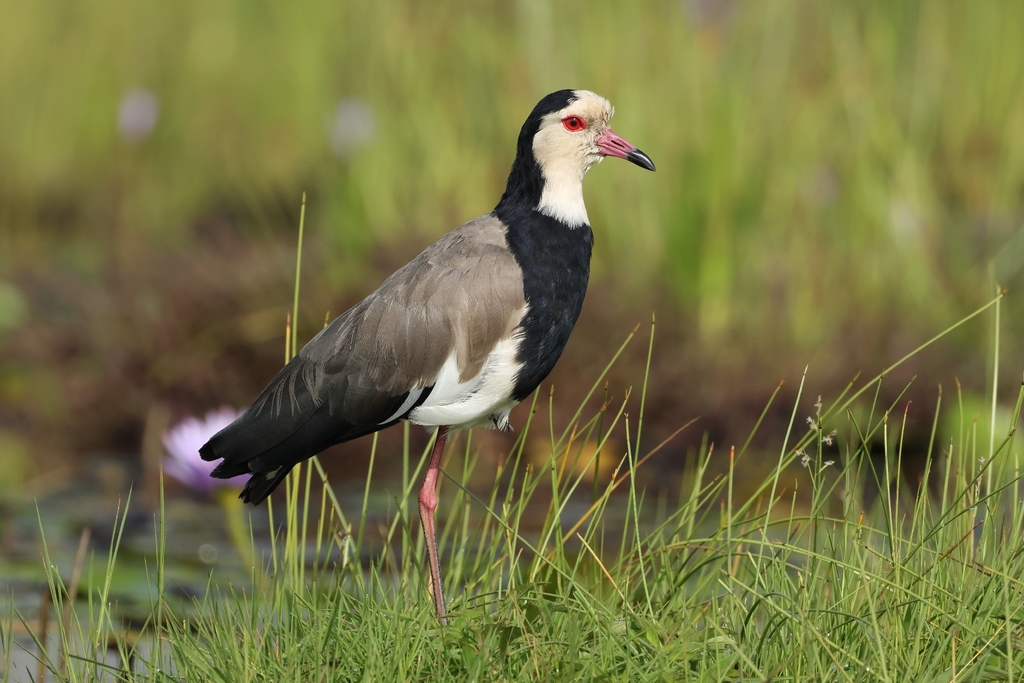
Long-toed Lapwing
Photo © Barry Stewart
Photo © Barry Stewart — CC BY 4.0 — Source: iNaturalist photo #659561035Identification
The long-toed lapwing is a compact wading bird measuring 31 cm in length with a distinctive appearance combining brown, black, and white plumage. Its most striking features are its long red legs, elongated toes, and red bill tipped with black—characteristics that reflect its specialized aquatic lifestyle. The species shows extensive white in the wing feathers during flight, along with legs and feet that extend noticeably beyond the tail. Short wing spurs and rounded wings complete its profile. Sexually monomorphic with no seasonal plumage variation, both males and females appear identical year-round. Juveniles can be distinguished by their browner breast and buff-tipped feathers, and notably retain their juvenile primary feathers after molting.
Two subspecies are recognized across the species' range. The nominate subspecies (V. c. crassirostris) displays black flight feathers throughout, while V. c. leucopterus shows white coloring on inner primary and secondary feathers with only the outer primaries remaining black. The southern subspecies also has a slightly longer tarsus despite a shorter overall wing length. White-crowned lapwing is the only similar species sharing extensive white wing plumage, but can be distinguished by its different pattern of black and white flight feathers.
Range & Habitat
This mainly sedentary species is distributed across central and eastern Africa from Chad and South Sudan in the north through to Mozambique, Botswana, and northeast South Africa in the south, with additional populations in western Angola. The nominate subspecies occupies the northern range from South Sudan to Uganda, while V. c. leucopterus is found from Tanzania southward, with an intergrade zone where ranges overlap in Tanzania, southeast Democratic Republic of Congo, and northern Malawi. The species has been recorded at elevations up to 1,300 meters in Zambia.
Long-toed lapwings favor wetland habitats including lakes, pools, marshes, floodplains, and swamps where they remain sedentary as long as water persists. They forage on floating vegetation and utilize pool edges during dry seasons and flooded rice fields and wet grasslands in the wet season. Their habitat preferences closely mirror those of African jacanas, leading to frequent territorial conflicts between these species.
Behaviour & Diet
Among lapwings, the long-toed species is unusual in its foraging behavior, employing jacana-like techniques to hunt aquatic invertebrates on floating vegetation. Its elongated toes distribute weight effectively across unstable surfaces. The bird feeds on aquatic insects, larvae, beetles, ants, dragonfly nymphs, and snails, with documented observations of individuals using one foot to stir water and dislodge prey. While typically foraging alone, long-toed lapwings gather in family groups or larger flocks of 10 to 20 birds during the dry season, with one exceptional record of approximately 80 individuals from Malawi. They opportunistically follow spur-winged geese, benefiting from the disturbance of invertebrates as geese uproot vegetation.
Long-toed lapwings are fiercely territorial and monogamous breeders with mean territory sizes of approximately 2,900 square meters in Kenya. Both parents share incubation, territory defense, and chick-rearing duties. Chicks receive intense protection from avian predators such as African fish-eagles, harriers, and coucals, with parents employing persistent alarm calls, swooping attacks, and escape flights over water. The species also aggressively attacks non-predatory birds sharing their habitat, including African jacanas, blacksmith lapwings, and squacco herons, though these encounters typically involve swooping without direct contact.
Best Time & Places to See It
The long-toed lapwing's sedentary nature means it can be encountered year-round throughout its African range wherever suitable wetland habitats exist with adequate water levels. However, birds are most reliably found during the wet season when flooded rice fields and grasslands expand their available habitat. The dry season presents an alternative opportunity, when lapwings concentrate at remaining pool edges and may gather in more observable groups.
Wetland sites across central and eastern Africa offer the best chances for encounters, particularly in South Sudan, Uganda, Tanzania, Malawi, Zambia, and Mozambique. The species' preference for marshes, floodplains, and lake margins with floating vegetation means birders should focus on areas where such habitats are well-developed and water levels are adequate.
Photography Tips
The long-toed lapwing's specialized habitat on floating vegetation can present challenging photography conditions due to water reflections and backlighting. Position yourself to avoid shooting into the sun when photographing birds on open water. The species' red legs and bill provide striking color contrasts against its brown and white plumage, so aim for lighting that emphasizes these features. Early morning and late afternoon light often enhance the visibility of plumage details.
Capture the distinctive long toes by photographing birds on floating vegetation or at pool edges where they spread their weight across unstable surfaces. In-flight photographs showcase the extensive white wing plumage and extended legs beyond the tail—hallmark identification features. During the dry season when birds gather in groups, you may document their social and territorial behaviors, including the aggressive swooping attacks directed at jacanas and other species. Patient observation from a distance minimizes disturbance to these fiercely territorial birds.
Serengeti National Park
Tanzania
+558 birds+57 mammals
Across Tanzania's northern plateau, where volcanic soils meet acacia woodland and open grassland, unfolds one of Earth's most dynamic ecosystems. The Serengeti National Park sprawls across…
VIEW NATIONAL PARKArusha National Park
Tanzania
+555 birds+16 mammals
Where the slopes of Mount Mawenzi rise above the Arusha region, a compact yet ecologically rich national park unfolds across montane forest, moorland, and alpine zones.…
VIEW NATIONAL PARKChobe National Park
Botswana
+446 birds+45 mammals
Where the Chobe River cuts a sinuous path through northern Botswana, the landscape transforms into one of Africa's most dynamic wetland-savanna mosaics. This national park encompasses…
VIEW NATIONAL PARKVirunga National Park
Uganda
+418 birds+13 mammals
Where the Western Rift Valley fractures the landscape of North Kivu, Virunga National Park sprawls across terrain as geologically dramatic as it is ecologically vital. Volcanic…
VIEW NATIONAL PARKBwindi Impenetrable National Park
Kanyashogi, Uganda
+603 birds+26 mammals
Steep ridges cloaked in montane forest rise from Uganda's southwestern borderlands, where the landscape grows so dense and tangled that early explorers named it impenetrable. At…
VIEW NATIONAL PARKKidepo Valley National Park
Uganda
+478 birds+24 mammals
Where the Narus and Kidepo rivers carve through northeastern Uganda's semi-arid lowlands, a landscape of sparse acacia woodland, grassland, and riverine thickets creates one of East…
VIEW NATIONAL PARKMgahinga Gorilla National Park
Cyanika, Uganda
+429 birds+6 mammals
Where the Virunga Mountains rise steeply from the Uganda–Rwanda–Democratic Republic of Congo frontier, montane forest cloaks the volcanic slopes in a dense, moisture-laden embrace. Mgahinga Gorilla…
VIEW NATIONAL PARKTsavo West National Park
Mwatate, Kenya
+513 birds+49 mammals
Where volcanic ridges and weathered lava flows meet the semi-arid lowlands of south-central Kenya, Tsavo West National Park unfolds across a landscape sculpted by fire and…
VIEW NATIONAL PARKAmboseli National Park
Etonet/Lenkism ward, Kenya
+501 birds+43 mammals
Where the Amboseli basin opens toward the Tanzanian frontier, a shallow alkaline lake mirrors vast skies across one of East Africa's most iconic savanna landscapes. The…
VIEW NATIONAL PARKTarangire National Park
Tanzania
+527 birds+50 mammals
Acacia woodland and grassland sweep across the Manyara Region where the Tarangire River carves through low hills and volcanic soils, creating one of East Africa's most…
VIEW NATIONAL PARKNgorongoro Conservation Area
Tanzania
+626 birds+55 mammals
Volcanic calderas and open grassland dominate this high plateau in northern Tanzania, where the landscape rises above 2,000 metres and ancient geological forces have shaped both…
VIEW WILDLIFE MANAGEMENT AREAToro-Semliki Proposed National Park
Uganda
+474 birds+5 mammals
Where the Albertine Rift's western escarpment rises above the Semliki River valley, a vast mosaic of forest, savanna and wetland converges to create one of East…
VIEW NATIONAL PARKQueen Elizabeth National Park
Uganda
+672 birds+30 mammals
Across the southwestern escarpment of Uganda, where the Western Rift Valley descends through ancient volcanic terrain, Queen Elizabeth National Park sprawls across more than 8,300 square…
VIEW NATIONAL PARKMabamba Swamp
Memere, Uganda
+464 birds+2 mammals
Across the Central Region of Uganda spreads one of Africa's most biodiverse freshwater wetlands, a sprawling nature reserve of roughly 283 square kilometres where papyrus swamps…
VIEW NATURE RESERVEZiwa Rhino and Wildlife Ranch
Nakasongola, Uganda
+359 birds+11 mammals
Where papyrus wetlands merge into sprawling savanna, Uganda's central landscape opens into one of East Africa's most vital rhino recovery zones. Ziwa Rhino and Wildlife Ranch…
VIEW WILDLIFE SANCTUARYNkasa Rupara National Park
Namibia
+283 birds+17 mammals
Where the Zambezi's floodplains spill across the border between Namibia and Botswana, Nkasa Rupara National Park unfolds across 518 square kilometers of wetland and woodland mosaic.…
VIEW NATIONAL PARKBwabwata National Park
Namibia
+377 birds+35 mammals
Where the Kavango River winds through northeastern Namibia, vast floodplains and dense riparian woodland create one of southern Africa's most ecologically dynamic protected landscapes. Spanning 14,249…
VIEW NATIONAL PARKMakgadikgadi Pans National Park
Gucta, Botswana
+272 birds+27 mammals
Where salt-crusted flatlands stretch endlessly toward a shimmering horizon, one of Africa's most extraordinary ecosystems awakens with the rains. The Makgadikgadi Pans comprise vast mineral-rich basins…
VIEW NATIONAL PARKNairobi National Park
Nairobi, Kenya
+515 birds+35 mammals
Just minutes from Kenya's capital, where the Nairobi River winds through acacia woodland and open grassland, lies one of Africa's most paradoxical wildlife sanctuaries. The park's…
VIEW NATIONAL PARKLake Nakuru National Park
Nakuru West, Kenya
+494 birds+32 mammals
Alkaline waters ringed by acacia woodland and grassland create one of East Africa's most distinctive wetland ecosystems, where the interplay of geology and climate sustains a…
VIEW NATIONAL PARKHell’s Gate National Park
Olkaria ward, Kenya
+388 birds+18 mammals
Volcanic scarps and geothermal vents dominate the floor of Hell's Gate, where the East African Rift has carved a dramatic gorge through crystalline rock formations. The…
VIEW NATIONAL PARKNo community photos yet. Log in to add the first one.
No community observations of this species yet.