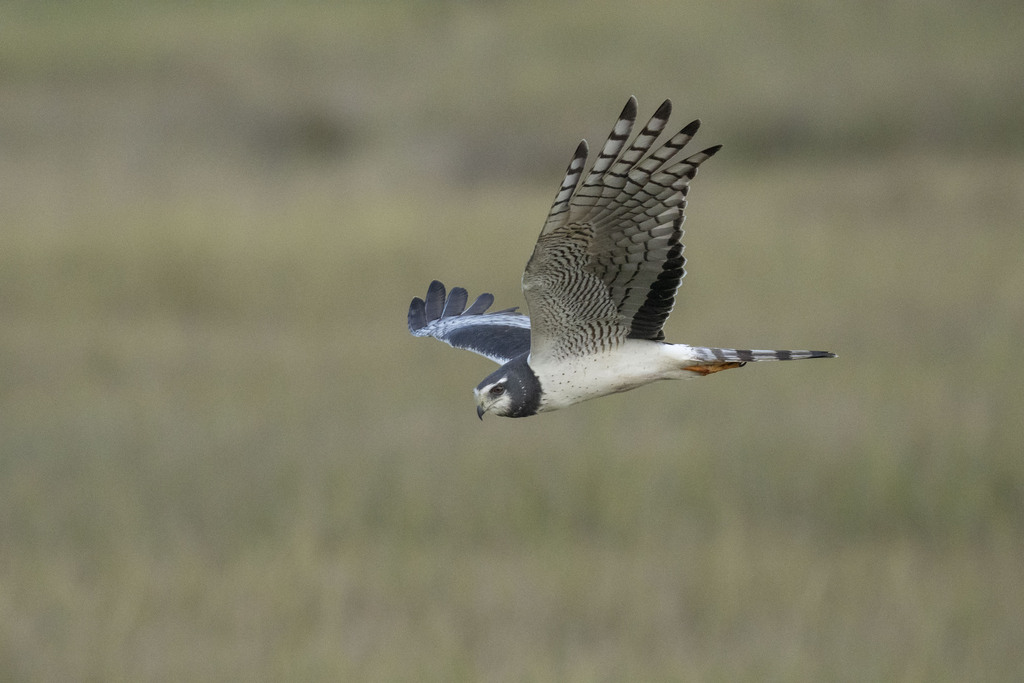
Long-winged Harrier
Photo © Luciano Massa
Photo © Luciano Massa — CC BY 4.0 — Source: iNaturalist photo #337727491Identification
The long-winged harrier is a mid-sized bird of prey with distinctive proportions: notably long, narrow wings and an elongated tail that immediately set it apart from other raptors. Males weigh 390 to 464 grams, while females are larger at 400 to 645 grams, with body lengths ranging from 46 to 60 centimeters and wingspans between 120 and 155 centimeters. The species exhibits two colour morphs. Light morph birds display striking white underparts that contrast sharply with grey-brown upper parts and darker primary feathers. Dark morph individuals are predominantly black on the belly, with females showing brown undertones. Juveniles resemble females but have more speckled chests. All long-winged harriers possess the distinctive facial disc characteristic of harriers—a recognizable arrangement of feathers around the face that aids hearing during hunts. Bright orange legs, sharp talons, and a large hooked beak complete the profile of this formidable hunter.
Range & Habitat
Endemic to South America, the long-winged harrier's year-round range spans most of eastern regions including eastern Argentina, Uruguay, Brazil, and Paraguay, extending northward through Colombia and Venezuela to the northern reaches of Guyana, Suriname, and French Guiana. The species occasionally appears in Bolivia, Peru, Chile, Trinidad and Tobago, and as far south as Tierra del Fuego, with vagrant records from Panama and the Falkland Islands.
This harrier favours large grasslands, agricultural fields, savannas, marshes, and wetlands across the continent. These open habitats are ideal for its active, wide-ranging hunting technique. While the long-winged harrier's range overlaps minimally with its close relative the cinereous harrier, both species share South American grassland and wetland ecosystems.
Behaviour & Diet
The long-winged harrier is a carnivore with a remarkably diverse diet reflecting its wide continental distribution. It hunts small mammals such as cavies, amphibians including frogs, reptiles like lizards, and birds—particularly crakes and young coots—which form the majority of its food intake. The species also takes bird eggs, from raiding nests of water-tyrants to plundering heronries.
Its hunting strategy is distinctive among local raptors. Rather than perching passively like the roadside hawk to scan for prey, the long-winged harrier employs active, energy-intensive tactics: flying slowly in large circles above its range while using keen vision and hearing to locate victims. The facial disc aids this acoustic hunting by triangulating sounds to pinpoint prey movement below.
Best Time & Places to See It
The long-winged harrier is a common bird throughout its South American range, making it a reliable sighting for travellers visiting grasslands and wetlands from Brazil and Paraguay to Colombia and Venezuela. The species is present year-round across most of its range. Nesting occurs between September and October in grassland habitats, potentially offering opportunities to observe breeding behaviour during these months. Look for the harrier's characteristic circling flight over open habitats—its wide-ranging hunting behaviour makes it relatively conspicuous compared to perch-hunting raptors.
Photography Tips
Photograph long-winged harriers in open grassland and wetland habitats where their hunting flights are unobstructed and well-lit. The species' circling behaviour provides extended opportunities to capture flight images, particularly during morning hours when light is optimal. Frame shots to showcase the distinctive long wings and tail proportions that define the species. Capture both morphs if possible—the striking contrast of light morph birds against grassland backgrounds and the darker plumage of dark morph individuals present different compositional opportunities. The bright orange legs and facial disc features are worth highlighting in close-up images when the harrier perches between hunts.
Emas National Park
Brazil
+333 birds+23 mammals
Across the high plateaux of central Brazil, where the cerrado grasslands roll toward distant horizons under an immense sky, Emas National Park anchors one of South…
VIEW NATIONAL PARKNatural Sierra de la Macarena National Park
Vista Hermosa, Colombia
+566 birds+15 mammals
Across nearly 20,000 square kilometres of Colombia's Meta Department, the terrain rises from lowland savanna into Andean foothills through a mosaic of gallery forests, palm-fringed wetlands,…
VIEW NATIONAL PARKItatiaia National Park
Brazil
+519 birds+12 mammals
Where granite peaks pierce the Atlantic rainforest canopy in southeastern Brazil, Itatiaia National Park rises as one of the country's oldest and most ecologically vital protected…
VIEW NATIONAL PARKPeixe National Park Lagoon
Brazil
+293 birds+4 mammals
Where the coastal plains of Rio Grande do Sul meet the Atlantic, Peixe National Park Lagoon sprawls across nearly 2,200 square kilometres of shallow waters, reed…
VIEW NATIONAL PARKIguaçu National Park
Brazil
+387 birds+17 mammals
Where the Paraná Plateau plunges toward the Atlantic watershed, six thousand square kilometers of subtropical rainforest cling to steep gorges and river valleys in this corner…
VIEW NATIONAL PARKIlha Grande National Park
Brazil
+233 birds
Across the subtropical plateaus and Atlantic forest remnants of southern Brazil, a vast protected landscape spanning nearly 4,600 square kilometers safeguards one of the continent's most…
VIEW NATIONAL PARKChapada dos Guimarães National Park
Brazil
+450 birds+1 mammals
Where weathered sandstone plateaus rise above the cerrado grasslands of central Brazil, Chapada dos Guimarães National Park protects 624 square kilometres of ecological transition zone that…
VIEW NATIONAL PARKBrasília National Park
Plano Piloto, Brazil
+338 birds+15 mammals
Cerrado grassland and scattered woodland sweep across the central Brazilian plateau where this national park sprawls across more than a thousand square kilometres of the Federal…
VIEW NATIONAL PARKCampos Gerais National Park
Brazil
+143 birds
Where rolling plateaus rise above the Atlantic forest escarpment in Paraná's interior, Campos Gerais National Park unfolds across 539 square kilometers of highland grassland and forest…
VIEW NATIONAL PARKEl Palmar National Park
Distrito Sexto, Argentina
+244 birds+14 mammals
Across the Paraná River floodplain in northeastern Argentina, palms rise from wetland and grassland in a landscape shaped by water and time. El Palmar National Park…
VIEW NATIONAL PARKCampos del Tuyú National Park
Argentina
+169 birds+5 mammals
Subtropical forest graces the borderlands where Misiones Province meets Paraguay, a landscape shaped by the Paraná Plateau's weathered topography and the warm, humid climate of northeastern…
VIEW NATIONAL PARKRío Pilcomayo National Park
Argentina
+271 birds+13 mammals
Where the Río Pilcomayo cuts through northeastern Argentina's subtropical lowlands, a sprawling mosaic of wetlands, grasslands, and seasonally flooded forests creates one of South America's most…
VIEW NATIONAL PARKParque Provincial Pampa del Indio
Laguna Limpia, Argentina
+231 birds+4 mammals
Across the flat horizons of Chaco Province, where the Paraná River system spills into vast wetlands and grasslands, Parque Provincial Pampa del Indio protects one of…
VIEW NATURE RESERVEChaco National Park
Municipio de Presidencia de la Plaza, Argentina
+258 birds+7 mammals
Across the humid subtropical lowlands of northeastern Argentina, where the Paraná River basin feeds vast seasonal wetlands and gallery forests, Chaco National Park protects one of…
VIEW NATIONAL PARKNo community photos yet. Log in to add the first one.
No community observations of this species yet.