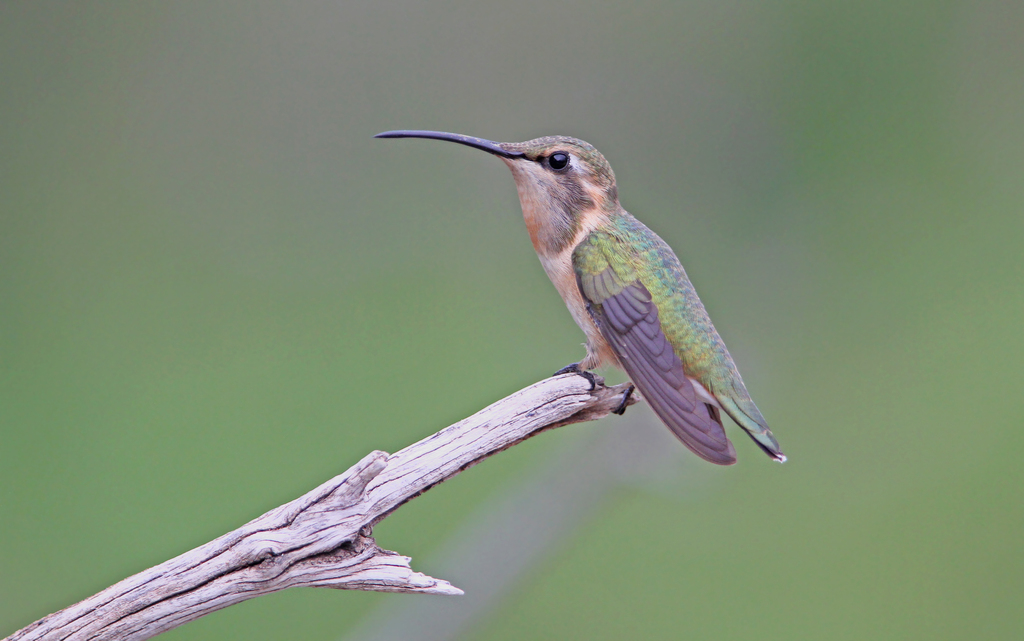
Lucifer Sheartail
Photo © Christoph Moning
Photo © Christoph Moning — CC BY 4.0 — Source: iNaturalist photo #104591806Identification
The lucifer sheartail is a medium-sized hummingbird, measuring 10 centimetres in length, with predominantly green plumage and a long, slightly curved bill. Males are particularly striking, displaying iridescent plumage with a vibrant magenta gorget—the distinctive outward flare of gorget feathers is a key identifying feature—along with a forked dark tail, green crown, and white underparts. A white streak behind the eye adds to their characteristic appearance. Females are larger than males but considerably duller in coloration, with pale throats and white or buff underside feathers usually trimmed in crimson.
Range & Habitat
The lucifer sheartail inhabits deserts and arid areas across the southwestern United States and Mexico. In the United States, its range extends from southwest Texas through extreme southwestern New Mexico to southeastern Arizona. South of the border, it is found in central and northern Mexico, including the Madrean sky islands at the northern end of the Sierra Madre Occidental. These birds prefer high-altitude locations between 3,500 and 5,500 feet, typically in canyons, mountain slopes, and dry washes where desert shrubs and cacti provide both shelter and food sources. During winter months, populations migrate to central Mexico.
Behaviour & Diet
The lucifer sheartail's diet consists primarily of nectar from agave and colourful desert flowers, supplemented by spiders and small insects. Like other hummingbirds, they employ typical hovering flight while feeding and are agile enough to catch insects mid-flight. They fly in direct lines to specific destinations for food, nesting, or roosting. While some males defend feeding territories from rival males, females, and black-chinned hummingbirds, most lucifer sheartails are non-territorial and forage peacefully at agave plants, especially those surrounded by dense vegetation.
Courtship displays are dramatic affairs. Males hover high above females before diving dramatically, creating snapping sounds with their wings or tail feathers. They then fly away with forked tail feathers spread, producing additional snapping sounds. These displays typically last 30 to 45 seconds and may be repeated several times per hour. Females construct small cup-like nests on desert shrubs or cacti on steep, rocky slopes, typically 2–10 feet above ground, sometimes building on top of previous nests. Females lay two white eggs, raising one or two broods per season, with incubation lasting about 15 days and fledging requiring approximately 23 days.
Best Time & Places to See It
The lucifer sheartail is locally common throughout its range and remains present year-round in its southwestern United States breeding habitat. The best viewing opportunities occur during the breeding season when males are most active and their courtship displays are most frequent. Visitors to deserts and canyons in southwest Texas, southeastern Arizona, and southwestern New Mexico should focus on areas with abundant agave plants and desert flowers. During winter months, central Mexico becomes the primary location for observing this species.
Photography Tips
Photographing lucifer sheartails requires patience and attention to their behaviour patterns. Males performing courtship displays offer dynamic photo opportunities, particularly when they're diving with their distinctive forked tails spread. Early morning hours, when hummingbirds are most active at flowering plants, provide optimal lighting and subject activity. Fast shutter speeds are essential to capture their rapid wing beats and aerial manoeuvres. Focus on areas with agave blooms and desert flowers where birds concentrate their feeding activity, and watch for the distinctive magenta gorget and white eye-stripe that make males instantly recognizable.
Big Bend National Park
Brewster County, United States
+345 birds+34 mammals
Where the Chisos Mountains rise abruptly from the Sonoran Desert floor, Big Bend National Park spans over 7,300 square kilometers of one of North America's most…
VIEW NATIONAL PARKSaguaro National Park
Rincon Valley, United States
+354 birds+40 mammals
Where the Sonoran Desert meets sky-island mountains, two geographically separated districts of Saguaro National Park sprawl across nearly two thousand square kilometers of Arizona's most iconic…
VIEW NATIONAL PARKCarlsbad Caverns National Park
Eddy County, United States
+309 birds+18 mammals
Beneath the Chihuahuan Desert floor of southern New Mexico lies one of North America's most spectacular subterranean landscapes. Carlsbad Caverns National Park encompasses over 518 square…
VIEW NATIONAL PARKParque Nacional Cerro de la Estrella
Mexico
+126 birds+4 mammals
Where volcanic peaks rise sharply above Mexico City's sprawling metropolis, Parque Nacional Cerro de la Estrella offers a rare glimpse of high-altitude terrain within one of…
VIEW NATIONAL PARKGuadalupe Mountains National Park
Culberson County, United States
+262 birds+14 mammals
Where fossil-laden limestone ridges thrust skyward above the Chihuahuan Desert floor, Guadalupe Mountains National Park reveals a landscape sculpted by ancient seas and relentless aridity. These…
VIEW NATIONAL PARKNo community photos yet. Log in to add the first one.
No community observations of this species yet.