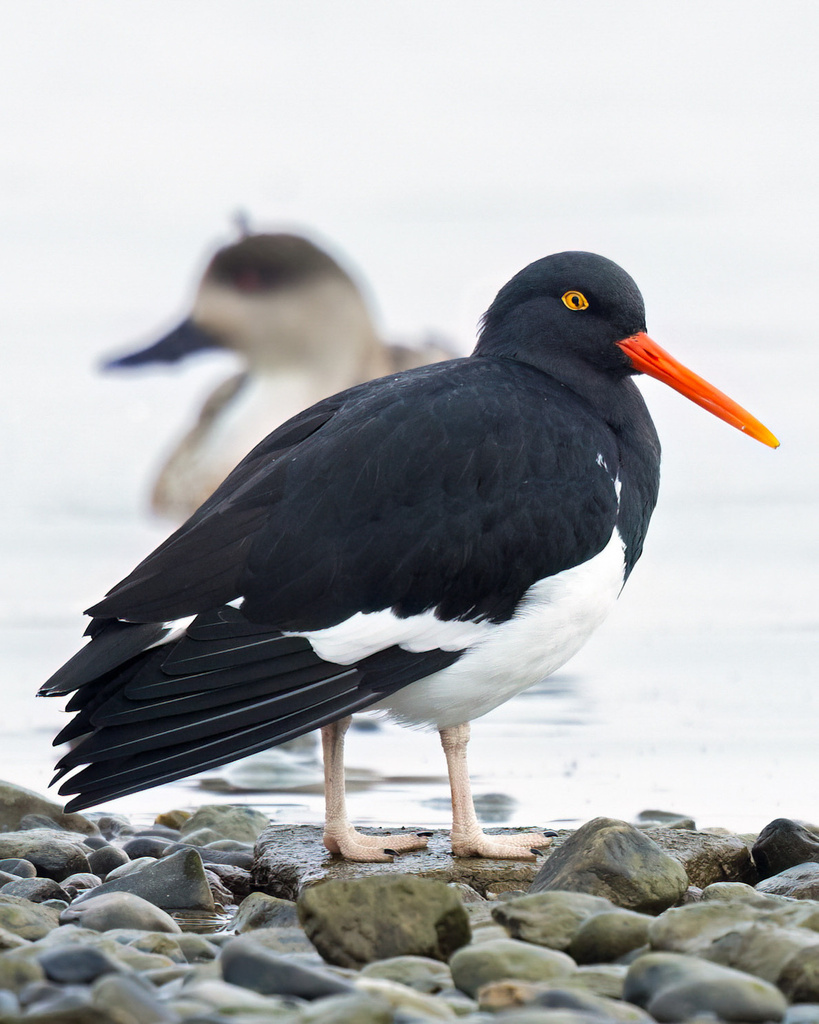
Magellanic Oystercatcher
Photo © Paulo Mascaretti
Photo © Paulo Mascaretti — CC0 1.0 — Source: iNaturalist photo #424606386Identification
The Magellanic oystercatcher is a striking wader measuring 42–46 cm in length, with males weighing around 600 g and females slightly heavier. Its most distinctive features are its long orange beak, bright yellow eye surrounded by a yellow eye ring, and yellow legs. The bird's plumage is boldly patterned: the head, breast, back, wings and tail are black, contrasting sharply with white underparts and white feathers on the inner wing visible in flight.
While superficially similar to the American oystercatcher, the Magellanic can be reliably distinguished by two key features found in no other oystercatcher species: the yellow bare-skin ring encircling its eye, and white secondary feathers. It is also the only New World oystercatcher with a black rather than brown back. The bird's call is a repeated high-pitched "pee-pee" similar to other oystercatchers.
Range & Habitat
The Magellanic oystercatcher is native to the southern tip of South America, with a range spanning southern Argentina, Tierra del Fuego and nearby islands, and the Falkland Islands. Its status on South Georgia and the South Sandwich Islands remains unclear.
This species exhibits seasonal habitat preferences: during breeding season it inhabits upland grasslands inland, but moves to coastal environments outside the breeding period, frequenting freshwater lakes and sandy shores.
Behaviour & Diet
The Magellanic oystercatcher's diet varies seasonally according to habitat. During inland breeding season, it feeds primarily on earthworms and insect larvae, using its sharp beak to probe soft ground and mud. When at the coast outside breeding season, it forages for mussels and limpets, and also feeds on crabs and polychaete worms.
When threatened near its nest, this bird employs several defensive strategies to protect eggs and chicks. These include false-brooding, where it moves to sit on an imaginary nest site to misdirect predators, and tail-flagging—a ritualized aggressive display involving raising both tail and wings. It also produces a distinctive peeping call to warn off intruders.
Best Time & Places to See It
The Falkland Islands and southern Argentina, particularly Tierra del Fuego, offer the best opportunities to encounter this species. Coastal areas during non-breeding seasons and upland grasslands during breeding season are the most productive habitats to search.
Photography Tips
The Magellanic oystercatcher's bold black-and-white plumage and bright yellow facial markings make it highly photogenic. The bright orange beak and yellow eye ring provide excellent points of focus and color contrast. Photograph birds in flight to capture the distinctive white secondary feathers and inner wing patches. During breeding season, upland grassland habitats may offer opportunities to photograph defensive displays such as tail-flagging, though care should be taken to avoid disturbing nesting birds.
Chile: Fuegian Snipe & Juan Fernandez
Sea Lion Island
Sealion Island Settlement, Falkland Islands
+74 birds+3 mammals
Windswept tussock grasslands roll across volcanic terrain where Southern Ocean swells crash against rocky shores, creating one of the Falkland Islands' most dramatic wildlife theatres. This…
VIEW ISLAND & ARCHIPELAGOKidney Island
Stanley, Falkland Islands
+47 birds
Wind-scoured tussock grassland sweeps across this remote South Atlantic outcrop, where peaty soils and exposed rock formations create a landscape as austere as it is vital.…
VIEW ISLAND & ARCHIPELAGOPort Stephens
Port Stephens, Falkland Islands
+29 birds
Windswept moorlands sweep down to pristine beaches where kelp forests fringe the turquoise shallows, their giant fronds swaying in the southern current. Port Stephens, cradled on…
VIEW NATURE RESERVEMurrell Farm
falskland islands, Falkland Islands
+54 birds
Rolling grasslands sweep across windswept plateaux where the South Atlantic exerts its relentless influence on the vegetation, sculpting tussock grassland into a tapestry of browns and…
VIEW NATURE RESERVECape Dolphin
falskland islands, Falkland Islands
+54 birds+1 mammals
Where windswept grasslands meet dramatic coastal cliffs, the Falkland Islands' northern reaches reveal one of the Southern Hemisphere's most compelling seabird sanctuaries. The terrain here is…
VIEW NATURE RESERVEVolunteer Point
Stanley, Falkland Islands
+70 birds+3 mammals
Windswept grasslands meet volcanic black sand beaches where three penguin species converge in the South Atlantic's most theatrical wildlife theatre. This remote peninsula on East Falkland…
VIEW NATURE RESERVEWest Point Island
West Point, Falkland Islands
+67 birds+3 mammals
Windswept cliffs plunge dramatically into the South Atlantic, their rust-coloured rock faces sculpted by millennia of gales and spray. This northwestern outpost of the Falkland Islands…
VIEW ISLAND & ARCHIPELAGOChiloé National Park
Dalcahue, Chile
+122 birds+6 mammals
Temperate rainforest cloaks the Chiloé archipelago's northwestern reaches, where granite ridges thrust through dense, moisture-laden canopy and freshwater streams carve ravines toward the Pacific. Across approximately…
VIEW NATIONAL PARKCabo de Hornos National Park
Cape Horn, Chile
+88 birds+9 mammals
Where the Andes plunge into the Southern Ocean and the Drake Passage churns between two continents, Cabo de Hornos National Park sprawls across one of Earth's…
VIEW NATIONAL PARKTorres del Paine National Park
Torres del Paine, Chile
+143 birds+10 mammals
Where granite spires pierce the Patagonian sky, Torres del Paine commands one of South America's most dramatic landscapes. Across 4,106 square kilometres of southern Chile, jagged…
VIEW NATIONAL PARKPatagonia National Park
Cochrane, Chile
+133 birds+8 mammals
Where the Andes meet the Patagonian steppe, vast grasslands and shrublands sweep across rolling terrain carved by ancient glaciation, their contours softened by distance and dramatic…
VIEW NATIONAL PARKParque Provincial Península de Magallanes
Argentina
+125 birds+4 mammals
Granite peaks and windswept steppe converge across this 415-square-kilometre peninsula jutting into the cold Atlantic waters of southern Patagonia, where the Magallanes landscape embodies the raw,…
VIEW NATIONAL PARKMonte León National Park
Argentina
+100 birds+4 mammals
Where the Patagonian steppe meets the Atlantic, Monte León National Park protects a landscape of windswept coastal cliffs, rocky outcrops, and semi-arid grassland spanning over 1,200…
VIEW NATIONAL PARKLos Glaciares National Park
Argentina
+121 birds+3 mammals
Where granite peaks and sprawling ice fields dominate the landscape, Los Glaciares National Park encompasses over ten thousand square kilometres of Patagonian wilderness in southern Argentina.…
VIEW NATIONAL PARKPerito Moreno National Park
Argentina
+78 birds
Where the Patagonian steppe descends into a landscape carved by ancient ice, Perito Moreno National Park sprawls across nearly 1,590 square kilometres of some of South…
VIEW NATIONAL PARKNo community photos yet. Log in to add the first one.
No community observations of this species yet.