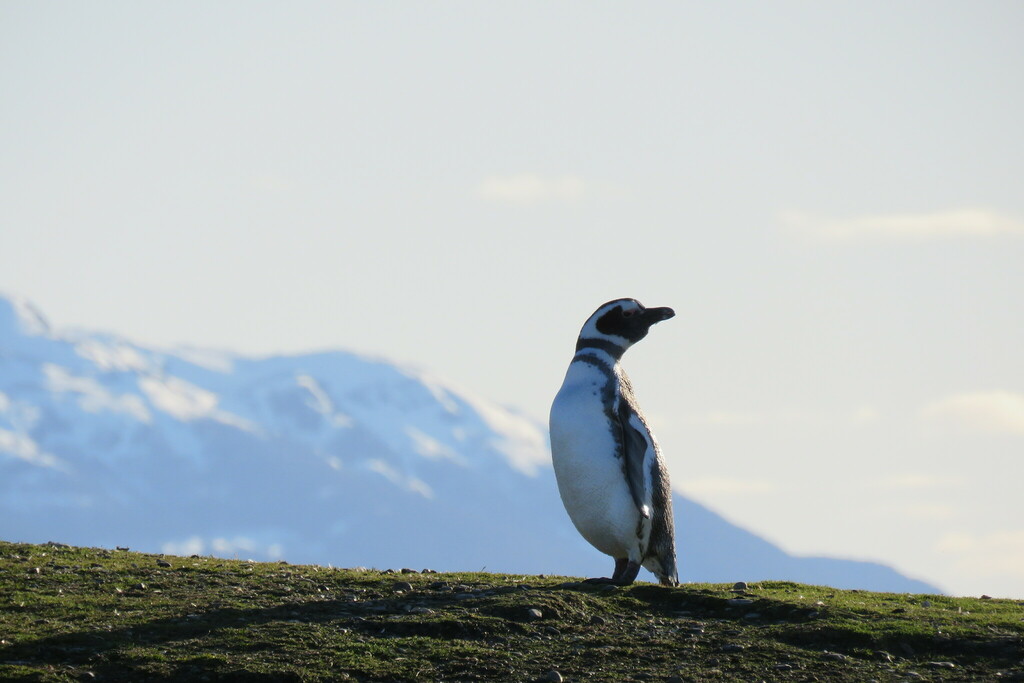
Magellanic Penguin
Photo © Federico Muñoz
Photo © Federico Muñoz — CC0 1.0 — Source: iNaturalist photo #231327476Identification
Magellanic penguins are medium-sized penguins, growing 61–76 cm tall and weighing between 2.7 and 6.5 kg, with males larger than females. Adults are unmistakable: they have black backs and white abdomens, marked by two distinctive black bands running between the head and breast. The lower band forms an inverted horseshoe shape. The head is black with a broad white border running from behind the eye, around the black ear-coverts and chin, meeting at the throat. This striking facial pattern makes them easy to identify in the field.
Younger birds look quite different, with grey-blue backs and faded grey-blue coloring on their chests. Young birds typically have a blotched pattern on their feet that gradually fades with age; by around ten years old, their feet become entirely black. These penguins can live up to 25 years in the wild, with some individuals reaching 30 years or more in captivity.
Range & Habitat
The Magellanic penguin is a South American species, breeding in coastal Patagonia across Argentina, Chile, and the Falkland Islands. These birds gather in large nesting colonies during the breeding season, with some colonies reaching densities of 20 nests per 100 square meters. One of the largest colonies is located at Punta Tombo. Once breeding is complete, Magellanic penguins migrate north for winter, with populations feeding in waters offshore from Peru and Brazil, and occasionally reaching as far north as Espírito Santo. Vagrants have been recorded in El Salvador, Antarctica, Australia, and New Zealand.
The species is the most numerous of the banded penguins (genus Spheniscus) and benefits from the Atlantic coast's large continental shelf, which provides consistent food supply and allows them to forage far from their breeding colonies. This abundance distinguishes them from their relatives, the Galápagos penguins, which face more severe food shortages.
Behaviour & Diet
Magellanic penguins are highly social, traveling in large groups when hunting for food. They are skilled divers, regularly descending to depths of 20–50 meters to forage. Their diet is diverse and opportunistic, including small pelagic fish such as Argentine anchoita, silversides, and Argentine hake, along with squid, krill, cuttlefish, squat lobsters, and hagfish. Interestingly, jellyfish species are actively sought out as food items, contrary to earlier assumptions that they were only accidentally ingested.
During breeding season, males and females show similar foraging patterns and diving behavior. However, their diets diverge after breeding ends, when the demands of chick-rearing are removed. Magellanic penguins mate with the same partner year after year, with females recognizing their mates through their calls alone. Males return each breeding season to reclaim their burrow from the previous year and await their partner's arrival. Both parents share incubation duties in 10–15 day shifts, and chicks are cared for by both parents for 29 days, being fed every two to three days. Normally both chicks fledge successfully, though on average a breeding pair raises approximately 0.7 chicks per season.
Best Time & Places to See It
The breeding season runs from September through late February and March, when adult Magellanic penguins gather at their coastal colonies in Argentina, southern Chile, and the Falkland Islands. This is the best time to encounter large numbers of birds. Punta Tombo, one of the largest colonies, is a prime destination for viewing. Outside the breeding season, these penguins migrate north to offshore waters from Peru and Brazil, making them more difficult to observe but still present in significant numbers during the southern winter months.
Photography Tips
Photographing Magellanic penguins is most rewarding during the breeding season when birds are concentrated in accessible colonies. The distinctive black-and-white plumage and striking facial markings photograph well in natural light, particularly during golden hour. Nests are built under bushes or in burrows, so patience and a respectful distance are essential—note that human interaction and tourism can cause stress responses in newly hatched chicks. Capture both the adults with their characteristic inverted-horseshoe breast bands and the gray-blue fledglings for a complete visual record of the species.
Chile: Fuegian Snipe & Juan Fernandez
Peixe National Park Lagoon
Brazil
+293 birds+4 mammals
Where the coastal plains of Rio Grande do Sul meet the Atlantic, Peixe National Park Lagoon sprawls across nearly 2,200 square kilometres of shallow waters, reed…
VIEW NATIONAL PARKSea Lion Island
Sealion Island Settlement, Falkland Islands
+74 birds+3 mammals
Windswept tussock grasslands roll across volcanic terrain where Southern Ocean swells crash against rocky shores, creating one of the Falkland Islands' most dramatic wildlife theatres. This…
VIEW ISLAND & ARCHIPELAGOKidney Island
Stanley, Falkland Islands
+47 birds
Wind-scoured tussock grassland sweeps across this remote South Atlantic outcrop, where peaty soils and exposed rock formations create a landscape as austere as it is vital.…
VIEW ISLAND & ARCHIPELAGOPort Stephens
Port Stephens, Falkland Islands
+29 birds
Windswept moorlands sweep down to pristine beaches where kelp forests fringe the turquoise shallows, their giant fronds swaying in the southern current. Port Stephens, cradled on…
VIEW NATURE RESERVEMurrell Farm
falskland islands, Falkland Islands
+54 birds
Rolling grasslands sweep across windswept plateaux where the South Atlantic exerts its relentless influence on the vegetation, sculpting tussock grassland into a tapestry of browns and…
VIEW NATURE RESERVECape Dolphin
falskland islands, Falkland Islands
+54 birds+1 mammals
Where windswept grasslands meet dramatic coastal cliffs, the Falkland Islands' northern reaches reveal one of the Southern Hemisphere's most compelling seabird sanctuaries. The terrain here is…
VIEW NATURE RESERVEVolunteer Point
Stanley, Falkland Islands
+70 birds+3 mammals
Windswept grasslands meet volcanic black sand beaches where three penguin species converge in the South Atlantic's most theatrical wildlife theatre. This remote peninsula on East Falkland…
VIEW NATURE RESERVEWest Point Island
West Point, Falkland Islands
+67 birds+3 mammals
Windswept cliffs plunge dramatically into the South Atlantic, their rust-coloured rock faces sculpted by millennia of gales and spray. This northwestern outpost of the Falkland Islands…
VIEW ISLAND & ARCHIPELAGOChiloé National Park
Dalcahue, Chile
+122 birds+6 mammals
Temperate rainforest cloaks the Chiloé archipelago's northwestern reaches, where granite ridges thrust through dense, moisture-laden canopy and freshwater streams carve ravines toward the Pacific. Across approximately…
VIEW NATIONAL PARKCabo de Hornos National Park
Cape Horn, Chile
+88 birds+9 mammals
Where the Andes plunge into the Southern Ocean and the Drake Passage churns between two continents, Cabo de Hornos National Park sprawls across one of Earth's…
VIEW NATIONAL PARKCorcovado National Park
Chaitén, Chile
+39 birds+1 mammals
Where temperate rainforest meets the raw Pacific coastline of Chilean Patagonia, Corcovado National Park sprawls across 6,585 square kilometres of some of South America's most pristine…
VIEW NATIONAL PARKTorres del Paine National Park
Torres del Paine, Chile
+143 birds+10 mammals
Where granite spires pierce the Patagonian sky, Torres del Paine commands one of South America's most dramatic landscapes. Across 4,106 square kilometres of southern Chile, jagged…
VIEW NATIONAL PARKMonte León National Park
Argentina
+100 birds+4 mammals
Where the Patagonian steppe meets the Atlantic, Monte León National Park protects a landscape of windswept coastal cliffs, rocky outcrops, and semi-arid grassland spanning over 1,200…
VIEW NATIONAL PARKArchipiélago Juan Fernández National Park
San Juan Bautista, Chile
+31 birds+2 mammals
Granite peaks rise abruptly from the South Pacific off the Chilean coast, their weathered slopes studded with native woodland and sweeping down to coves where seabirds…
VIEW NATIONAL PARKNo community photos yet. Log in to add the first one.
No community observations of this species yet.