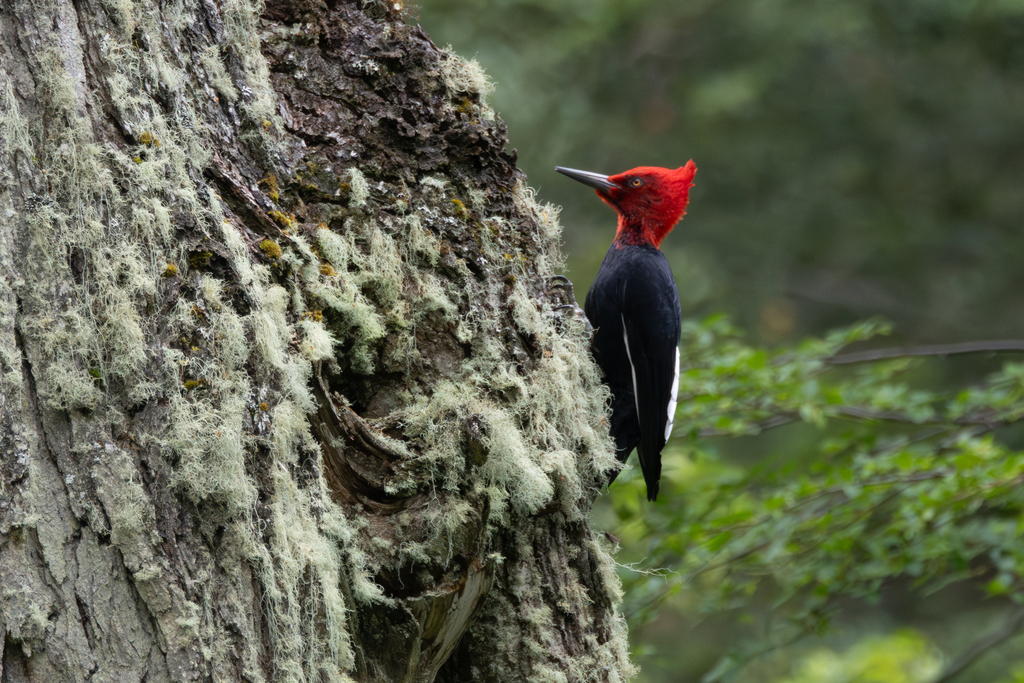
Magellanic Woodpecker
Photo © Ryan F. Mandelbaum
Photo © Ryan F. Mandelbaum — CC BY 4.0 — Source: iNaturalist photo #467936354Identification
The Magellanic woodpecker is the largest South American woodpecker and one of the largest woodpeckers in the world, measuring 36 to 45 cm in length. Males are notably heavier than females, weighing 312–369 g compared to females at 276–312 g. With the likely extinction of the ivory-billed and imperial woodpeckers, the Magellanic woodpecker is now the largest living species of the genus Campephilus and perhaps the heaviest certainly extant woodpecker in the Americas.
The species is unmistakable in appearance within its range. It is mainly pure black with a distinctive white wing patch and a grey, chisel-like beak. Males are identified by their crimson head and crest, while females have a mainly black head with red coloration near the base of the bill. Juveniles resemble females but have a smaller crest and a browner tinge to their plumage. Both sexes produce several vocalizations, including an explosive nasal call (tsie-yaa or pi-caa) and a loud gargling call from pairs, along with their characteristic loud double-knock drum.
Range & Habitat
The Magellanic woodpecker is found in southern Chile and southwestern Argentina, where it is resident year-round. It inhabits mature Nothofagus and Nothofagus-Austrocedrus forests. The species' distribution has contracted and become fragmented as a consequence of native forest clearance, particularly in south-central Chile.
These woodpeckers feed mainly on wood-boring grubs and adult beetles, as well as spiders. They generally use live trees for foraging but also feed on dead substrates such as fallen or broken trees. Once snow disappears in spring, they forage on humid lower tree trunks. In Tierra del Fuego, Magellanic woodpeckers notably forage on decaying and dead trees around ponds hosting introduced American beavers. Occasionally, their diet is supplemented with sap, fruits, small reptiles, bats, and the eggs and nestlings of passerines.
Behaviour & Diet
Magellanic woodpeckers feed in pairs or small family groups and are very active in their food searching, spending most of the daytime hunting for prey. Family groups roost together, with up to five individuals observed roosting in a single cavity. Breeding pairs are highly territorial and aggressively displace conspecifics, sometimes cooperatively with juveniles raised in prior years. They breed during the Southern Hemisphere's springtime from October to January, with both sexes cooperating in nest excavation and all breeding duties. Adults breed every second year, a feature unique to this species among woodpeckers. Incubation lasts 15 to 17 days, with young fledging at 45 to 50 days. Young birds become sexually mature after 2-3 years but typically do not breed successfully until 4 to 5 years of age.
Best Time & Places to See It
The best time to observe Magellanic woodpeckers is during the breeding season from October to January in the Southern Hemisphere spring, when pairs are most active and visible as they excavate nests and rear young. Look for them in mature Nothofagus and Nothofagus-Austrocedrus forests in southern Chile and southwestern Argentina. In Tierra del Fuego, wetland areas with decaying trees around beaver ponds offer particularly good viewing opportunities. Since they spend most of the daytime actively searching for food in pairs or small family groups, patient observation during daylight hours in suitable forest habitat provides the best chances for sightings.
Photography Tips
Photograph Magellanic woodpeckers during daylight hours when they are most active foraging. The male's striking crimson head and crest provide excellent contrast against the pure black plumage and white wing patches, making for compelling images. Position yourself near mature forest trees where the birds forage, particularly on live trunks and around fallen wood where they spend considerable time searching for prey. The species' large size and bold coloration make it relatively photogenic compared to smaller woodpeckers, and their pair and family-group behaviour offers opportunities to capture multiple individuals in a single frame.
Chile: Fuegian Snipe & Juan Fernandez
Chiloé National Park
Dalcahue, Chile
+122 birds+6 mammals
Temperate rainforest cloaks the Chiloé archipelago's northwestern reaches, where granite ridges thrust through dense, moisture-laden canopy and freshwater streams carve ravines toward the Pacific. Across approximately…
VIEW NATIONAL PARKAlerce Costero National Park
Corral, Chile
+34 birds
Where temperate rainforest descends to the Pacific coast in southern Chile, Alerce Costero National Park protects one of the continent's rarest and most ancient ecosystems across…
VIEW NATIONAL PARKCorcovado National Park
Chaitén, Chile
+39 birds+1 mammals
Where temperate rainforest meets the raw Pacific coastline of Chilean Patagonia, Corcovado National Park sprawls across 6,585 square kilometres of some of South America's most pristine…
VIEW NATIONAL PARKTorres del Paine National Park
Torres del Paine, Chile
+143 birds+10 mammals
Where granite spires pierce the Patagonian sky, Torres del Paine commands one of South America's most dramatic landscapes. Across 4,106 square kilometres of southern Chile, jagged…
VIEW NATIONAL PARKLaja National Park Lagoon
Antuco, Chile
+123 birds+1 mammals
Where the Andes descend into the Biobío Region's temperate forests, a vast lagoon fills the caldera of the extinct Antuco volcano, cradled by steep native woodland…
VIEW NATIONAL PARKPuyehue National Park
Puyehue, Chile
+110 birds+4 mammals
Across the volcanic spine of the Los Lagos Region, where the Andes descend toward temperate rainforest, Puyehue National Park encompasses nearly 2,600 square kilometers of one…
VIEW NATIONAL PARKVicente Pérez Rosales National Park
Puerto Varas, Chile
+109 birds+8 mammals
Where the Andes descend toward the temperate rainforests of Chile's Lake District, nearly 4,641 square kilometers of pristine wilderness unfolds across Vicente Pérez Rosales National Park.…
VIEW NATIONAL PARKCerro Castillo National Park
Coyhaique, Chile
+89 birds+3 mammals
Granite peaks and windswept steppe converge across this vast Patagonian landscape, where the Andes' eastern flank drops into terrain sculpted by ice age glaciers and relentless…
VIEW NATIONAL PARKPatagonia National Park
Cochrane, Chile
+133 birds+8 mammals
Where the Andes meet the Patagonian steppe, vast grasslands and shrublands sweep across rolling terrain carved by ancient glaciation, their contours softened by distance and dramatic…
VIEW NATIONAL PARKReserva Nacional Magallanes
Punta Arenas, Chile
+78 birds+2 mammals
Where windswept steppe meets sub-Antarctic forest near the southern tip of continental South America, Reserva Nacional Magallanes unfolds across roughly 352 square kilometres of profound ecological…
VIEW NATIONAL PARKParque Provincial Península de Magallanes
Argentina
+125 birds+4 mammals
Granite peaks and windswept steppe converge across this 415-square-kilometre peninsula jutting into the cold Atlantic waters of southern Patagonia, where the Magallanes landscape embodies the raw,…
VIEW NATIONAL PARKParque Municipal Llao Llao
San Carlos de Bariloche, Argentina
+73 birds+1 mammals
Where the Andes meet the Patagonian lakes, granite peaks rise above temperate rainforest in a landscape of startling contrasts. Parque Municipal Llao Llao, sprawling across 23…
VIEW NATIONAL PARKLos Glaciares National Park
Argentina
+121 birds+3 mammals
Where granite peaks and sprawling ice fields dominate the landscape, Los Glaciares National Park encompasses over ten thousand square kilometres of Patagonian wilderness in southern Argentina.…
VIEW NATIONAL PARKNahuel Huapi National Park
Argentina
+124 birds+11 mammals
Where the Andes descend toward Patagonia, vast glacial lakes cut through a landscape of southern beech forest and granite peaks, creating one of South America's most…
VIEW NATIONAL PARKLanín National Park
Argentina
+128 birds+7 mammals
Where the volcanic spine of the Andes plunges into Patagonian steppe, Lanín National Park sprawls across nearly 4,700 square kilometers of one of Argentina's most visually…
VIEW NATIONAL PARKLago Puelo National Park
Argentina
+109 birds+1 mammals
Where temperate forests descend to crystalline waters in the foothills of the Andes, Lago Puelo National Park sprawls across nearly 300 square kilometers of pristine wilderness…
VIEW NATIONAL PARKLos Alerces National Park
Argentina
+84 birds+3 mammals
Where the temperate rainforests of southern Patagonia sweep down towards crystalline lakes, Los Alerces National Park unfolds across nearly 3,000 square kilometres of one of South…
VIEW NATIONAL PARKNo community photos yet. Log in to add the first one.
No community observations of this species yet.