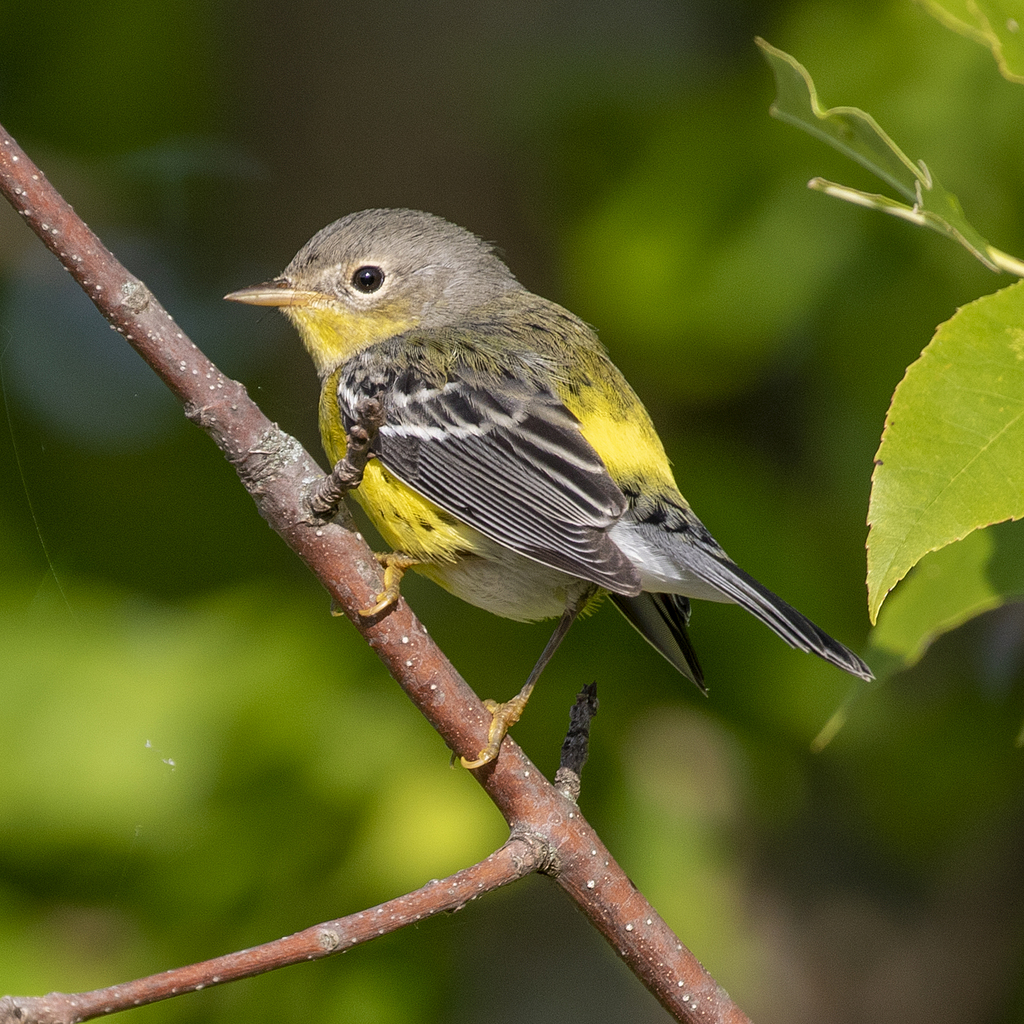
Magnolia Warbler
Photo © Dan Vickers
Photo © Dan Vickers — CC BY 4.0 — Source: iNaturalist photo #540965624Identification
The Magnolia Warbler is a small songbird measuring 11–13 cm in length with a wingspan of 16–20 cm. Breeding males are distinctively marked with white, gray, and black backs contrasted by bright yellow on the sides and a striking yellow-and-black-striped breast. They display black tails with white undertail stripes and prominent white wing bars. The face is white, gray, and black. Females and immature birds show the same pattern but in much duller tones. The combination of yellow breast with black stripes, along with the white wing patches, distinguishes this warbler from similar species such as the Prairie Warbler and Kirtland's Warbler.
Range & Habitat
This warbler breeds in the boreal forests of the northern Great Lakes, New England, and Appalachian regions of the United States, as well as across central and eastern Canada. It favors dense, young coniferous forests, particularly stands of tightly packed firs and spruces. During migration, birds move through eastern and central North America westward to Oklahoma and Kansas, eventually reaching their wintering grounds in southern Mexico, Central America, and the Caribbean. During migration, they inhabit various woodland types.
Behaviour & Diet
Magnolia Warblers are primarily insectivorous, with caterpillars forming their main diet. They also consume beetles, butterflies, spiders, and occasionally fruit and nectar, particularly during winter months. Both sexes sing, but males produce two distinct song types—one for attracting mates and another for defending territory. They use short call notes as alarm signals. Males arrive at breeding grounds approximately two weeks before females and are monogamous, investing considerable energy in foraging for their young.
Best Time & Places to See It
During breeding season, search for Magnolia Warblers in dense boreal forest stands of young conifers in the northern United States and Canada. Look for them during spring and fall migration when they pass through various woodland habitats across the eastern half of North America. The species is solitary and typically lives among the branches of young, densely packed trees. Patience and careful scanning of mid-height coniferous foliage will reward observers with sightings of this striking warbler.
Photography Tips
Position yourself within mature coniferous stands where young dense growth provides habitat. Early morning light enhances the striking yellow-and-black breast pattern of breeding males. Focus on the mid-canopy to lower branches where these warblers typically forage for insects. Use a fast shutter speed to capture their active movements through the foliage. During migration, check mixed woodlands where the species is more accessible. Breeding males are most visually striking and photogenic, while females offer a more subtle study in warbler identification.
Acadia National Park
Alaska Maritime National Wildlife Refuge
Algonquin Provincial Park
Alligator River National Wildlife Refuge
Arenal Volcano National Park
Arrecifes de Cozumel National Park
Banff National Park
Barra del Colorado National Wildlife Refuge
Baru Volcano National Park
Nothing matches these filters.
No community photos yet. Log in to add the first one.
No community observations of this species yet.