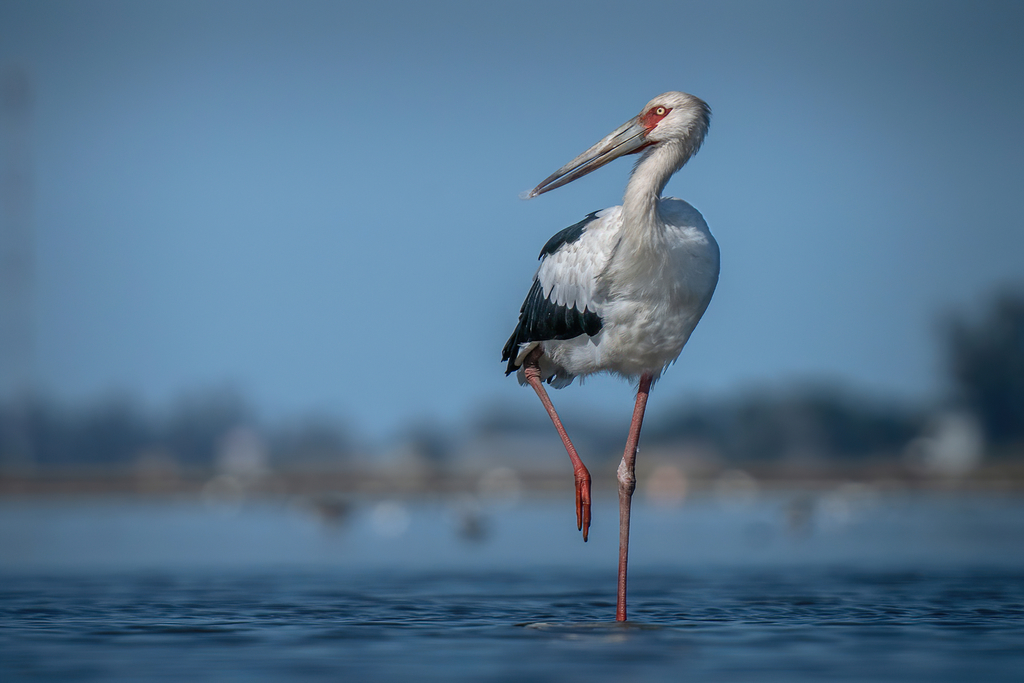
Maguari Stork
Photo © Luciano Massa
Photo © Luciano Massa — CC BY 4.0 — Source: iNaturalist photo #116651260Identification
The Maguari Stork is a large wading bird standing 97 to 120 cm tall with a wingspan of 155 to 180 cm, making it similar in size to the white stork. Males average 4.2 kg while females average 3.8 kg. Much of the adult plumage is white with striking black flight feathers and a forked black tail—a feature that clearly distinguishes it from the white stork. The forked tail is shorter than the stiff white under-tail coverts, which protrude beneath it and are easily visible in flight from the ground.
The bill is straight and bluish grey, lined with red, with the final third dark maroon. The iris is lemon-yellow or cream white, and the legs are purplish red. During the breeding season, individuals develop brighter plumage and long semi-plumes up to 18 cm on the head and neck that become erectile during courtship and aggressive displays. The throat and lores are orangey red, deepening during breeding season. Juveniles are distinctly darker than adults, with dark grey downy plumage rather than white, making them easily recognizable as a separate age class.
Range & Habitat
The Maguari Stork is the only Ciconia stork species found in the New World and one of only three stork species occurring in South America, alongside the wood stork and jabiru. It inhabits seasonal wetlands across much of the continent, where it may occur in sympatry with both of these species in parts of its range. The bird was first documented in the scientific record through Georg Marcgrave's descriptions and illustrations from Brazil in 1648.
Behaviour & Diet
The Maguari Stork is an impressive flyer, soaring at least a hundred metres above the ground with outstretched neck and extended legs, interspersing wing beats at a rate of 181 beats per minute with long glides. It requires three long jumps before taking off from the ground. The species strongly resembles both the white stork and Oriental stork in behaviour, including a characteristic up-down greeting display used in courtship and social interactions. Head and neck feathers with their distinctive structure play an important role in courtship and aggressive displays.
Best Time & Places to See It
The Maguari Stork is best found in seasonal wetland habitats throughout South America. The breeding season is when plumage is brightest and behaviour most active, making it an excellent time for observation. Look for birds soaring high above wetland areas, where their white plumage and distinctive flight silhouette make them visible from considerable distances.
Photography Tips
Photograph this stork in flight to capture its impressive soaring behaviour and distinctive forked tail with protruding white under-tail coverts—features that distinguish it from other large white storks. The contrast between white plumage and black flight feathers and tail provides excellent photographic opportunity. During breeding season, capture the erected semi-plumes on the head and neck during displays, and note the colour changes in the throat and lores. Wide-angle lenses work well for capturing birds in their wetland habitat and soaring overhead.
Emas National Park
Brazil
+333 birds+23 mammals
Across the high plateaux of central Brazil, where the cerrado grasslands roll toward distant horizons under an immense sky, Emas National Park anchors one of South…
VIEW NATIONAL PARKPeixe National Park Lagoon
Brazil
+293 birds+4 mammals
Where the coastal plains of Rio Grande do Sul meet the Atlantic, Peixe National Park Lagoon sprawls across nearly 2,200 square kilometres of shallow waters, reed…
VIEW NATIONAL PARKViruá National Park
Brazil
+389 birds+6 mammals
Across the northern frontier of Roraima, where the forest canopy rises from ancient Amazonian lowlands, Viruá National Park protects nearly 3,700 square kilometres of terra firme…
VIEW NATIONAL PARKIguaçu National Park
Brazil
+387 birds+17 mammals
Where the Paraná Plateau plunges toward the Atlantic watershed, six thousand square kilometers of subtropical rainforest cling to steep gorges and river valleys in this corner…
VIEW NATIONAL PARKIlha Grande National Park
Brazil
+233 birds
Across the subtropical plateaus and Atlantic forest remnants of southern Brazil, a vast protected landscape spanning nearly 4,600 square kilometers safeguards one of the continent's most…
VIEW NATIONAL PARKSerra dos Órgãos National Park
Brazil
+446 birds+13 mammals
Granite peaks thrust skyward through the Atlantic Forest canopy in the mountains immediately north of Rio de Janeiro, their bare rock faces rising above a landscape…
VIEW NATIONAL PARKChapada dos Guimarães National Park
Brazil
+450 birds+1 mammals
Where weathered sandstone plateaus rise above the cerrado grasslands of central Brazil, Chapada dos Guimarães National Park protects 624 square kilometres of ecological transition zone that…
VIEW NATIONAL PARKPantanal Matogrossense National Park
Brazil
+322 birds+17 mammals
Where the flooded forests of central Brazil meet vast seasonally inundated grasslands, Pantanal Matogrossense National Park sprawls across nearly 2,900 square kilometers of one of the…
VIEW NATIONAL PARKSerra Geral National Park
Brazil
+211 birds+2 mammals
Where basalt cliffs and sandstone escarpments rise above the subtropical forests of southern Brazil, Serra Geral National Park preserves one of the Atlantic region's most dramatic…
VIEW NATIONAL PARKBahuaja Sonene National Park
San Pedro de Putina Punco, Peru
+602 birds+8 mammals
Where the Madre de Dios and Heath rivers converge in southeastern Peru rises one of South America's most biodiverse wilderness regions: a vast protected realm of…
VIEW NATIONAL PARKEl Palmar National Park
Distrito Sexto, Argentina
+244 birds+14 mammals
Across the Paraná River floodplain in northeastern Argentina, palms rise from wetland and grassland in a landscape shaped by water and time. El Palmar National Park…
VIEW NATIONAL PARKCampos del Tuyú National Park
Argentina
+169 birds+5 mammals
Subtropical forest graces the borderlands where Misiones Province meets Paraguay, a landscape shaped by the Paraná Plateau's weathered topography and the warm, humid climate of northeastern…
VIEW NATIONAL PARKRío Pilcomayo National Park
Argentina
+271 birds+13 mammals
Where the Río Pilcomayo cuts through northeastern Argentina's subtropical lowlands, a sprawling mosaic of wetlands, grasslands, and seasonally flooded forests creates one of South America's most…
VIEW NATIONAL PARKEl Rey National Park
Municipio de Las Lajitas, Argentina
+317 birds+4 mammals
Where the eastern slopes of the Andes descend into northwestern Argentina's subtropical transition zone, El Rey National Park unfolds across 841 square kilometers of dramatically varied…
VIEW NATIONAL PARKCalilegua National Park
Municipio de Calilegua, Argentina
+288 birds+8 mammals
Where the eastern Andean slopes plunge into northwestern Argentina's humid subtropics, nearly 2,645 square kilometers of steep terrain and luxuriant forest compose one of South America's…
VIEW NATIONAL PARKParque Provincial Pampa del Indio
Laguna Limpia, Argentina
+231 birds+4 mammals
Across the flat horizons of Chaco Province, where the Paraná River system spills into vast wetlands and grasslands, Parque Provincial Pampa del Indio protects one of…
VIEW NATURE RESERVEChaco National Park
Municipio de Presidencia de la Plaza, Argentina
+258 birds+7 mammals
Across the humid subtropical lowlands of northeastern Argentina, where the Paraná River basin feeds vast seasonal wetlands and gallery forests, Chaco National Park protects one of…
VIEW NATIONAL PARKNo community photos yet. Log in to add the first one.
No community observations of this species yet.