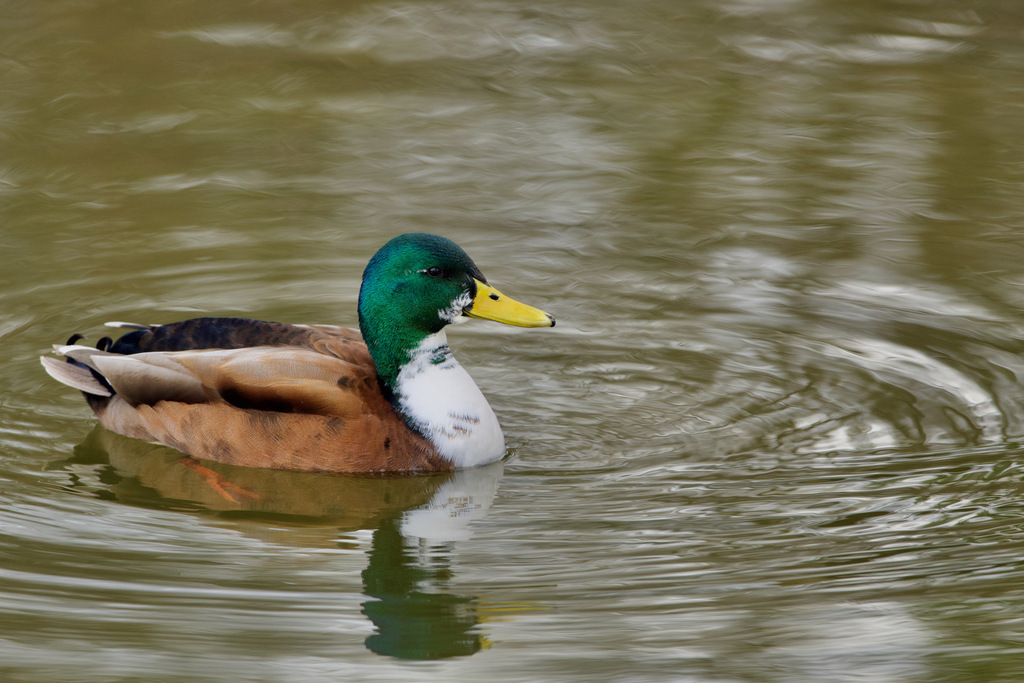
Mallard
Photo © Codrin Bucur
Photo © Codrin Bucur — CC BY 4.0 — Source: iNaturalist photo #180394066Identification
The mallard is a medium-sized dabbling duck, measuring 50–65 cm in length with a wingspan of 81–98 cm, making it slightly heavier than most other dabbling ducks. The most distinctive feature is the dramatic sexual dimorphism: males sport an iridescent green head, while females display predominantly brown-speckled plumage. Both sexes share a characteristic speculum—a white-bordered patch of black or iridescent purple or blue feathers on the wings—with males typically showing more prominent blue speculum feathers. The bill is notably broad, ranging from 4.4 to 6.1 cm in length, reflecting the species' scientific name platyrhynchus, meaning "broad-billed."
Range & habitat
The mallard breeds throughout temperate and subtropical regions of the Americas, Eurasia, and North Africa, and has been widely introduced to New Zealand, Australia, and South America. This highly adaptable species inhabits wetlands of various types and is notably capable of thriving in urban environments. The mallard's flexibility has made it one of the most successful waterfowl globally, though its invasive tendencies in some regions present conservation concerns for indigenous duck species.
Behaviour & diet
Mallards are highly social animals that prefer to congregate in groups or flocks of varying sizes. They feed on water plants and small animals, employing dabbling techniques typical of their subfamily. Breeding females lay 8 to 13 creamy white to greenish-buff eggs on alternate days, with incubation lasting 27 to 28 days. The ducklings are precocial, capable of swimming immediately upon hatching, and fledging occurs within 50 to 60 days. Notably, mallards are non-migratory in some populations and readily interbreed with closely related duck species, producing fertile offspring that have contributed to genetic changes in wild populations.
Best time & places to see it
Mallards are widespread and abundant across their range, making them accessible to nature travellers visiting wetlands, parks, and urban waterways. Their adaptability to human-modified landscapes means they can be encountered in diverse settings, from pristine natural wetlands to city parks and suburban ponds. The species' year-round presence in many regions provides reliable opportunities for observation and photography throughout the year.
Photography tips
The mallard's striking sexual dimorphism offers excellent photographic opportunities. The vivid green head of breeding males provides strong colour contrast, particularly when photographed against water or vegetation. Early morning and late afternoon light can enhance the iridescent quality of the male's head plumage. Since mallards are social and relatively unafraid in populated areas, patient photographers can often achieve close approaches, especially in urban settings. Capturing females requires attention to the subtle brown-speckled patterns and the white-bordered wing speculum visible in flight.
Delta de l’Ebre Natural Park
Tombstone Territorial Park
Abel Tasman National Park
Abruzzo, Lazio and Molise National Park
Acadia National Park
Agulhas National Park
Alaska Maritime National Wildlife Refuge
Algonquin Provincial Park
Alligator River National Wildlife Refuge
Nothing matches these filters.
No community photos yet. Log in to add the first one.