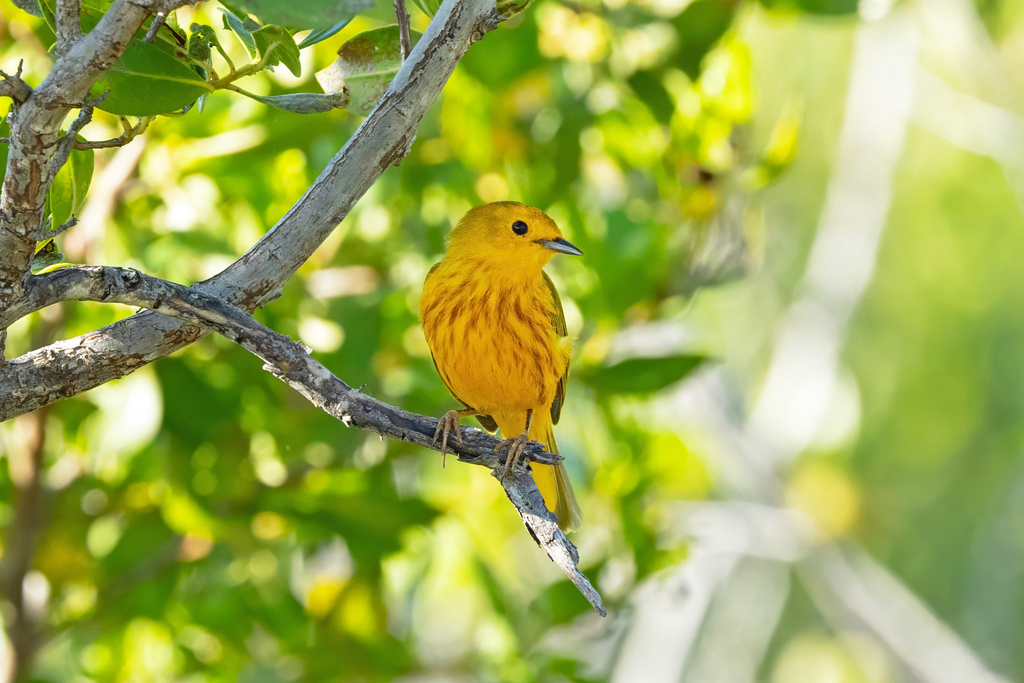
Mangrove Warbler
Photo © Thibaud Aronson
Photo © Thibaud Aronson — CC BY-SA 4.0 — Source: iNaturalist photo #462922159Identification
The mangrove warbler is a small bird, around 13 cm (5.1 in) in length, and one of the most strikingly coloured warblers across its range. It is predominantly bright yellow, with males displaying a distinctive rufous hood that makes them particularly eye-catching. Females and immature birds are noticeably duller, with greenish-yellow upperparts and a more subdued yellow below. All subspecies are remarkably similar in plumage aside from the male's hood colouration. In all birds, the flight feathers and tail feathers are blackish olive with yellow edges, sometimes creating an indistinct wing-band effect. The bird's dark eyes and thin, dark beak are characteristic features, while the feet range from lighter to darker olive-buff depending on the subspecies.
Range & Habitat
The mangrove warbler is found exclusively in mangrove habitats along the Atlantic and Pacific coasts of the tropical Americas, with populations also present throughout the Caribbean and on the Galápagos Islands. The species comprises 34 recognized subspecies distributed across this vast range, from southern Mexico through Central America and into South America as far south as Peru, as well as across numerous Caribbean islands. Each subspecies occupies specific mangrove territories, with some endemic to single islands or archipelagos. The bird's strong association with mangrove ecosystems makes these coastal wetland habitats essential for its survival and distribution.
Behaviour & Diet
The mangrove warbler is an insectivorous species that hunts for food within its mangrove habitat. The genus name Setophaga reflects this feeding specialization, combining Ancient Greek words meaning "moth" and "eating," though the bird takes a broader range of small insects and arthropods beyond moths. Like other warblers, it is an active forager, gleaning prey from foliage and branches within the mangrove canopy. The species was formerly considered conspecific with the migratory American yellow warbler but is now recognized as a separate species based on differences in mitochondrial DNA, plumage characteristics, and vocalizations.
Best Time & Places to See It
Mangrove warblers are resident species throughout their range and can be observed year-round in suitable mangrove habitat. Birders and nature travellers visiting the tropical Americas should focus their efforts on coastal mangrove areas from Mexico southward through Central America and the Caribbean, and into South America. The species is particularly notable on the Galápagos Islands, where it represents one of the endemic bird populations. Given the bird's bright yellow plumage and relatively small size, early morning hours often provide the best viewing opportunities when birds are most active and vocal.
Photography Tips
The mangrove warbler's bright yellow plumage and small size present both opportunities and challenges for photographers. The vivid yellow coloration of males, especially those with rufous hoods, offers excellent photographic subjects with strong natural contrast. However, the species' small stature and tendency to forage within dense mangrove vegetation can make photography difficult. Position yourself near mangrove edges at dawn to maximize light and visibility. Fast shutter speeds are essential to freeze the bird's active movements through branches. The distinctive plumage of males makes them easier to photograph than duller females and immatures, which may blend more readily with their mangrove surroundings.
Tombstone Territorial Park
Acadia National Park
Alaska Maritime National Wildlife Refuge
Algonquin Provincial Park
Alligator River National Wildlife Refuge
Arches National Park
Arctic National Wildlife Refuge
Arenal Volcano National Park
Arrecifes de Cozumel National Park
Nothing matches these filters.
No community photos yet. Log in to add the first one.
No community observations of this species yet.