Identification
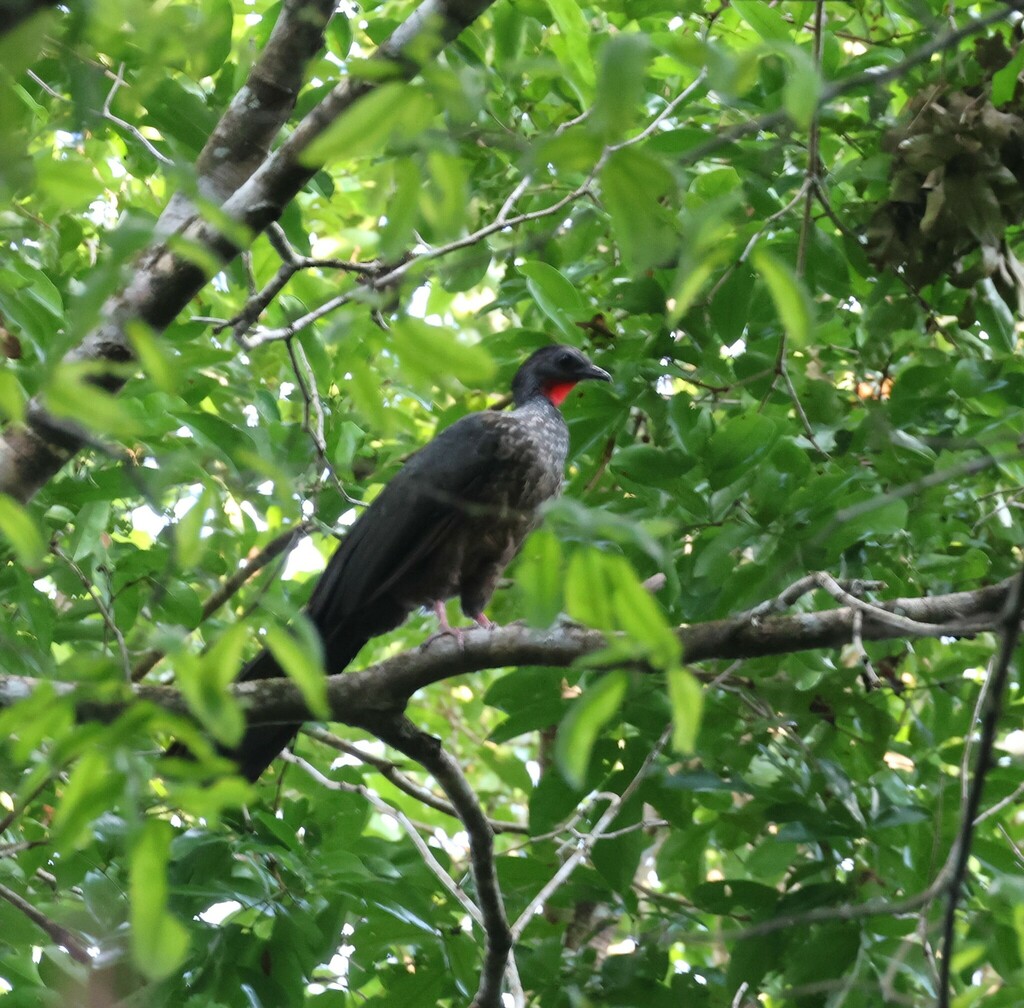
The marail guan is a medium-sized member of the guan family, measuring 63 to 68 cm in length, with males weighing 772 to 1,310 g and females 770 to 1,450 g. The nominate subspecies displays a dark back, wings, and central tail feathers with a distinctive greenish olive gloss, while the outer tail feathers are bluish black. Its throat and chest are dark with white speckles contrasting against a reddish-brown belly. A striking red dewlap adorns the throat. The subspecies P. m. jacupeba, found in northern Brazil and possibly southeastern Venezuela, is slightly smaller, paler, and more grayish brown in overall coloration.
Range & Habitat
The marail guan is found across a broad range spanning Brazil, French Guiana, Guyana, Suriname, and Venezuela. The nominate subspecies occurs from eastern Venezuela through the Guianas, while P. m. jacupeba inhabits northern Brazil north of the Amazon River. This species shows a strong preference for mature tropical forest, particularly terre firma forest with dense undergrowth in the Guianas and Brazil, though it can adapt to secondary forest habitats. It is primarily a lowland species, with Venezuelan populations ranging between 100 and 600 m elevation.
Behaviour & Diet
The marail guan appears to be sedentary, with territory sizes in Suriname ranging from 2 to 9 hectares. It forages singly or in small groups of up to six birds, moving through both the canopy and lower forest levels, occasionally descending to the ground. Its diet consists almost entirely of fruits, with insects taken only occasionally. The species is vocal and notably active at dawn and dusk, performing a distinctive wing-whirring display usually in early morning hours, typically followed by barking calls of "whaf, whaf, whaf." Similar barking calls are given again at dusk.
Best Time & Places to See It
Travellers seeking the marail guan should focus on the primary forest regions of the Guianas and northern Brazil, where the species is fairly common to common throughout its range. Early morning and dusk visits to mature tropical forest with dense undergrowth offer the best chances of encounter, when the bird's distinctive vocalizations are most active. The species' breeding season varies by location, spanning October to February in the Guianas and extending further into the year in Brazil, potentially offering opportunities to observe breeding behaviour during these periods.
Photography Tips
Photographers should position themselves in mature forest habitat during dawn and dusk hours when the marail guan is most vocal and active. The bird's preference for foraging in the canopy and mid-storey levels requires patience and positioning for good sight lines through the forest. The striking red dewlap and contrasting white speckles on dark plumage provide distinctive identification features worth capturing. Since birds often forage in small groups, multiple individuals may present photo opportunities in a single encounter. Early morning light filtering through the canopy will best reveal the greenish olive gloss on the bird's back and wings.
Viruá National Park
Brazil
+389 birds+6 mammals
Across the northern frontier of Roraima, where the forest canopy rises from ancient Amazonian lowlands, Viruá National Park protects nearly 3,700 square kilometres of terra firme…
VIEW NATIONAL PARKMonte Roraima National Park
Brazil
+226 birds+1 mammals
Where the tepuis rise from the Amazon basin like islands in a sea of forest, Monte Roraima National Park sprawls across 3,714 square kilometres of one…
VIEW NATIONAL PARKNo community photos yet. Log in to add the first one.
No community observations of this species yet.