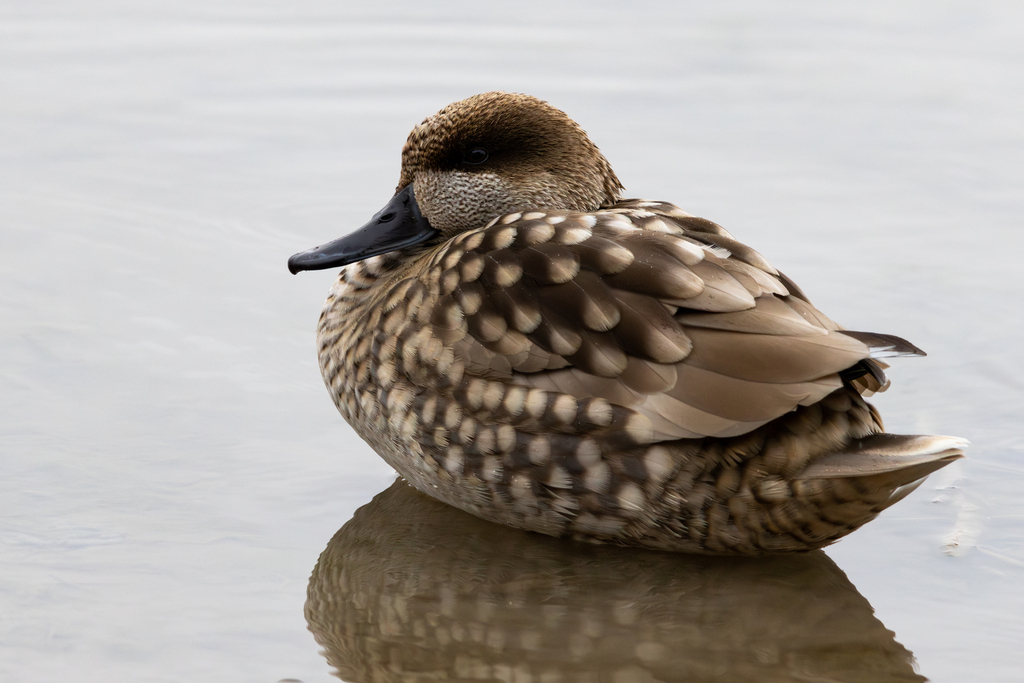
Marbled Duck
Photo © Diego González Dopico
Photo © Diego González Dopico — CC BY 4.0 — Source: iNaturalist photo #458514769Identification
The marbled duck is a medium-sized dabbling duck, measuring approximately 39–42 cm in length. Its most distinctive features are its pale sandy-brown plumage diffusely blotched with off-white, combined with a striking dark eye-patch and characteristically shaggy head. Adults of both sexes are similar in appearance, though females average slightly smaller than males. Juveniles resemble adults but display more prominent off-white blotches. In flight, the wings appear uniformly pale without marked patterns, and notably lack a speculum on the secondaries—a feature that distinguishes them from many other duck species.
Range & Habitat
Once abundant throughout the Mediterranean region, the marbled duck's range has contracted dramatically and is now fragmented across southern Europe, northern Africa, and western to central Asia. Breeding populations persist in only a few scattered locations including southern Spain, southern Italy, and northwest Africa, with larger populations in the Levant region. The species exhibits nomadic tendencies, with populations ranging eastward to the Mesopotamian marshes of southern Iraq, the Shadegan Marshes in Iran (the world's most important site), and isolated pockets in Armenia, Azerbaijan, southern European Russia, western India, and western China.
Marbled ducks favour temporary and shallow freshwater, brackish, or alkaline waters bordered by dense vegetation in otherwise arid regions. They breed in coastal lagoons, along slow-moving rivers, and in man-made waters such as reservoirs. Nests, typically containing around 12 eggs on average, are concealed beneath dense vegetation at the water's edge, usually on the ground but occasionally elevated among reeds or constructed reed structures.
Behaviour & Diet
These are gregarious birds, remaining social even during the breeding season. Outside breeding periods, flocks are typically small, though large winter concentrations occur in certain regions, with the largest known wintering population in Khuzestan, Iran. Marbled ducks are nervous and flighty birds, even when held in captive collections. They feed primarily in shallow water using dabbling and up-ending techniques. Adults consume mainly seeds from aquatic plants, supplemented by significant quantities of invertebrates including aquatic insect larvae and pupae, tiny crustaceans, and unusually for ducks, ants. They also eat green plants. Their specialized gizzard enables them to process seeds, while lamellae in their beaks facilitate filter-feeding on zooplankton. Young marbled ducks rely predominantly on invertebrates, lacking the large gizzard necessary to process the larger seeds consumed by adults.
Best Time & Places to See It
The Shadegan Marshes in Iran represent the world's most important site for observing marbled ducks and offer the best opportunity to see significant numbers of this increasingly rare species. The Mesopotamian marshes of southern Iraq also support important populations, where Iraqi ornithologists documented a single flock numbering at least 40,000 birds in 2011. During winter, Khuzestan in Iran hosts the largest known concentration. In western Europe, small numbers may be encountered in southern Spain and Italy, though sightings are irregular. Some birds disperse south during winter and may be found in the Sahel zone, south of the Sahara.
Photography Tips
Photographing marbled ducks presents challenges due to their nervous and flighty nature—approach slowly and use appropriate distance to avoid disturbance. Their pale sandy-brown colouration with off-white blotches requires careful exposure management to retain detail in both highlights and shadows. The dark eye-patch and shaggy head are key identifying features worth capturing in portraiture. Visit wetland sites during early morning or late afternoon when birds are most active and lighting is favourable. In flight shots, watch for the characteristic pale, unpatternned wings. Large flocking behaviour at key sites like the Shadegan Marshes offers opportunities for landscape and flock photography, capturing the scale of these important concentrations.
S’Albufera Natural Park
Platja de Muro, Spain
+253 birds+6 mammals
Where Mediterranean lagoons meet the Balearic coast, S'Albufera stretches across nearly 1,600 hectares of wetland and dune systems that rank among Europe's most ecologically vital shallow-water…
VIEW NATURAL PARKMarjal Pego-Oliva Natural Park
Molinell, Spain
+219 birds+2 mammals
Where the Valencian littoral flattens into wetland and reed-bed, Marjal Pego-Oliva straddles the boundary between the Mediterranean and its inland margins, a mosaic of shallow lagoons,…
VIEW NATURAL PARKL’Albufera Natural Park
València, Spain
+321 birds+18 mammals
Where shallow lagoons meet Mediterranean coastal marshland, L'Albufera Nature Park unfolds as one of Spain's most vital wetland complexes. This protected landscape, designated under IUCN Category…
VIEW NATURAL PARKDoñana National Park
Hinojos, Spain
+300 birds+13 mammals
Where the Guadalquivir River delta spreads into the Atlantic, vast marshes, cork woodlands, and coastal dunes converge to create one of southwestern Europe's most biodiverse wetland…
VIEW NATIONAL PARKTablas de Daimiel National Park
Daimiel, Spain
+246 birds+6 mammals
Where the Guadiana River spreads into a labyrinth of shallow lagoons and reed beds across the sun-baked plains of central Spain, Tablas de Daimiel National Park…
VIEW NATIONAL PARKCabo de Gata-Níjar Natural Park
San José, Spain
+274 birds+11 mammals
Where volcanic ridges plunge toward the Mediterranean, Cabo de Gata-Níjar Nature Park unfolds across one of Europe's most arid coastlines, a landscape sculpted by tectonic violence…
VIEW NATURAL PARKDelta de l’Ebre Natural Park
Eucaliptus, Spain
+341 birds+18 mammals
Where the Ebro River spreads into a vast labyrinth of shallow lagoons, reed beds, and brackish marshes before surrendering to the Mediterranean, one of southern Europe's…
VIEW NATURAL PARKEspacio Natural Remolar-Filipinas
El Prat del Llobregat, Spain
+297 birds+7 mammals
Where the Llobregat River delta meets the Mediterranean, a patchwork of salt marshes, reed beds, and shallow lagoons creates one of Catalonia's most dynamic wetland ecosystems.…
VIEW NATURE RESERVECamargue Regional Nature Park
Saintes-Maries-de-la-Mer, France
+378 birds+48 mammals
Where the Rhône Delta sprawls into the Mediterranean, a landscape of stark and haunting beauty emerges—vast salt marshes punctuated by shallow lagoons, reed beds, and scrubland…
VIEW NATURAL PARKPort-Cros National Park
Hyères, France
+271 birds+29 mammals
Where Mediterranean granite islands rise from crystalline waters off the Provençal coast, Port-Cros National Park protects one of Europe's most intact marine and terrestrial ecosystems. The…
VIEW NATIONAL PARKLindisfarne National Nature Reserve
Holy Island, United Kingdom
+240 birds+13 mammals
Windswept tidal flats and rocky outcrops define this reserve on Holy Island, where the North Sea's relentless rhythm shapes both landscape and wildlife. The terrain shifts…
VIEW NATURE RESERVENo community photos yet. Log in to add the first one.
No community observations of this species yet.