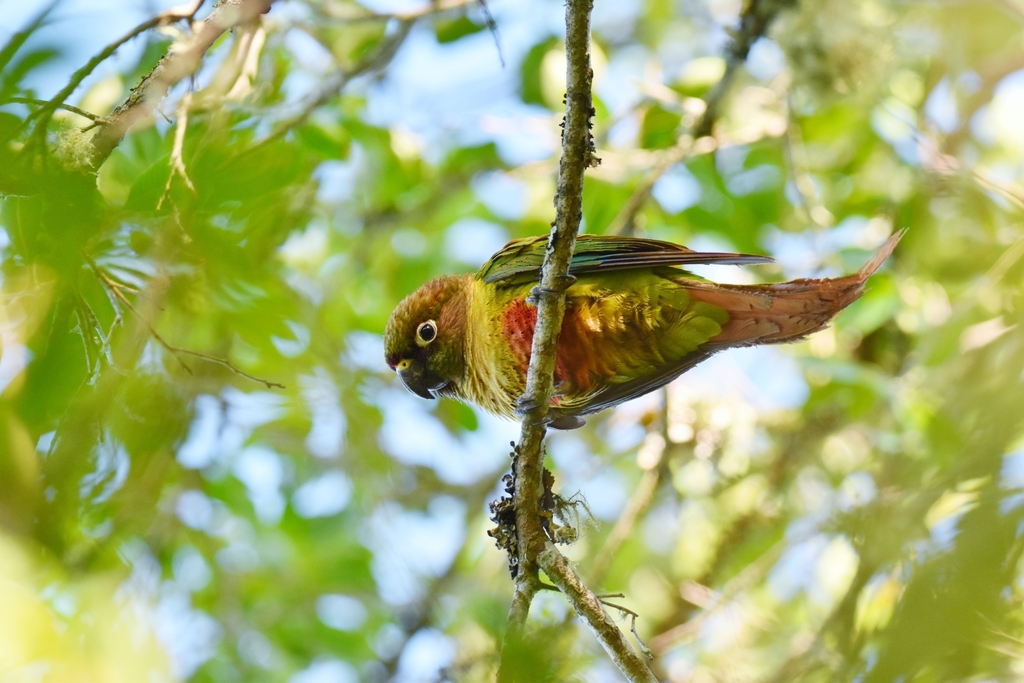
Maroon-bellied Parakeet
Photo © Gabriel Martínez
Photo © Gabriel Martínez — CC BY 4.0 — Source: iNaturalist photo #349077852Identification
The maroon-bellied parakeet is a small parrot measuring 25–28 cm in length. Its plumage is primarily green, with distinctive field marks that make identification straightforward. Look for a dark maroon frontlet on the forehead—the feature that gives the species its scientific name frontalis—along with a maroon patch on the belly and maroon undertail coverts. The breast and sides of the neck display a characteristic "scaly" yellow-green-barred pattern, and there is a whitish ear-patch often tinged with brown. The flight feathers are blue on the outer webs and green on the inner webs with dark tips, and the beak is black. Subspecies differ slightly in tail coloration: the nominate subspecies has a greenish-yellow uppertail grading into a broad reddish tip, while the southern subspecies chiripepe lacks this reddish tip.
Range & Habitat
This species is found from southeastern Brazil south through eastern Paraguay to northeastern Argentina, with its range also extending into Uruguay. The maroon-bellied parakeet is common in woodland and forest edges throughout its range. In the northern part of its distribution, it inhabits highland areas up to 1,400 m elevation, while elsewhere it is primarily found in lowlands up to 1,000 m. Notably, this species tolerates human disturbance well and has adapted to urban environments, living in parks in major cities such as Rio de Janeiro and São Paulo, where it regularly feeds in gardens and cultivated areas.
Behaviour & Diet
Maroon-bellied parakeets are social birds typically found in small flocks of 6–12 individuals, though occasionally groups of up to 40 may gather. They primarily feed on fruits, flowers, and other plant matter, and unlike many parakeet species, they rarely participate in mixed-species feeding flocks. These are among the quietest conures, though their vocalizations can still be shrill and may irritate some observers. They are capable of learning to talk, though their speech is typically unclear.
Best Time & Places to See It
The maroon-bellied parakeet is generally common throughout its range and not considered threatened. Urban parks in Rio de Janeiro and São Paulo offer reliable opportunities for observation, particularly in gardens and cultivated areas. The species' tolerance of human disturbance and urban habitats makes it one of the more accessible parakeets for travelers in southeastern Brazil and the southern cone of South America.
Photography Tips
The maroon-bellied parakeet's compact size and tendency to feed in open gardens make it a rewarding photographic subject. Focus on capturing the distinctive maroon frontlet and belly patch, which are key identification features. Small flock sizes (typically 6–12 birds) offer opportunities for behavioral photography. Early morning and late afternoon light will best reveal the subtle color gradations in the plumage, particularly the "scaly" breast pattern and the contrast between the green and maroon areas. Since these birds tolerate urban parks and gardens, patient photographers can often find accessible locations with good lighting.
Araucárias National Park
Campos Gerais National Park
Carlos Botelho State Park
Chaco National Park
Chapada Diamantina National Park
Ibitipoca State Park
Iguaçu National Park
Iguazú National Park
Ilha do Cardoso State Park
Nothing matches these filters.
No community photos yet. Log in to add the first one.
No community observations of this species yet.