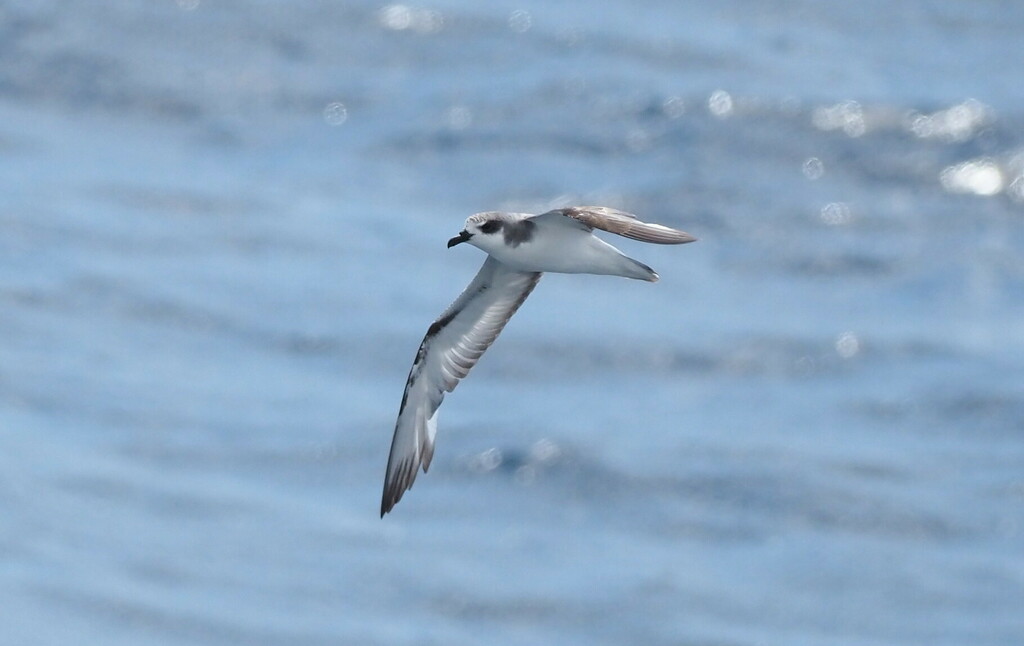
Masatierra Petrel
Photo © Rosario Douglas
Photo © Rosario Douglas — CC BY 4.0 — Source: iNaturalist photo #468987676Identification
The Masatierra petrel is a small seabird, growing to approximately 26 centimetres in length. It is readily identified by its distinctive plumage pattern: a dark grey cap and mask contrasting with a white forehead, dark grey upperparts marked with a characteristic "M" pattern, and a paler grey partial collar. The underparts are predominantly white, including the throat, belly, and under wing-coverts. When viewed from below in flight, the wings display striking black tips and black trailing edges, making this a recognisable species even at a distance across open water.
Range & Habitat
Endemic to Chile, the Masatierra petrel spends most of the year at sea in the eastern Pacific Ocean south of the equator, where it exploits the nutrient-rich waters of the Humboldt Current. The bird returns to breed on two Chilean island groups: the Juan Fernández Islands and the Desventuradas Islands. On the Desventuradas Islands, San Ambrosio supports the largest colony, while Santa Clara Island in the Juan Fernández group remains an important breeding site, though numbers are limited by scarce suitable nesting habitat. The species no longer breeds on Robinson Crusoe Island.
Behaviour & Diet
The Masatierra petrel is a true ocean bird, feeding by skimming across the water surface and scooping up prey on the wing while ranging across the productive upwelling zones of the Humboldt Current. It returns to land only to breed, nesting on cliff ledges in its island strongholds. The species faces significant conservation challenges from introduced predators: feral cats and coatis prey on eggs and chicks, while rats also present a threat to breeding success. These predators are believed responsible for the species' local extinction on Robinson Crusoe Island.
Best Time & Places to See It
The Masatierra petrel is most reliably encountered at sea in the eastern Pacific south of the equator, particularly in areas influenced by the Humboldt Current's upwelling. For those seeking to observe breeding birds, the Desventuradas Islands—particularly San Ambrosio—offer the best prospects, supporting substantial populations. Santa Clara Island in the Juan Fernández group is another option, though with smaller numbers. Access to these remote Chilean islands requires planning and may present logistical challenges, making pelagic trips into the bird's oceanic range an alternative viewing opportunity.
Photography Tips
Photographing this species presents considerable challenges due to its oceanic lifestyle and remote island breeding sites. At sea, patience and stable positioning on a vessel are essential for capturing the bird's distinctive "M" marking and contrasting plumage. The white forehead and dark cap provide good contrast for exposure metering. When the bird is viewed from below during low-level flight, try to capture the characteristic black wing tips and trailing edges. Island breeding colonies offer opportunities for more controlled photography, though access restrictions and the birds' cliff-nesting behaviour require careful planning and appropriate safety measures.
Chile: Fuegian Snipe & Juan Fernandez
Pan de Azúcar National Park
Chañaral, Chile
+74 birds+4 mammals
Where the Atacama Desert plunges toward the Pacific, Pan de Azúcar National Park sprawls across 727 square kilometres of one of Earth's most extreme transitions—a landscape…
VIEW NATIONAL PARKArchipiélago Juan Fernández National Park
San Juan Bautista, Chile
+31 birds+2 mammals
Granite peaks rise abruptly from the South Pacific off the Chilean coast, their weathered slopes studded with native woodland and sweeping down to coves where seabirds…
VIEW NATIONAL PARKNo community photos yet. Log in to add the first one.
No community observations of this species yet.