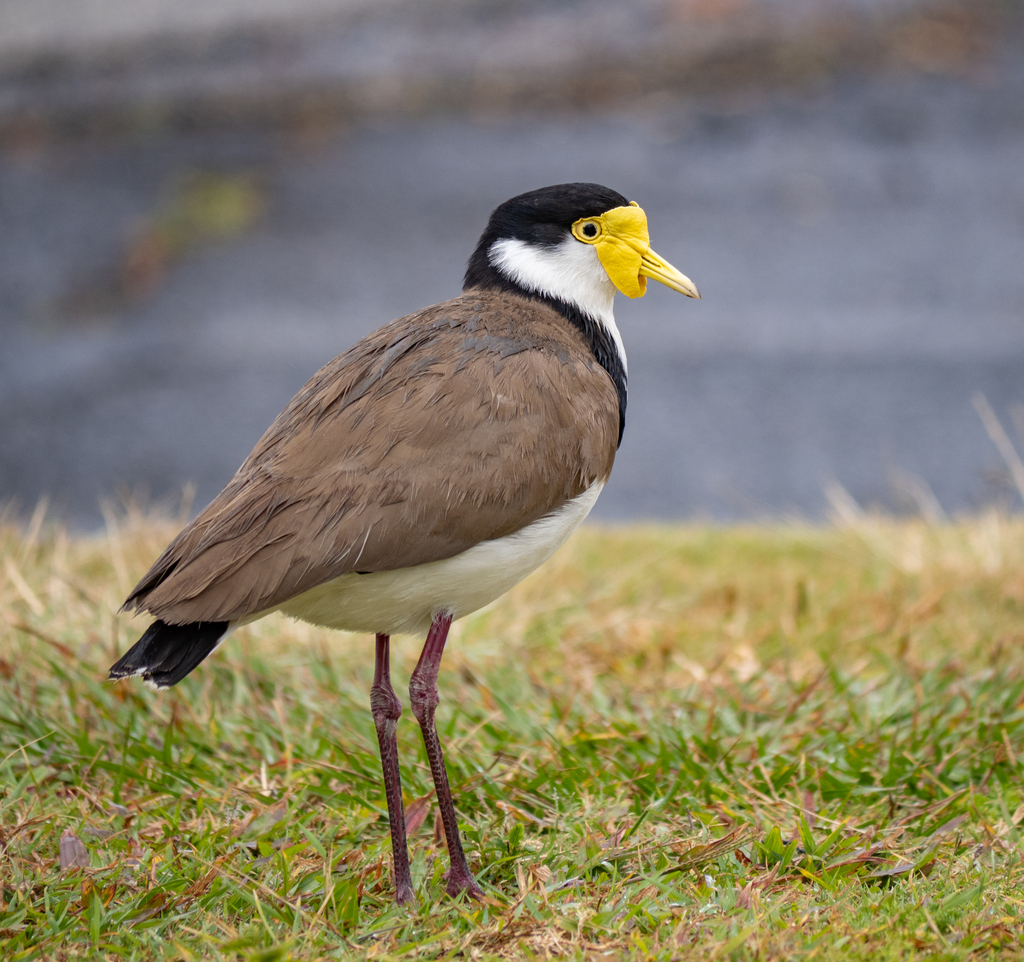
Masked Lapwing
Photo © Philipp Hoenle
Photo © Philipp Hoenle — CC0 1.0 — Source: iNaturalist photo #332871757Identification
The Northern Masked Lapwing is the largest member of the plover family, measuring 30–37 cm in length with a wingspan of 75–85 cm. Its most striking features are the conspicuous yellow spurs on the carpal joints of each wing and distinctive facial markings. The nominate northern subspecies (V. m. miles) displays an all-white neck and large yellow facial wattles, with males bearing a more prominent mask. The southern subspecies (V. m. novaehollandiae), sometimes called the Black-shouldered Lapwing, features a black neck-stripe and smaller wattles. Both forms are unmistakable in flight and on the ground.
Range & Habitat
This species is native to Australia—particularly the northern and eastern regions—as well as New Guinea and New Zealand, where the southern subspecies naturally colonised in the 1930s. Masked Lapwings favour wetland edges and moist, open environments but show remarkable adaptability, appearing even in surprisingly arid areas, on beaches, and coastlines. They readily inhabit suburban parks, gardens, school ovals, and other open ground, making them conspicuous and common throughout much of their range.
Behaviour & Diet
These ground-dwelling birds spend most of their time foraging for insects and worms. They possess a remarkable range of calls—warning calls, defensive calls, courtship calls, and calls to young—which can be heard at any time of day or night. Masked Lapwings are notably shy in summer and autumn, but during breeding season they become famously aggressive and territorial. Nesting occurs on almost any open ground, and breeding pairs vigorously defend their territory by calling loudly, spreading wings, and executing swift, low swoops. They strike intruders with their feet and may attack with their wing spurs; they also employ distraction displays such as hopping on one leg to lead predators away from nests and chicks. Once chicks reach about 60% of full size after two or three months, defensive attacks diminish.
Best Time & Places to See It
Masked Lapwings are common and conspicuous year-round throughout their range. Breeding season, typically after the winter solstice, offers the best opportunity to observe their dramatic defensive behaviour. Look for them in open fields, around wetlands, coastal areas, suburban parks, and gardens. Their bold nesting habits mean they often occupy accessible locations, making them relatively easy to locate and observe. However, exercise caution in breeding areas, as the birds' aggressive territorial defence makes close approach hazardous.
Photography Tips
The Masked Lapwing's striking plumage, bold facial markings, and conspicuous yellow wattles and spurs make it a rewarding photographic subject. Capture images from a respectful distance during non-breeding season to avoid triggering defensive displays. The bird's ground-nesting habits and time spent on open terrain offer excellent opportunities for natural behaviour photography. Early morning or late afternoon light will enhance the detail of facial markings and the brightness of the yellow facial features. During breeding season, document the dramatic swooping displays and wing-spreading behaviour from a safe distance.
Abel Tasman National Park
Alpine National Park
Aoraki / Mount Cook National Park
Arthur’s Pass National Park
Bald Rock National Park
Barrington Tops National Park
Belair National Park
Ben Boyd National Park
Blue Mountains National Park
Nothing matches these filters.
No community photos yet. Log in to add the first one.
No community observations of this species yet.