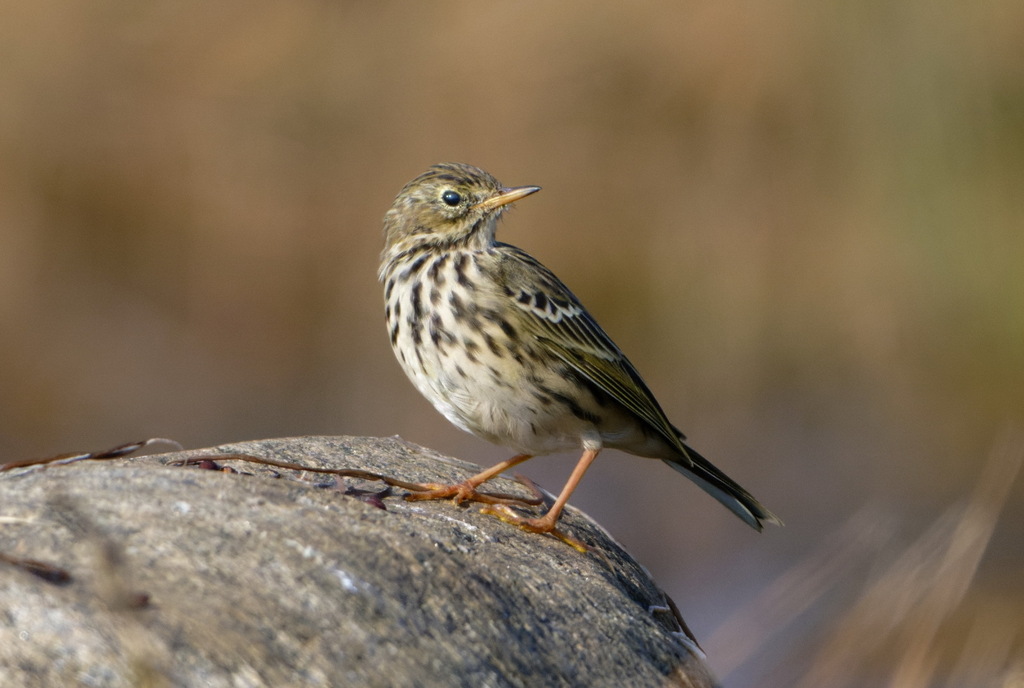
Meadow Pipit
Photo © Лариса Артемьева
Photo © Лариса Артемьева — CC0 1.0 — Source: iNaturalist photo #431606033Identification
The meadow pipit is a small passerine measuring 14.5–15 cm in length and weighing 15–22 g. It is predominantly brown above and buff below, with darker barring across most of its plumage. The tail is brown with narrow white lateral edges, and the bird has a thin bill and pale pinkish-yellow legs. A distinctive feature is its conspicuously long rear claw, which is longer than the rest of the rear toes. Birds breeding in Ireland and western Scotland are slightly darker than those elsewhere. The call is a faint tsi-tsi, and the simple, repetitive song is delivered during short song flights that accelerate towards the end.
The meadow pipit can be confused with the red-throated pipit, which is more heavily barred and has an orange-red throat in summer, and the tree pipit, which is slightly larger, less heavily streaked, has stronger facial markings, and a shorter rear claw. The meadow pipit's accelerating song contrasts with the tree pipit's decelerating song, providing a useful identification aid.
Range & Habitat
The meadow pipit breeds throughout much of the Palearctic, from south-eastern Greenland and Iceland east to just east of the Ural Mountains in Russia, and south to central France and Romania, with an isolated population in the Caucasus Mountains. It is migratory over most of its range, wintering in southern Europe, North Africa, and south-western Asia, though it is resident year-round in western Europe, with many birds moving to coasts or lowlands during winter.
This species is primarily found in open habitats such as grassland, moorland, and heathland, whether uncultivated or under low-intensity agriculture. It occasionally occurs on arable land and uses saltmarshes and open woodland in winter. The total population is estimated at 12 million pairs. It is an abundant species in the north of its range and is generally the most common breeding bird of the British uplands, though less common further south. Recent decades have seen a general population decline, notably in French farmland.
Behaviour & Diet
The meadow pipit is a fairly terrestrial species that always feeds on the ground but uses elevated perches such as shrubs, fence lines, or electric wires as vantage points to watch for predators. Its diet consists mainly of insects and other invertebrates, mostly small items less than 5 mm long. It also consumes seeds from grasses, sedges, rushes, and heather, and crowberry berries, particularly in winter.
Breeding birds construct ground nests concealed in dense vegetation, typically containing two to seven eggs, most commonly three to five. Eggs hatch after 11–15 days, with chicks fledging 10–14 days later. Two broods are usually raised annually. The meadow pipit is one of the cuckoo's most important nest hosts and serves as important prey for merlins and hen harriers.
Best Time & Places to See It
Meadow pipits are best observed during the breeding season in open upland habitats such as moorlands, grasslands, and heathlands across northern Europe. The British uplands are particularly reliable, where the species is the most common breeding bird. In winter, birds move to coastal areas, lowlands, and saltmarshes. Migration timing varies across the range, with birds present year-round in western Europe but moving seasonally elsewhere.
Photography Tips
The meadow pipit's small size and cryptic brown plumage make it challenging to photograph on the ground. Look for birds perching on exposed vantage points such as fence posts, wires, or low shrubs, where they are more visible and easier to approach. During breeding season, watching for the characteristic short song flight provides excellent photographic opportunities. Early morning light is ideal for capturing the subtle plumage details and the bird's pale legs. Be patient and move slowly to avoid flushing birds, and use telephoto lenses to maintain distance while achieving good frame-filling images.
Abruzzo, Lazio and Molise National Park
Aggtelek National Park
Alpilles Regional Nature Park
Alta Murgia National Park
Appennino Lucano Val d’Agri Lagonegrese National Park
Appennino Tosco-Emiliano National Park
Asinara National Park
Åsnens National Park
Aspromonte National Park
Nothing matches these filters.
No community photos yet. Log in to add the first one.
No community observations of this species yet.