Identification
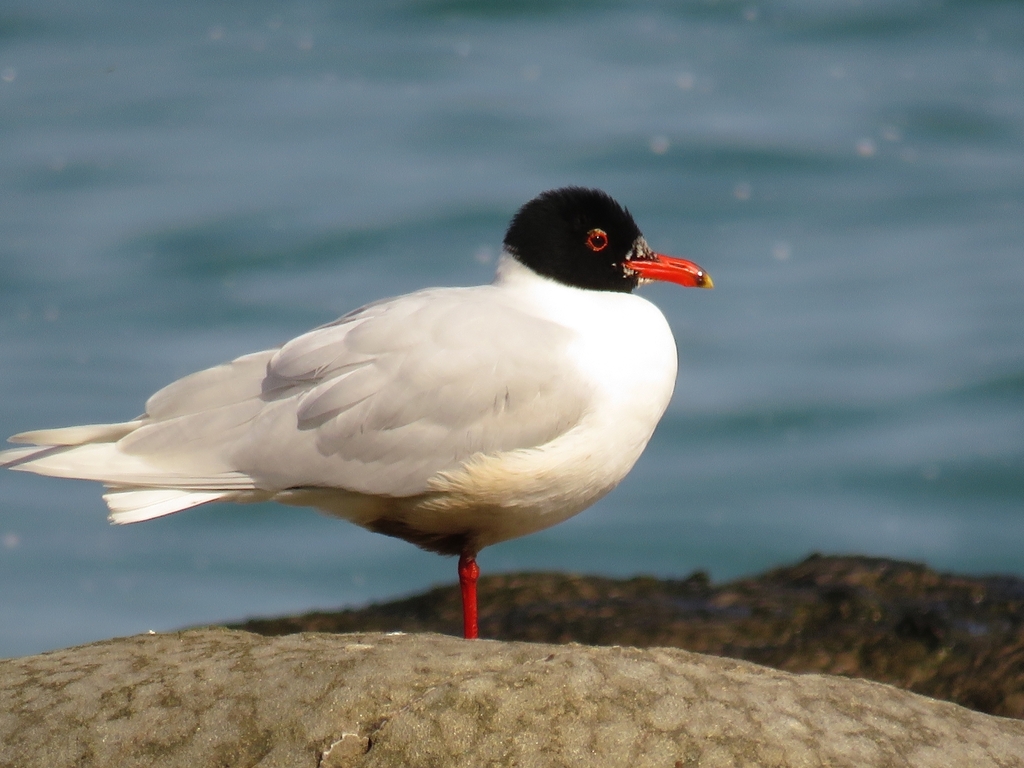
The Mediterranean gull is a small, elegant gull slightly larger and bulkier than the black-headed gull, with a noticeably heavier bill and longer, darker legs. In breeding plumage, adults are unmistakably white with a very pale grey mantle and wings, distinguished by white primary feathers that lack the black tips seen in many other gull species. The most striking feature is the black hood extending down the nape, framed by distinctive white eye crescents that give the bird a striking masked appearance. The sharp-tipped bill is dark red with a black subterminal band.
Non-breeding adults retain a similar overall pattern but lose the full hood, instead showing an extensive dusky "bandit" mask through the eye. Young birds take two years to reach full maturity. First-year birds display a black terminal tail band and more extensive black areas in the upperwings, though their underwings remain pale, helping to distinguish them from older birds.
Range & Habitat
Historically restricted to the Black Sea and eastern Mediterranean, the Mediterranean gull has undergone a dramatic range expansion in recent decades and now breeds across most of Europe, extending as far as Great Britain and Ireland. Breeding colonies have been established in Belgium, the Netherlands, Denmark, Sweden, Estonia, Switzerland, the Czech Republic, Hungary and the Balkans, with the species even reaching Scotland for the first time in 2023.
These gulls breed in colonies in large reed beds, marshes, or on islands in lakes, and may nest alongside black-headed gull colonies where populations are small. They are not pelagic and are rarely seen far from coasts at sea. In winter, the species migrates to Mediterranean and Atlantic coasts, where birds gather in large gregarious flocks both for feeding and at evening roosts.
Behaviour & Diet
Mediterranean gulls are highly gregarious birds, particularly during winter when they congregate in substantial numbers for both feeding and roosting. The species is notably vocal, especially at breeding colonies, with a distinctive nasal "yeah" call that reflects its noisy, social nature.
Like most gulls, Mediterranean gulls are opportunistic omnivores with varied diets. They feed on fish, worms, insects, eggs, young birds, offal and carrion, adapting their foraging to available food sources in their environment.
Best Time & Places to See It
The best time to observe Mediterranean gulls is during the breeding season when birds gather at established colonies, particularly in large reed beds and marshes of southern and central Europe. Winter months bring concentrations of these birds to Mediterranean and Atlantic coasts, making them easier to locate. In Britain and Ireland, the species is increasingly regular, with established breeding populations offering reliable viewing opportunities during spring and summer months.
Photography Tips
The Mediterranean gull's striking plumage and distinctive markings make it an attractive photographic subject. The white eye crescents against the black hood are particularly distinctive features worth capturing in breeding birds. Photographing birds in non-breeding plumage requires attention to the dusky eye-mask, which is the key identifying feature when the full hood is absent. Winter gatherings on coasts provide opportunities for flock photography, while breeding colonies in reed beds and marshes require patience and careful positioning to avoid disturbance. The sharp-tipped red bill with its black band provides excellent detail for close-up shots.