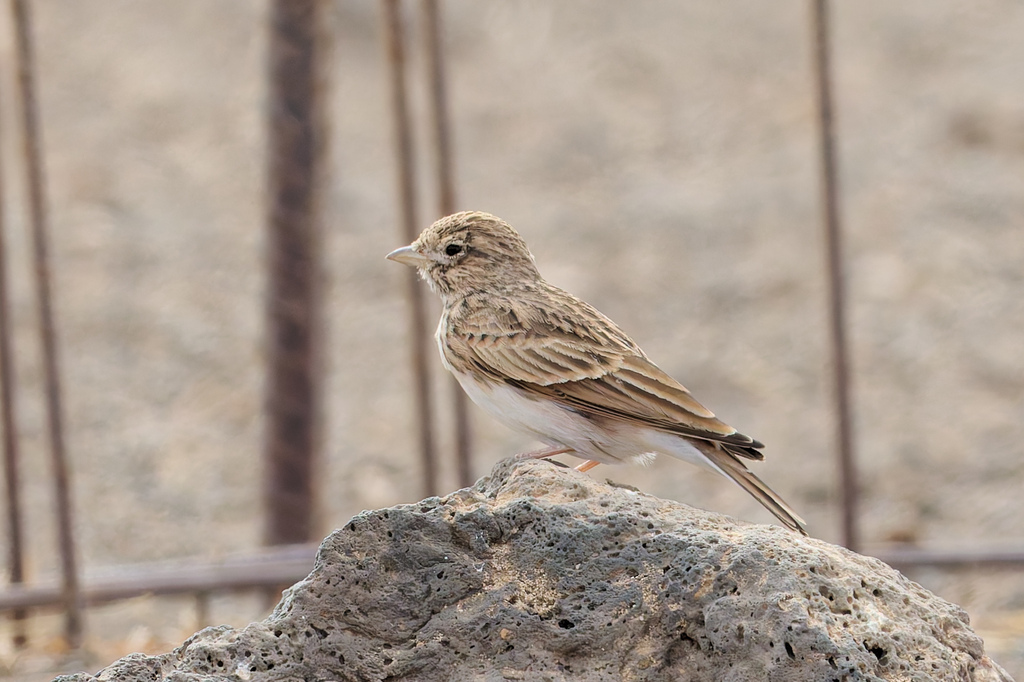
Mediterranean Short-toed Lark
Photo © Donald Davesne
Photo © Donald Davesne — CC BY 4.0 — Source: iNaturalist photo #464176982Identification
The Mediterranean Short-toed Lark is a small passerine measuring 13–14 cm in length, with the sexes similar in appearance. It is generally a duller-looking bird than its relative the Greater Short-toed Lark, characterized by dark-streaked greyish-brown upperparts, white underparts, a pale supercilium, and a notably short, stubby bill. The most distinctive feature is fine streaking across the breast, which helps separate it from the Greater Short-toed Lark, which lacks this fine streaking and displays dark neck patches instead.
Care should be taken when distinguishing this species from Calandrella larks. The Mediterranean Short-toed Lark has a shorter, less-conical bill and a more rounded, smaller head compared to those larks. In the field, listen for its richer, more varied and imitative song, which differs noticeably from that of the Greater Short-toed Lark. Colour varies across its broad range and is not a reliable distinguishing feature.
Range & Habitat
The Mediterranean Short-toed Lark is a common bird with a very wide range spanning from the Canary Islands north to the Iberian Peninsula and east throughout North Africa to parts of the Middle East. It breeds in Spain and North Africa, including Turkey and eastwards across semi-deserts. Five recognized subspecies occur across this distribution, from the western Canaries to the Nile Delta and into the eastern Mediterranean regions.
This species is a bird of dry open country, preferring even drier and barer soils than the Greater Short-toed Lark. Many populations, including Spanish and African breeders, are sedentary year-round, though some Asian birds from the northern breeding range migrate south in winter. It is a very rare wanderer to northern and western Europe, making sightings outside its core range noteworthy for birders.
Behaviour & Diet
The Mediterranean Short-toed Lark nests on the ground, laying two or three eggs per clutch. Its diet consists of seeds and insects, with insects becoming especially important during the breeding season when energy demands and chick-feeding requirements are highest. This ground-nesting strategy and dietary flexibility make it well-adapted to the arid and semi-arid habitats it frequents.
Best Time & Places to See It
The Mediterranean Short-toed Lark is best observed in its core Mediterranean Basin range, particularly in Spain, North Africa, and Turkey, where populations are resident year-round. In the Canary Islands, both western and eastern populations are permanent residents. Breeders in northern parts of the range may be observed during the breeding season, with some moving south in winter.
Look for this species in open, dry, barren landscapes and semi-desert habitats where it blends in with sparse vegetation. Patience and familiarity with its call and song will greatly aid in locating this small and cryptic bird. The bird's conservation status is rated as "least concern," indicating stable populations across its range.
Photography Tips
Photographing the Mediterranean Short-toed Lark requires patience, as its small size (13–14 cm) and preference for open, arid terrain mean subjects can be distant and difficult to approach. The bird's duller plumage and heavily streaked breast are key identification features to capture; ensure your images clearly show the fine breast streaking and pale supercilium. Ground-level perspectives will help capture this terrestrial species in its natural habitat.
Early morning light is ideal for photographing in open desert environments, as it reduces harsh shadows and enhances the subtle details of the bird's greyish-brown plumage. Since this species often remains stationary on bare ground, scanning open, sparsely vegetated areas will improve your chances of locating individuals before attempting photography. Capturing behavioral shots of ground-nesting or feeding activity will add narrative value to your portfolio.
Doñana National Park
Hinojos, Spain
+300 birds+13 mammals
Where the Guadalquivir River delta spreads into the Atlantic, vast marshes, cork woodlands, and coastal dunes converge to create one of southwestern Europe's most biodiverse wetland…
VIEW NATIONAL PARKTablas de Daimiel National Park
Daimiel, Spain
+246 birds+6 mammals
Where the Guadiana River spreads into a labyrinth of shallow lagoons and reed beds across the sun-baked plains of central Spain, Tablas de Daimiel National Park…
VIEW NATIONAL PARKTeide National Park
La Orotava, Spain
+83 birds+7 mammals
At nearly 3,900 metres, Spain's highest peak rises from the Canary Islands as a singular volcanic monument, its slopes sweeping through five distinct climate zones in…
VIEW NATIONAL PARKCabo de Gata-Níjar Natural Park
San José, Spain
+274 birds+11 mammals
Where volcanic ridges plunge toward the Mediterranean, Cabo de Gata-Níjar Nature Park unfolds across one of Europe's most arid coastlines, a landscape sculpted by tectonic violence…
VIEW NATURAL PARKDirigida Laguna de Gallocanta Nature Reserve
Las Cuerlas, Spain
+250 birds+7 mammals
Where continental steppe meets the vast mirror of inland water, Spain's largest natural lagoon reveals a landscape of haunting beauty. The shallow alkaline lake, cradled in…
VIEW NATURE RESERVEMontañas de Prades
Capafonts, Spain
+151 birds+13 mammals
Where granite peaks rise abruptly from the Tarragona hinterland, a wild mosaic of pine forests, scrubland, and limestone cliffs creates one of northeastern Spain's most biodiverse…
VIEW MOUNTAIN & ALPINENo community photos yet. Log in to add the first one.
No community observations of this species yet.