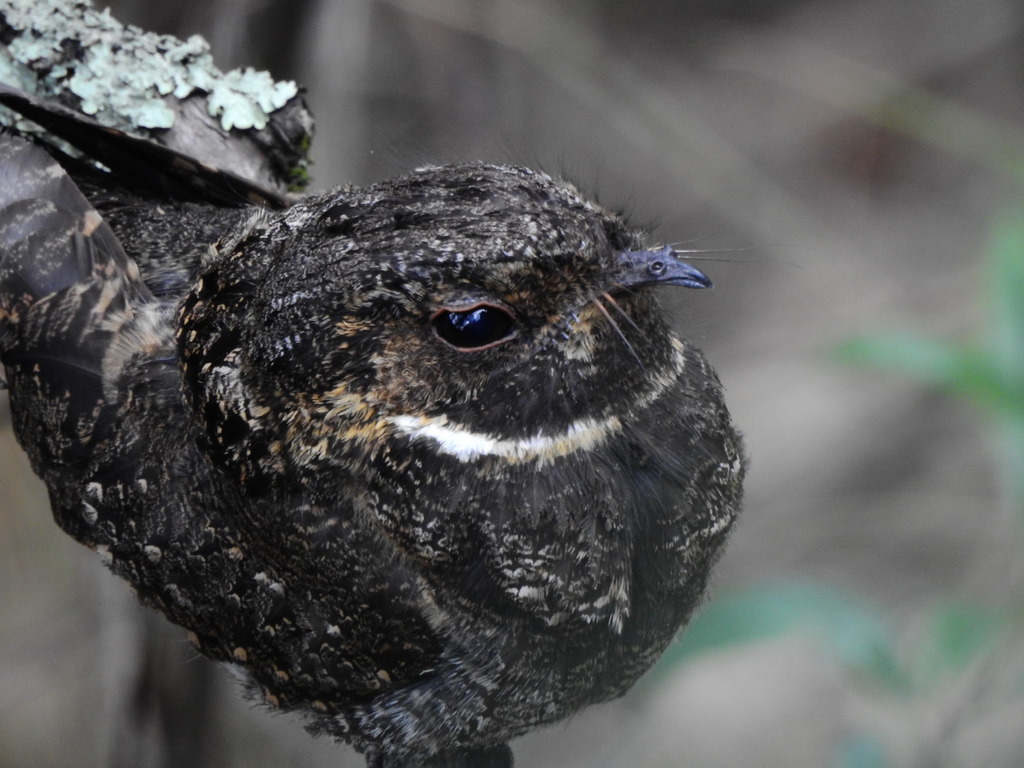
Mexican Whip-poor-will
Photo © Diana Fuentes
Photo © Diana Fuentes — CC BY-SA 4.0 — Source: iNaturalist photo #40195232Identification
The Mexican whip-poor-will is a medium-sized nightjar, measuring 23 to 24 cm in length and weighing 45 to 50 grams. Its upperparts are grayish brown with blackish-brown streaks, while the crown displays wide blackish-brown stripes. A distinctive thin white band separates the blackish throat from the blackish breast, and the belly is buff with brown barring. Males show broad white tips on their outermost three pairs of tail feathers, while females display narrower, buffy tips. The wings are brown with tawny and buff spots and speckles throughout. Among the five subspecies, plumage varies geographically: northern populations tend to be lighter, while southern birds are darker, with some subspecies showing redder tones and variations in spot and speckle size and shape.
Range & Habitat
The Mexican whip-poor-will occurs across the southwestern United States, Mexico, and northern Central America, with five subspecies distributed from southeastern California and southwestern Texas south through Mexico to Honduras and El Salvador. The northern subspecies (A. a. arizonae) breeds from the southwestern United States to the Mexican states of Jalisco and Guanajuato, withdrawing southward in winter. Other subspecies are year-round residents in their respective ranges across eastern and southern Mexico and Central America. These birds inhabit mid- to mid-upper elevation, semi-arid to moist landscapes characterized by oaks and pines, with southern resident subspecies occurring in forests and woodlands.
Behaviour & Diet
The Mexican whip-poor-will is crepuscular and nocturnal, remaining motionless and well-camouflaged during daylight hours. It forages primarily by sallying from tree perches, occasionally from the ground, capturing insects in flight. Moths and beetles constitute the dominant prey items. During breeding, females lay a clutch of two eggs directly on leaf litter without constructing a conventional nest. In Arizona, eggs are laid in May and early June. Notably, both males and females possess a brood patch, suggesting both sexes share incubation duties.
Best Time & Places to See It
The Mexican whip-poor-will is far more often heard than seen. Best encountered during crepuscular hours—at dawn and dusk—when the bird is most vocal and active. In the United States, the breeding subspecies can be found in suitable oak-pine habitats of southeastern California, Arizona, New Mexico, and southwestern Texas during spring and early summer, though northern populations depart in winter. In Mexico and Central America, resident subspecies occur year-round in appropriate forest and woodland habitats. Listening for its distinctive vocalization significantly improves detection chances.
Photography Tips
Photographing this nocturnal species presents considerable challenges. The Mexican whip-poor-will's cryptic plumage and daytime immobility make it extremely difficult to locate and photograph visually. Audio recording of its distinctive call may prove more rewarding than attempting photography. If attempting visual documentation during active periods at dusk or dawn, use high-ISO settings and fast lenses to compensate for low light. Patience is essential—spotlighting techniques used for other nightjars may potentially disturb the bird. Understanding the bird's behavior and habitat preferences will aid in positioning yourself in suitable locations during peak activity hours.
Big Bend National Park
Cave Creek Canyon
Chiricahua Mountains
Grand Canyon National Park
Guadalupe Mountains National Park
Lagunas de Montebello National Park
Madera Canyon
Parque Nacional Cerro de la Estrella
Saguaro National Park
Nothing matches these filters.
No community photos yet. Log in to add the first one.
No community observations of this species yet.