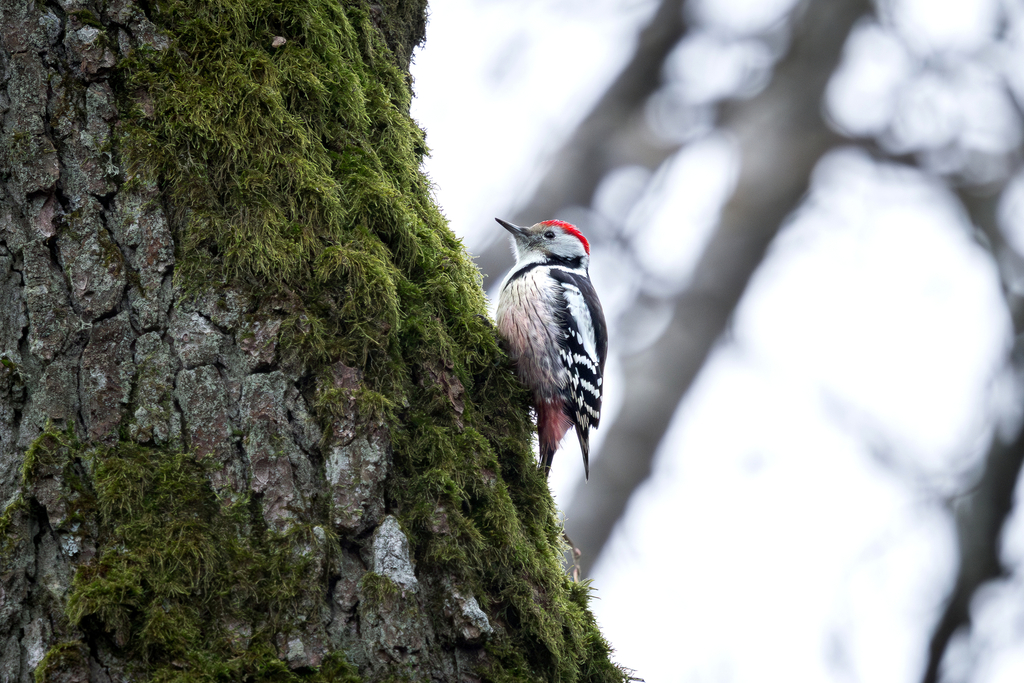
Middle Spotted Woodpecker
Photo © Chris Kirby-Lambert
Photo © Chris Kirby-Lambert — CC BY 4.0 — Source: iNaturalist photo #608032799Identification
The middle spotted woodpecker is a compact European woodpecker measuring 20–22 cm in length. At first glance, it resembles the great spotted woodpecker, sharing similar black and white plumage with distinctive white oval wing patches and barring on the wings, contrasting white underparts, and dark streaks on the flanks. However, several field marks set it apart: the middle spotted woodpecker sports a striking red crown, lacks the bold black moustachial stripe characteristic of its larger cousin, and displays a pink vent. Its shorter, more slender bill and rounder, paler head make it appear noticeably smaller than the great spotted woodpecker despite only marginal size differences. Juveniles can be confused with the Syrian woodpecker, but the middle spotted woodpecker's smaller bill, red crown without narrow black sides, and moustachial stripe that doesn't reach the bill provide reliable distinction.
Range & Habitat
This sedentary species is restricted to Europe and parts of West Asia, ranging from northern Spain and France eastward to Poland and Ukraine, and south through central Italy, the Balkans, Turkey, the Caucasus, and into Iran. It is particularly common in Estonia, though virtually absent from Finland. Historically breeding in Sweden, it disappeared during the 1980s but has been recorded again in recent years, indicating possible recolonisation. Due to its non-migratory nature, it has never established itself in the British Isles.
The middle spotted woodpecker shows a strong preference for deciduous forest regions, particularly those featuring old oak, hornbeam, and elm trees interspersed with clearings, pasture, and dense woodland patches. This habitat mosaic provides ideal conditions for foraging and nesting.
Behaviour & Diet
This species is primarily insectivorous, gleaning insects and their larvae from branches and twigs rather than excavating beneath bark. It will supplement its diet with tree sap. The middle spotted woodpecker characteristically feeds high in the canopy, moving constantly and deliberately, which often makes observation challenging for birdwatchers.
During breeding season, it excavates nest holes approximately 5 cm wide in decaying tree trunks or thick branches, where it lays four to seven eggs with an incubation period of 11–14 days. Rather than drumming for territorial purposes, the species asserts its territory through song: a distinctive slow, nasal sequence of "gvayk gvayk gvayk gvayk gvayk." Additional calls include a rapid "kik kekekekek."
Best Time & Places to See It
The breeding season offers the best opportunity to locate this species, as territorial males become more vocal and active. Estonia represents a particularly promising destination where middle spotted woodpeckers are common. Recent sightings in Sweden suggest that country may offer emerging opportunities for observing this species during its breeding habitat season. Throughout its European range, old-growth deciduous forests with oak and hornbeam should be your primary focus.
Photography Tips
Patience is essential when photographing this species, as it feeds high in trees and moves constantly, presenting fleeting viewing opportunities. Focus your efforts on capturing the distinctive red crown and the absence of the black moustachial stripe that distinguish it from the great spotted woodpecker. Overcast conditions often provide better light for highlighting the bird's plumage details among the canopy. Listen for its nasal territorial song during breeding season to help locate individuals, then position yourself carefully to anticipate feeding movements through the higher branches.
Aggtelek National Park
Appennino Lucano Val d’Agri Lagonegrese National Park
Avesnois Regional Nature Park
Białowieża National Park
Biebrza National Park
Boucles de la Seine Normande Regional Nature Park
Bükk National Park
Caps et Marais d’Opale Regional Nature Park
Causses du Quercy Regional Nature Park
Nothing matches these filters.
No community photos yet. Log in to add the first one.
No community observations of this species yet.