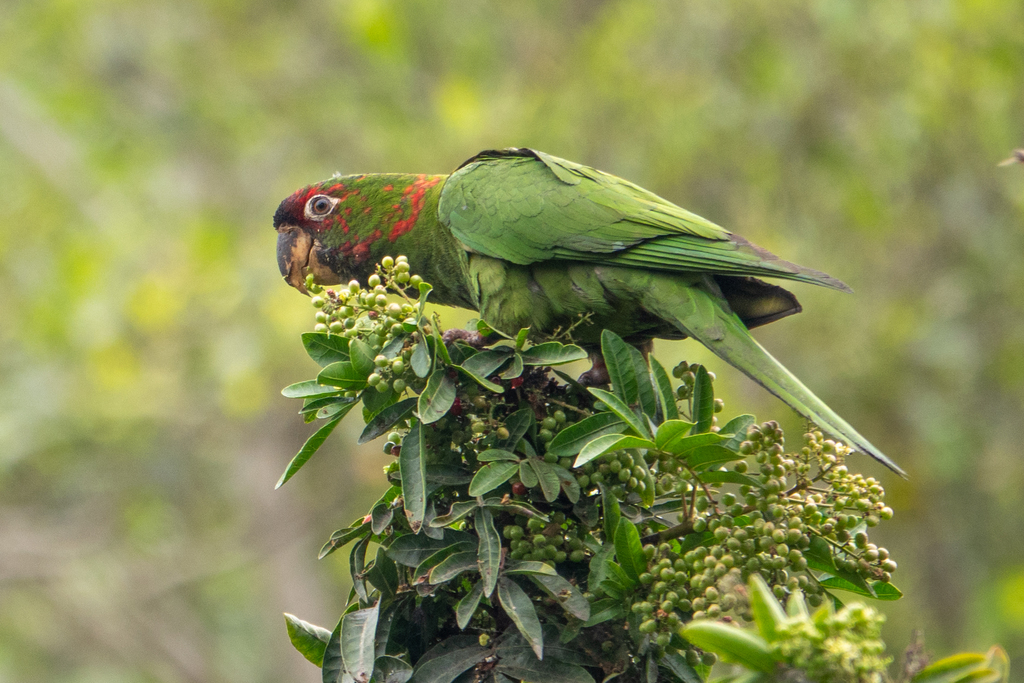
Mitred Parakeet
Photo © Rob Felix
Photo © Rob Felix — CC BY 4.0 — Source: iNaturalist photo #615062835Identification
The mitred parakeet is a medium-sized parrot measuring 31 to 38 cm long and weighing 219 to 275 grams. Its most distinctive feature is a bright red forecrown and red markings around the eye, which typically extend past the eye and down the cheeks—creating the "mitred" appearance that gives the species its name. The rest of the plumage is predominantly green with a purplish forehead. The amount and pattern of red facial coloring varies among subspecies and individuals; some birds show only flecks of red on the ear coverts, while others display more extensive red markings. A conspicuous feature is the bare white skin encircling the eye, paired with a horn-colored bill. Both sexes are alike in appearance. Juveniles are noticeably duller, with little or no red coloring on the face, making age determination important when identifying individuals in the field.
Range & Habitat
The mitred parakeet is native to South America, where it inhabits the Andes and adjacent regions of Peru, Bolivia, and Argentina, with the nominate subspecies ranging from Ayacucho and Cuzco in Peru south through Bolivia into northwestern Argentina as far as Córdoba Province. In its native range, the species occupies diverse forested landscapes including evergreen and deciduous montane forest, cloudforest, secondary forest, and semi-humid to humid scrub. Elevations typically range from 1,000 to 3,400 meters, with occasional sightings recorded as high as 4,000 meters in Peru. The species has been introduced to Uruguay and is now established there. Introduced populations also occur in California, Florida, and Hawaii, apparently derived from escaped or released cage birds, where they primarily inhabit suburban and urban areas, though Hawaiian populations also occur in less populated regions.
Behaviour & Diet
Mitred parakeets are highly social and vocal birds, particularly when in flight, producing "continuous loud screeching chatter" alongside nasal squeaky notes. They form flocks that vary in size, with groups of around 100 individuals being typical, though flocks of up to 2,000 have been reported. The species exhibits movements in response to food availability and also roams outside the breeding season. In their native range, their diet includes berries, other fruits, seeds, nuts, and maize. Introduced populations show dietary flexibility: in California they feed on fruits and flowers, while in south Florida birds have been documented feeding on 34 different plant species, both native and introduced.
Best Time & Places to See It
In South America, the mitred parakeet is considered generally common and locally abundant throughout its native range in the Andes of Peru, Bolivia, and Argentina, occurring in several protected areas. For travelers seeking introduced populations, California and Florida host established communities, particularly in suburban and urban settings. Hawaii also supports a population, with birds occasionally visible in both populated and unpopulated areas. The species' loud, distinctive vocalizations make it relatively easy to locate by ear, even when visual spotting proves difficult among dense foliage.
Photography Tips
The mitred parakeet's bright red facial markings and predominantly green plumage provide excellent photographic contrast, especially in good light. Early morning activity, when flocks are most vocal and active, offers prime opportunities for capturing behavior shots. The bare white eye-ring is a useful identifying feature to emphasize in close-up portraits. When photographing introduced populations in urban or suburban settings, look for birds in fruiting trees or flowering plants, which concentrate feeding activity. The species' tendency to call frequently means photographers can often locate and track flocks by sound before positioning for shots. Avoid harsh midday sunlight, which can wash out the subtle purple tones on the forehead; softer morning or late afternoon light better reveals the plumage's full color range.
Everglades National Park
Monroe County, United States
+345 birds+22 mammals
Where freshwater marsh meets subtropical sky, the Everglades sprawls across southwestern Florida as one of North America's most expansive wetland ecosystems. Spanning over 13,000 square kilometers,…
VIEW NATIONAL PARKParc del Garraf
Rat-Penat, Spain
+190 birds+15 mammals
Where limestone ridges rise abruptly from the Mediterranean coastal plain, Parc Natural del Garraf unfolds across 319 square kilometers of one of Catalonia's most dramatic protected…
VIEW NATURAL PARKCollserola Natural Park
Barcelona, Spain
+194 birds+20 mammals
Where Mediterranean scrubland rises steeply from Barcelona's urban edge, Collserola unfolds across 173 square kilometres of low mountains that form a crucial ecological buffer between city…
VIEW NATURAL PARKYanachaga–chemillén National Park
Palcazu, Peru
+639 birds+6 mammals
Where the eastern slopes of Peru's central cordillera plunge into cloud forest, Yanachaga–Chemillén National Park protects nearly three thousand square kilometres of montane wilderness that few…
VIEW NATIONAL PARKManu National Park
Manu, Peru
+892 birds+26 mammals
Across the eastern slopes of the Peruvian Andes, tropical rainforest descends into the Amazon basin with a complexity that few terrestrial ecosystems match. Manu National Park…
VIEW NATIONAL PARKTingo Maria National Park
Mariano Dámaso Beraún, Peru
+423 birds
Where the eastern slopes of the Peruvian Andes descend toward the Amazon basin, the landscape fractures into a maze of limestone ridges, humid gorges, and cloud-wrapped…
VIEW NATIONAL PARKEspacio Natural Remolar-Filipinas
El Prat del Llobregat, Spain
+297 birds+7 mammals
Where the Llobregat River delta meets the Mediterranean, a patchwork of salt marshes, reed beds, and shallow lagoons creates one of Catalonia's most dynamic wetland ecosystems.…
VIEW NATURE RESERVELos Cardones National Park
Argentina
+193 birds+6 mammals
Where the Andes descend into northwestern Argentina, Los Cardones National Park sprawls across nearly 1,200 square kilometres of one of South America's most distinctive high-altitude desert…
VIEW NATIONAL PARKEl Rey National Park
Municipio de Las Lajitas, Argentina
+317 birds+4 mammals
Where the eastern slopes of the Andes descend into northwestern Argentina's subtropical transition zone, El Rey National Park unfolds across 841 square kilometers of dramatically varied…
VIEW NATIONAL PARKCalilegua National Park
Municipio de Calilegua, Argentina
+288 birds+8 mammals
Where the eastern Andean slopes plunge into northwestern Argentina's humid subtropics, nearly 2,645 square kilometers of steep terrain and luxuriant forest compose one of South America's…
VIEW NATIONAL PARKBaritú National Park
Argentina
+81 birds+2 mammals
Where the eastern slopes of the Serranías del Hornocal descend into cloud forest and subtropical ravines, Baritú National Park protects one of northwestern Argentina's most biodiverse…
VIEW NATIONAL PARKBiscayne National Park
Miami-Dade County, United States
+263 birds+7 mammals
Coral reefs and mangrove shallows dominate this marine sanctuary where the Florida Keys meet the Atlantic, creating a mosaic of shallow seagrass meadows, patch reefs, and…
VIEW NATIONAL PARKNo community photos yet. Log in to add the first one.
No community observations of this species yet.