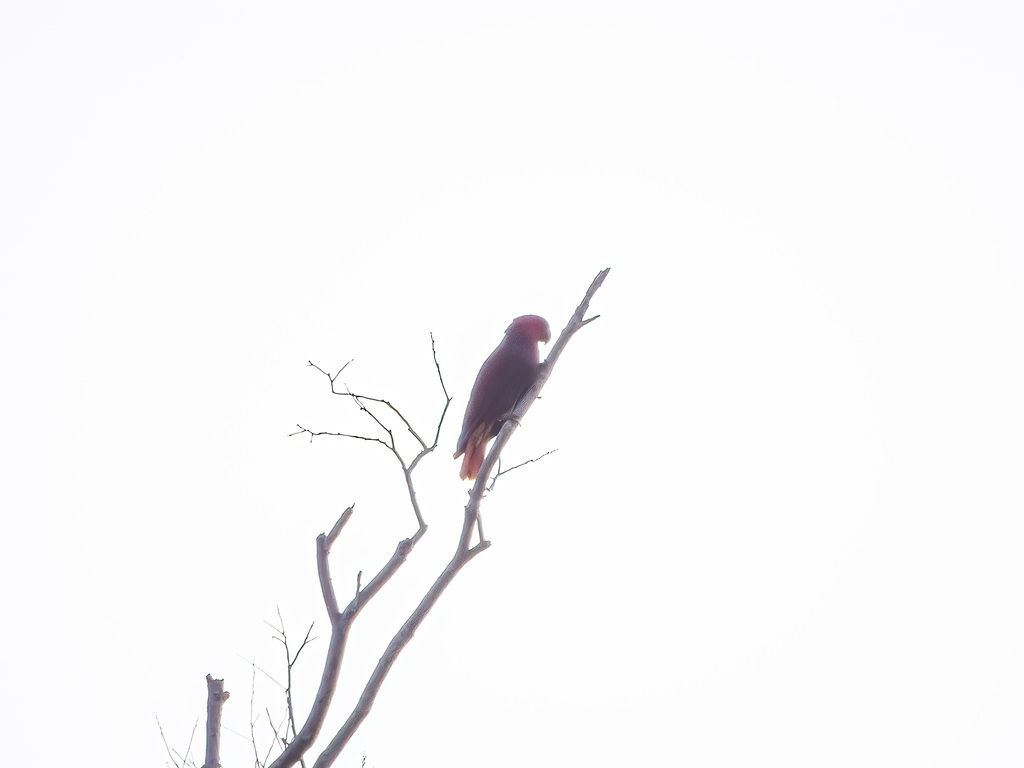
Moluccan Eclectus
Photo © Jason Alexander
Photo © Jason Alexander — CC BY 4.0 — Source: iNaturalist #292518713Identification
The Moluccan eclectus is one of the parrot family's most striking examples of sexual dimorphism. Males are predominantly bright emerald green with yellow tinging on the head, blue primaries, and red flanks and underwing coverts. The tail is edged with a narrow creamy yellow band and features green central feathers that become progressively bluer toward the edges. Females are dramatically different: mostly bright red with darker hues on the back and wings, purple or blue-tinted underwing coverts and mantle, and a mauve-blue wing edge. Both sexes measure around 35 cm in length with stocky, short-tailed builds. Males have orange-based upper mandibles fading to yellow, while females have entirely black beaks. Adults display yellow to orange irises, whereas juveniles have dark brown to black irises. The extreme difference in plumage led early European ornithologists to believe they were observing two entirely distinct species.
Range & Habitat
The Moluccan eclectus is native to the Maluku Islands (Moluccas) of Indonesia. Three subspecies are recognized, though the taxonomy requires further review due to limited field access in some regions. The nominate subspecies, E. r. roratus (grand eclectus), inhabits Buru, Seram, Ambon, Saparua, and Haruku in the southern Moluccas. E. r. vosmaeri (Vosmaer's eclectus) occurs on islands in the North Maluku province and is larger with more yellow in the plumage. E. r. westermani (Westerman's eclectus) has uncertain status and may be extinct. Some island populations remain comparatively rare, while large populations persist elsewhere and are sometimes considered agricultural pests.
Behaviour & Diet
In the wild, Moluccan eclectus parrots feed primarily on fruits, wild figs, unripe nuts, flower and leaf buds, and seeds. Their diet reflects their preference for fruit, making them occasional crop raiders. They possess an unusually long digestive tract, allowing them to tolerate high-fiber foods efficiently. These parrots typically do not develop clear vocalizations until approximately one year of age. The bright feathers of both sexes hold cultural significance to native tribespeople of New Guinea, who use them for traditional decorations.
Best Time & Places to See It
The Moluccan eclectus is best encountered in the Maluku Islands, particularly where large populations persist. The islands of Seram, Buru, and Ambon in the southern Moluccas offer opportunities to observe the nominate subspecies, while North Maluku islands provide habitat for Vosmaer's eclectus. Some island populations are more restricted and therefore rarer. Access to certain regions may be challenging due to geographical or political constraints, so advance research and local guidance are recommended for field visits.
Photography Tips
The extreme sexual dimorphism of this species presents exceptional photographic opportunities—males and females offer dramatically contrasting color palettes that make for striking comparative images. The green males are challenging to photograph in dappled forest light, so seek birds in open canopy areas where bright green plumage is fully illuminated. The red females provide excellent contrast and are often more visible. Early morning light often brings these fruit-eating parrots into fruiting trees where they feed openly. The stocky build and relatively short tail distinguish them from other large parrots, making them recognizable subjects even at distance.
Daintree National Park
Dedin, Australia
+362 birds+37 mammals
Daintree National Park is one of the world’s oldest and most biologically diverse tropical rainforests, protecting an extraordinary landscape where ancient forests meet the Great Barrier…
VIEW NATIONAL PARKAketajawe Lolobata National Park
Oba Tengah, Indonesia
+123 birds+2 mammals
Across the northeastern arm of Halmahera, where the Wallace Line once marked the boundary between Asian and Australasian fauna, lies a sprawling wilderness of over 13,800…
VIEW NATIONAL PARKManusela National Park
Maluku Tengah, Indonesia
+112 birds+3 mammals
Across the Maluku Tengah district of Indonesia's eastern archipelago, a sprawling expanse of 4,175 square kilometers of largely intact tropical forest rises from coastal lowlands toward…
VIEW NATIONAL PARKNo community photos yet. Log in to add the first one.
No community observations of this species yet.