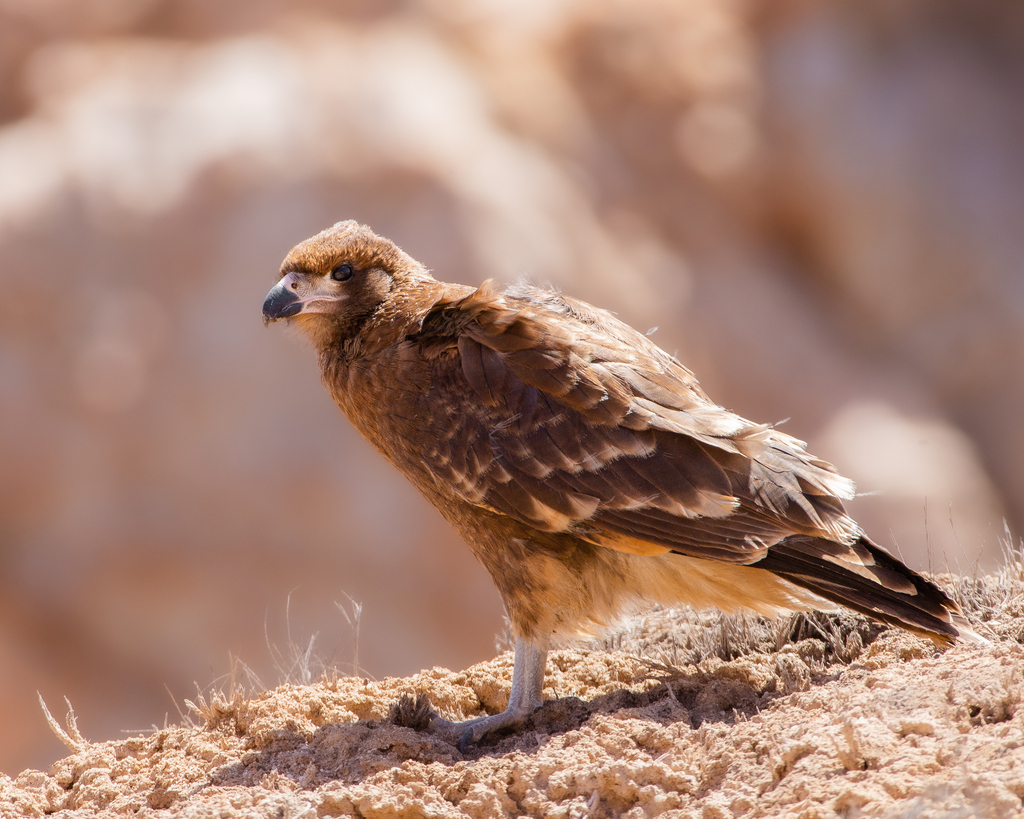
Mountain Caracara
Photo © Nicolás Villaseca Merino
Photo © Nicolás Villaseca Merino — CC BY-SA 4.0 — Source: iNaturalist photo #252254826Identification
The mountain caracara is a medium-sized bird of prey with striking plumage that makes it distinctive across the high Andes. Adults display a dramatic colour contrast: a jet-black head, back, and chest sharply demarcate from pure white rump, belly, and tail coverts. The faintly blue beak tip turns to bright orange, providing a vivid accent to the black facial feathers. Its wings are black with small white shoulder patches and white spots on some outer primaries, while yellow legs complete the striking appearance. Males and females look similar, making field identification straightforward for adults.
Juveniles are far less distinctive, appearing overall brown with dull pinkish-grey facial skin, which may cause confusion with younger birds of related species. The mountain caracara most closely resembles the carunculated caracara and white-throated caracara, but differs from both in having a uniform black chest rather than white markings in that area. Despite feeding heavily on carrion, unlike some vultures, the species retains fully feathered head and throat, with only the lores left naked.
Range & Habitat
This species is endemic to South America, ranging from northern Ecuador through Peru and Bolivia to northern Argentina and Chile, where it inhabits the puna and páramo zones of the Andes. Generally uncommon to fairly common throughout its range, the mountain caracara shows a clear preference for unforested regions where it can perch on power poles or fence posts to overlook large areas while hunting. The species has adapted remarkably well to human presence and is usually grouped near cities and along highways, where opportunities for scavenging are greatest.
Behaviour & Diet
Mountain caracaras are highly opportunistic feeders commonly seen walking on the ground in search of prey. They consume both carrion and virtually any small animal they can catch, with diet varying by region: birds in the high plains of northwestern Argentina rely more heavily on animal carcasses, while those in the Andes of South Central Chile feed primarily on insects, with some pellets composed of up to 94 percent insect remains. These resourceful hunters scratch and stamp at dirt to scare up insects, flip over rocks to find arthropods and rodents, and occasionally prey on small birds such as the plain-mantled tit-spinetail.
A unique behaviour among caracaras is their cooperative group foraging, typically involving a couple of adults and a juvenile that combine efforts to overturn rocks too large for a single bird to move alone. Interestingly, prey captured is usually not shared among hunters, and the bird that identifies the most promising rock typically claims the food—though abundant prey may allow all group members to feed. When foraging, an adult finding a worthwhile rock will call out to attract nearby companions. Unlike most falcons, caracaras build their own nests from sticks, ranging from bare cliff ledges to substantial branch structures. Breeding occurs from October to December, with clutches of two eggs (rarely three) hatching in December; chicks fledge and become independent by March.
Best Time & Places to See It
Mountain caracaras are most reliably encountered in unforested puna and páramo habitats throughout the central Andes, particularly near cities and along highways where food is more abundant. The species' adaptation to human settlements means that travellers exploring high-altitude regions of Ecuador, Peru, Bolivia, Chile, and Argentina have good chances of spotting them perched on power poles and fence posts. Their preference for open terrain with good vantage points makes them relatively conspicuous once you know where to look, though their exact abundance varies by locality.
Photography Tips
The mountain caracara's bold plumage and habit of perching openly on utility structures make it an excellent photographic subject. The striking contrast between jet-black and pure white plumage is most dramatic when photographed in bright, high-altitude sunlight that emphasizes these colours. Position yourself to capture the orange-tipped beak and yellow legs, which add vivid accent colours to your images. Early morning and late afternoon light will bring out the intensity of the black feathers while minimizing harsh midday shadows. Watch for ground-feeding behaviour and rock-flipping activities, which offer dynamic shooting opportunities, and listen for the contact calls used during group foraging sessions that may alert you to nearby birds engaged in this fascinating cooperative behaviour.
Manu National Park
Manu, Peru
+892 birds+26 mammals
Across the eastern slopes of the Peruvian Andes, tropical rainforest descends into the Amazon basin with a complexity that few terrestrial ecosystems match. Manu National Park…
VIEW NATIONAL PARKHuascarán National Park
Independencia, Peru
+201 birds+5 mammals
Where granite peaks pierce the Andean sky above 6,000 metres, Huascarán National Park sprawls across more than 11,500 square kilometres of Peru's Cordillera Blanca, a landscape…
VIEW NATIONAL PARKLaja National Park Lagoon
Antuco, Chile
+123 birds+1 mammals
Where the Andes descend into the Biobío Region's temperate forests, a vast lagoon fills the caldera of the extinct Antuco volcano, cradled by steep native woodland…
VIEW NATIONAL PARKLauca National Park
Putre, Chile
+139 birds+17 mammals
Where the Andes rise toward the altiplano in Chile's far north, Lauca National Park sprawls across more than 3,000 square kilometres of some of South America's…
VIEW NATIONAL PARKLos Cardones National Park
Argentina
+193 birds+6 mammals
Where the Andes descend into northwestern Argentina, Los Cardones National Park sprawls across nearly 1,200 square kilometres of one of South America's most distinctive high-altitude desert…
VIEW NATIONAL PARKNo community photos yet. Log in to add the first one.
No community observations of this species yet.