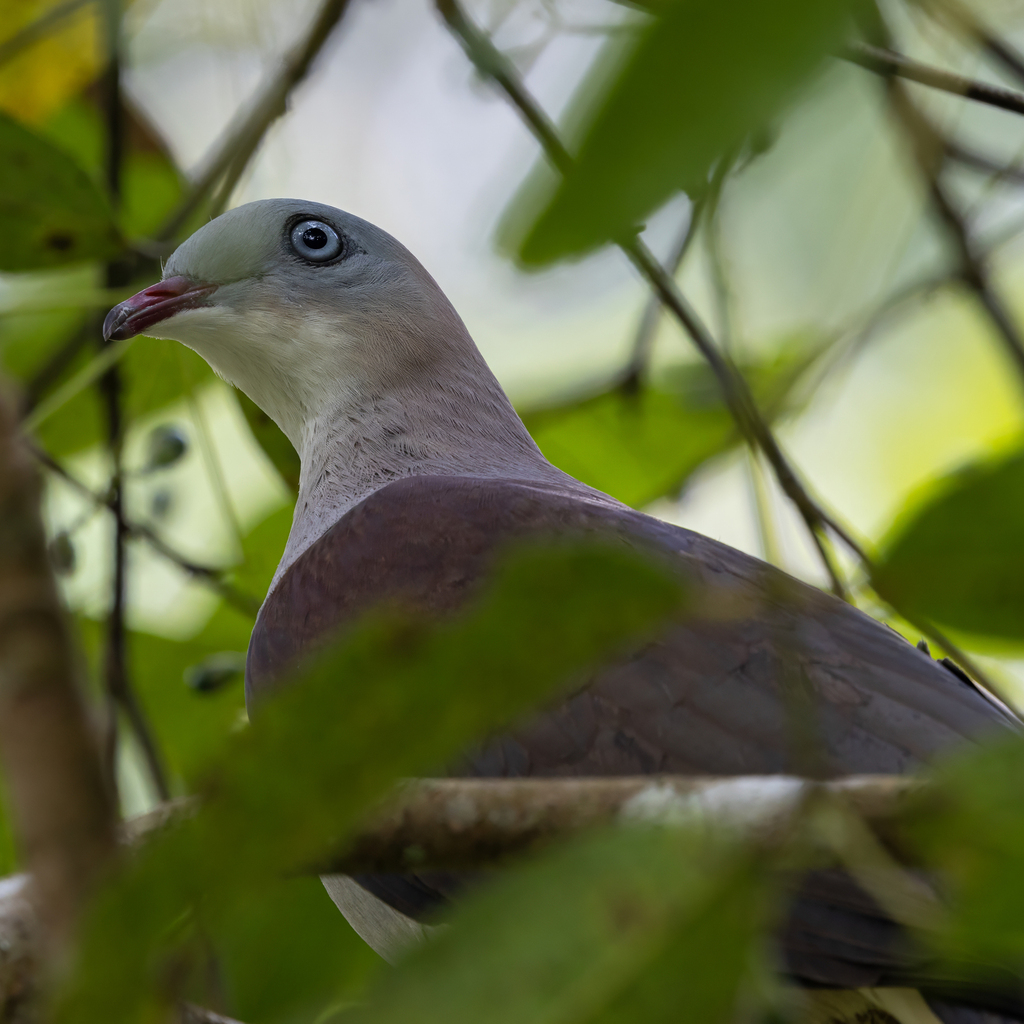
Mountain Imperial Pigeon
Photo © Dan Vickers
Photo © Dan Vickers — CC BY 4.0 — Source: iNaturalist #346086444Identification
The mountain imperial pigeon is the largest pigeon species in its range, measuring 43–51 cm long. Its most distinctive feature is the striking maroon-brown upperparts and wings contrasting sharply with vinous-grey head, neck, and underparts. The throat is white, the underwing slate-grey, and the tail blackish with a grey horizontal line. The bird has a fairly long tail, broad rounded wings, and characteristically slow wing-beats. Its deep, resonant boom call is only audible at close range, making visual identification particularly important in the field.
Range & Habitat
This species has a wide distribution across southeastern Asia, occurring in Bangladesh, Bhutan, Brunei, Cambodia, China, India, Indonesia, Laos, Malaysia, Myanmar, Nepal, Thailand, and Vietnam. It inhabits subtropical and tropical moist lowland forests, mangrove forests, and montane forests, ranging from sea level to 2,550 m in the Himalayas and 2,200 m on Sumatra. Primarily a foothill bird, it breeds above 500 m elevation, though feeding flocks occur at lower altitudes. The species is generally fairly common where extensive old-growth forest remains intact.
Behaviour & Diet
Though usually solitary, mountain imperial pigeons occasionally gather in groups of up to 20, particularly when roosting or moving between elevations. They spend most time in the high canopy and typically fly well above the forest top, making them challenging to observe. During breeding season (March–August in northern range, January–May in southern areas), males perform elaborate displays: puffing their throats while calling and bowing to mates, then launching vertically 6–8 m into the air before gliding down with wings and tail spread wide. Nests are flimsy platforms built 5–8 m high in relatively small trees; typically one egg is laid and incubated by both parents.
Best Time & Places to See It
Look for this species in old-growth forest habitats from foothill elevations upward, particularly in areas with fruiting fig and nutmeg trees. Feeding flocks sometimes gather in accessible locations such as mangrove areas, where hundreds may be flushed simultaneously, offering exceptional viewing opportunities. The breeding season (varying by latitude) may concentrate birds in specific areas. Patience and morning hours often yield better sightings, as birds feed in the canopy and are most active early in the day.
Photography Tips
The combination of large size, distinctive maroon back, and vinous-grey underparts makes this pigeon visually striking, though obtaining clear images requires patience. Position yourself beneath fruiting trees or along flight routes between roosting and feeding sites. Early morning light is ideal for capturing the subtle colour contrasts. The bird's high canopy preference and rapid flight demand a fast shutter speed and good tracking ability. Photograph roosting birds and displaying males during breeding season for behavioural shots, including the characteristic vertical flight display with wings and tail spread.
Khao Yai National Park
Prachantakham District, Thailand
+377 birds+46 mammals
Evergreen dipterocarp forest blankets the rolling terrain of this national park in eastern Thailand, where limestone hills rise abruptly from the forest floor and seasonal streams…
VIEW NATIONAL PARKKaziranga National Park
Kohora, India
+422 birds+26 mammals
Dawn breaks over the floodplains of the Brahmaputra, where tall grasslands stretch endlessly beneath monsoon-heavy skies. This sprawling wilderness of northeastern Assam is a mosaic of…
VIEW NATIONAL PARKGunung Mulu National Park
Long Seridan, Malaysia
+280 birds+39 mammals
Where granite monoliths pierce the rainforest canopy of Sarawak, an ancient limestone karst landscape reveals one of Southeast Asia's most biodiverse strongholds. Soaring peaks cloaked in…
VIEW NATIONAL PARKKerinci Seblat National Park
Kerinci, Indonesia
+228 birds+16 mammals
Across nearly 67,000 square kilometres of Sumatra's spine, a mountainous realm of equatorial rainforest rises from steaming lowlands to volcanic peaks shrouded in cloud. Kerinci Seblat…
VIEW NATIONAL PARKBerbak National Park
Tanjung Jabung Timur, Indonesia
+24 birds
Across the lowland peatswamps and tidal forests of eastern Sumatra's coast, Berbak National Park sprawls over more than 3,000 square kilometres of one of Southeast Asia's…
VIEW NATIONAL PARKHainan Tropical Rainforest National Park
Haikou, China
+69 birds+1 mammals
Tropical forests blanket the volcanic slopes of central Hainan, where moisture-laden winds from the South China Sea collide with mountainous terrain to create some of China's…
VIEW NATIONAL PARKGaoligong Mountain National Nature Reserve
Nujiang Lisu Autonomous Prefecture, China
+443 birds+13 mammals
VIEW NATURE RESERVENo community photos yet. Log in to add the first one.
No community observations of this species yet.