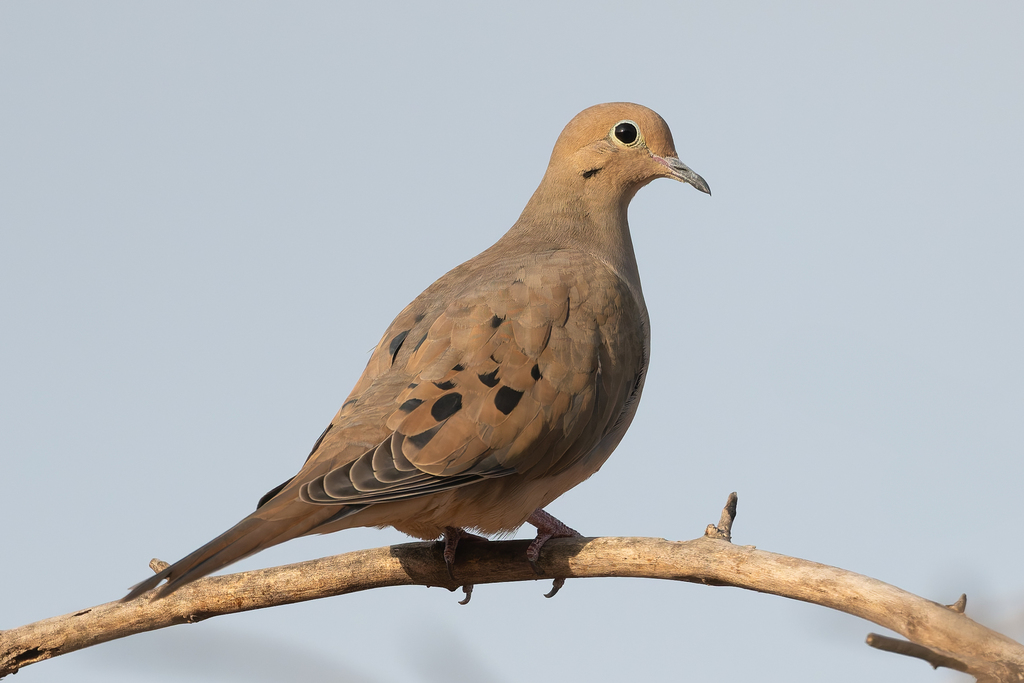
Mourning Dove
Photo © Adam Jackson
Photo © Adam Jackson — CC0 1.0 — Source: iNaturalist photo #447371849Identification
The mourning dove is a medium-sized, slender dove approximately 31 cm (12 in) in length, with a wingspan of 37–45 cm and weighing typically around 128 g (4.5 oz). The species is light gray and brown with generally muted coloring throughout. Males and females are similar in appearance, making the species straightforward to identify once you've become familiar with its subtle plumage. The bird's name derives from its doleful call, which many listeners find haunting and evocative.
Range & Habitat
The mourning dove is one of the most abundant and widespread North American birds. Five subspecies are recognized across different regions: the eastern subspecies occupies eastern North America, Bermuda, and the Bahamas; the western subspecies inhabit western North America and parts of Mexico; Caribbean subspecies are found throughout the Greater Antilles and the Florida Keys; a Central American subspecies ranges through Costa Rica and western Panama; and an endemic subspecies occurs only on Clarion Island off Mexico's Pacific coast. The ranges of most subspecies overlap slightly.
Behaviour & Diet
Mourning doves are strong fliers, capable of speeds up to 88 km/h (55 mph), and produce an unusual whistling sound with their wings upon take-off and landing. The species is generally monogamous, with both male and female parents incubating eggs and caring for young. Each brood consists of two squabs (young), and in warm areas, a single pair may raise up to six broods in one year, demonstrating remarkable breeding productivity. Adults eat almost exclusively seeds, while parents feed their young crop milk.
Best Time & Places to See It
As one of the most abundant North American birds, mourning doves are relatively easy to encounter across their wide range. They can be found year-round throughout much of North America, the Caribbean, and Central America depending on the subspecies and season. Look for them in open and semi-open habitats where seeds are available. Their widespread distribution and prolific nature mean that patient observers in appropriate habitat have excellent chances of encountering this species.
Photography Tips
The mourning dove's muted gray and brown coloring requires careful exposure metering to capture detail without losing subtle tonal gradations. Photograph during golden hour to enhance the warm tones in their plumage. If possible, capture the moment of take-off or landing to record the characteristic wing whistle in action. The similarity between males and females means identification in photos relies on overall form and behavior rather than plumage differences, so document full body postures and habitat context.
Acadia National Park
Alaska Maritime National Wildlife Refuge
Algonquin Provincial Park
Arches National Park
Arenal Volcano National Park
Badlands National Park
Banff National Park
Baru Volcano National Park
Bear River Migratory Bird Refuge
Nothing matches these filters.
No community photos yet. Log in to add the first one.
No community observations of this species yet.