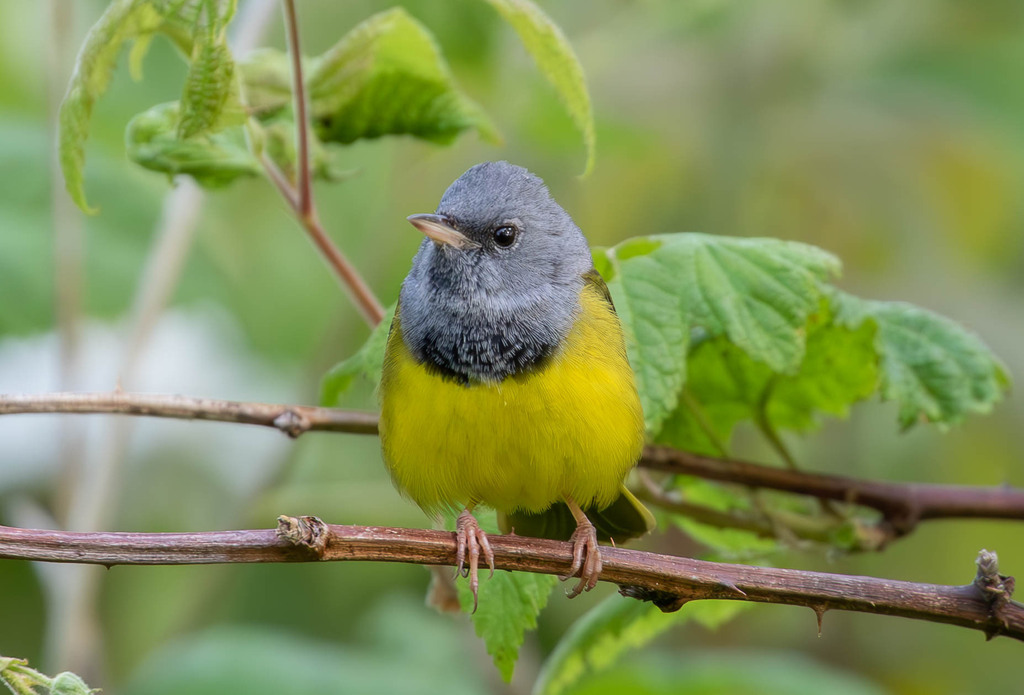
Mourning Warbler
Photo © kirk gardner
Photo © kirk gardner — CC BY 4.0 — Source: iNaturalist photo #289725031Identification
The Mourning Warbler is a small songbird measuring 10–15 cm in length, with a wingspan of 18 cm and weighing 11–13 g. It features yellow underparts, olive-green upperparts, a thin pointed bill, and pink legs. Adult males are distinctive with a gray hood, black lores, and a black patch on the throat and breast—a pattern that inspired the bird's name, thought to resemble a mourning veil. In fall, this bold plumage becomes duller and more challenging to distinguish from similar species.
Females and immature birds present a more subtle appearance with gray-brown heads, an incomplete eye-ring, and a yellow-gray throat tinged with brown or olive on the breast. Crucially, Mourning Warblers never display a complete eye-ring, distinguishing them from Connecticut Warblers. They are often confused with MacGillivray's Warblers (though their ranges do not overlap), Nashville Warblers (which have yellow throats and gray backs), and Connecticut Warblers (which have complete eye-rings and whiter chests).
Range & Habitat
Mourning Warblers are neotropical migrants native to eastern and central North America, with breeding ranges extending from Newfoundland and Labrador south through the Appalachians to Virginia, and west to the Northwest Territories and northeastern British Columbia. They winter across Central and South America, with populations concentrated in Ecuador, Venezuela, and Colombia, though also recorded in Nicaragua, Costa Rica, El Salvador, and the Dominican Republic. During breeding season, they favor dense second-growth forests—thickets and semi-open areas with dense shrubs, dead fallen trees, and covered canopies—typically occupying cleared areas 1–7 years after disturbance from logging, mining, agriculture, or natural events like storms and fires. In winter, they adapt to scrublands, dry woods, coasts, and urban areas.
Behaviour & Diet
Mourning Warblers forage low in vegetation and along tree branches, often catching insects in flight. Their diet consists primarily of insects, spiders, beetles, caterpillars, and larvae, supplemented with plant material including fruits from Cecropia trees during winter and increased fruit consumption during migration. They characteristically remove the legs and wings of insects before feeding.
These birds nest in open-cup structures placed low or on the ground in well-concealed locations beneath thick shrubs and vegetation, constructed from grass, leaves, and bark lined with roots. Females typically lay 2–5 white or brown-and-black speckled eggs, with an incubation period of 12 days shared by both parents. Young fledge in 7–9 days. Migration occurs in late August through November (southbound) and March through May (northbound), with birds following coastal Central American routes and major river valleys before dispersing to breeding grounds by May–June.
Best Time & Places to See It
Mourning Warblers are best observed during their breeding season from May through July in second-growth habitats across eastern North America, from the Appalachians northward. Look for them in recently disturbed forest areas with dense shrub cover and thickets. During migration periods—late August through November southbound, and March through May northbound—they may be encountered in more varied habitats along their migration routes, particularly in coastal Central America and river valley corridors.
Photography Tips
The Mourning Warbler's small size and preference for dense, low vegetation present challenges for photographers. Focus on observing males in breeding plumage, as their gray hoods and black throat patches provide excellent contrast for photography. Early morning light works best for capturing detail in thick second-growth habitat. Exercise patience, as these birds often forage low and skulk through dense cover. During migration, when birds may be more active and accessible, use a telephoto lens to maintain distance and reduce disturbance. The bird's yellow underparts and distinctive throat pattern are key features to highlight in successful images.
Acadia National Park
Algonquin Provincial Park
Antisana National Park
Arenal Volcano National Park
Barra del Colorado National Wildlife Refuge
Baru Volcano National Park
Bic National Park
Big Bend National Park
Braulio Carrillo National Park
Nothing matches these filters.
No community photos yet. Log in to add the first one.
No community observations of this species yet.