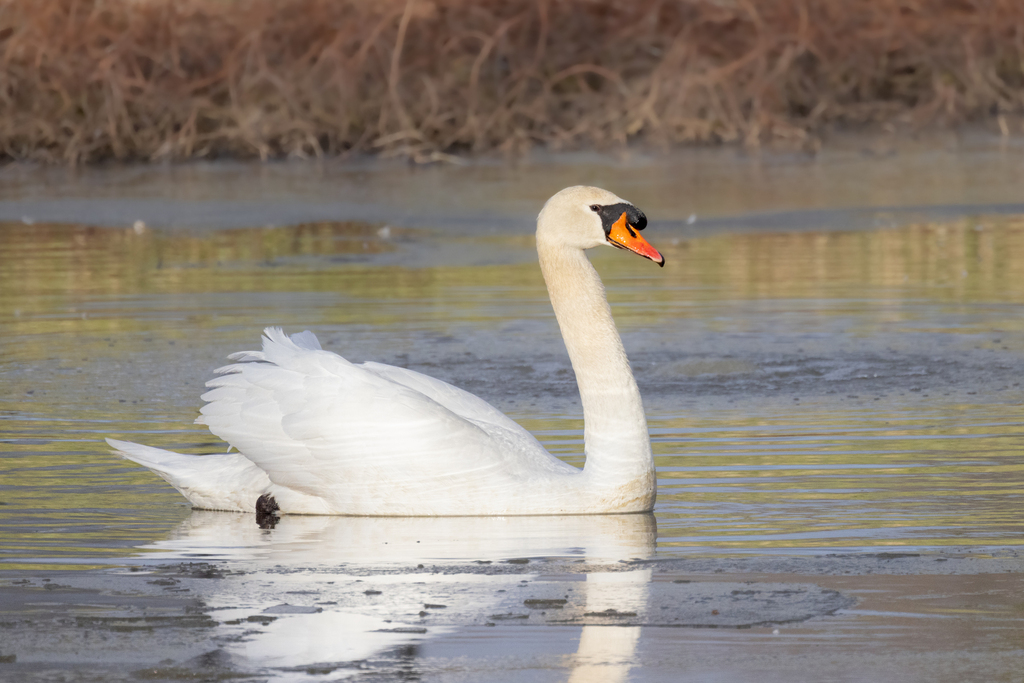
Mute Swan
Photo © Andy Wilson
Photo © Andy Wilson — CC0 1.0 — Source: iNaturalist photo #456025125Identification
The mute swan is one of the heaviest flying birds and one of the largest waterfowl species. Adults typically measure 140 to 160 centimetres in length, with wingspans reaching 200 to 240 centimetres. They are unmistakable: entirely white plumage, dark grey legs, and a distinctive bright orange beak bordered with black. Males, known as cobs, are larger than females (pens) and sport a more pronounced knob atop the beak—a feature that becomes particularly prominent in mature males and makes them readily distinguishable from females.
Young birds, called cygnets, look markedly different from their parents. Rather than bright white, their down ranges from pure white to grey to buff, with grey and buff being most common. Their bills are dull greyish-black rather than orange. Cygnets grow remarkably quickly, reaching near-adult size within approximately three months of hatching, and typically retain their grey feathers until at least one year old. A rare colour morph, the "Polish swan," features pinkish legs and dull-white cygnets, found only in populations with a history of domestication.
Range & Habitat
The mute swan is native to much of Europe and parts of Asia, and appears as a rare winter visitor to the far north of Africa. It has been introduced to North America, where it now maintains the largest populations outside its native range, and has also been introduced in smaller numbers to Australasia and Southern Africa. The species has a deep historical presence in Europe; subfossils dating back 6,000 years have been discovered in post-glacial peat beds of East Anglia in Great Britain.
Behaviour & Diet
Unlike their black swan cousins, mute swans are typically strongly territorial, with single pairs occupying smaller lakes. However, where extensive suitable feeding habitat exists, they can be colonial; the largest colonies exceed 100 pairs with nests sometimes spaced just 2 metres apart. Notable colonies include Abbotsbury Swannery in Southern England and Ottenby Preserve at the southern tip of Öland in the Baltic Sea. Non-mated juveniles aged 3–4 years commonly form much larger flocks, sometimes numbering several hundred birds at traditional gathering sites such as the River Tweed estuary at Berwick-upon-Tweed in Northeastern England.
Best Time & Places to See It
Mute swans can be encountered year-round across their native European range and established introduced populations. Large concentrations of non-breeding birds gather at traditional sites, making these particularly rewarding for observation. Notable locations include Abbotsbury Swannery and the Thames near Windsor Castle in England, and Ottenby Preserve in Sweden. The species' size and white plumage make it relatively easy to locate in suitable freshwater and coastal habitats.
Photography Tips
The mute swan's striking white plumage and bright orange beak offer excellent photographic opportunities. Males with their larger knobs provide distinctive portrait subjects. Capture the pronounced knob and black facial markings in close-ups to highlight field marks. Photographing cygnets alongside adults illustrates their dramatic transformation from grey downy chicks to white adults. In flight, these heavy birds achieve speeds up to 88.5 kilometres per hour, making action shots challenging but rewarding. Early morning light reflecting off water enhances the purity of their white plumage.
Algonquin Provincial Park
Alligator River National Wildlife Refuge
Alpilles Regional Nature Park
Appennino Lucano Val d’Agri Lagonegrese National Park
Åsnens National Park
Avesnois Regional Nature Park
Bannau Brycheiniog National Park
Bardenas Reales
Bavarian Forest National Park
Nothing matches these filters.
No community photos yet. Log in to add the first one.
No community observations of this species yet.