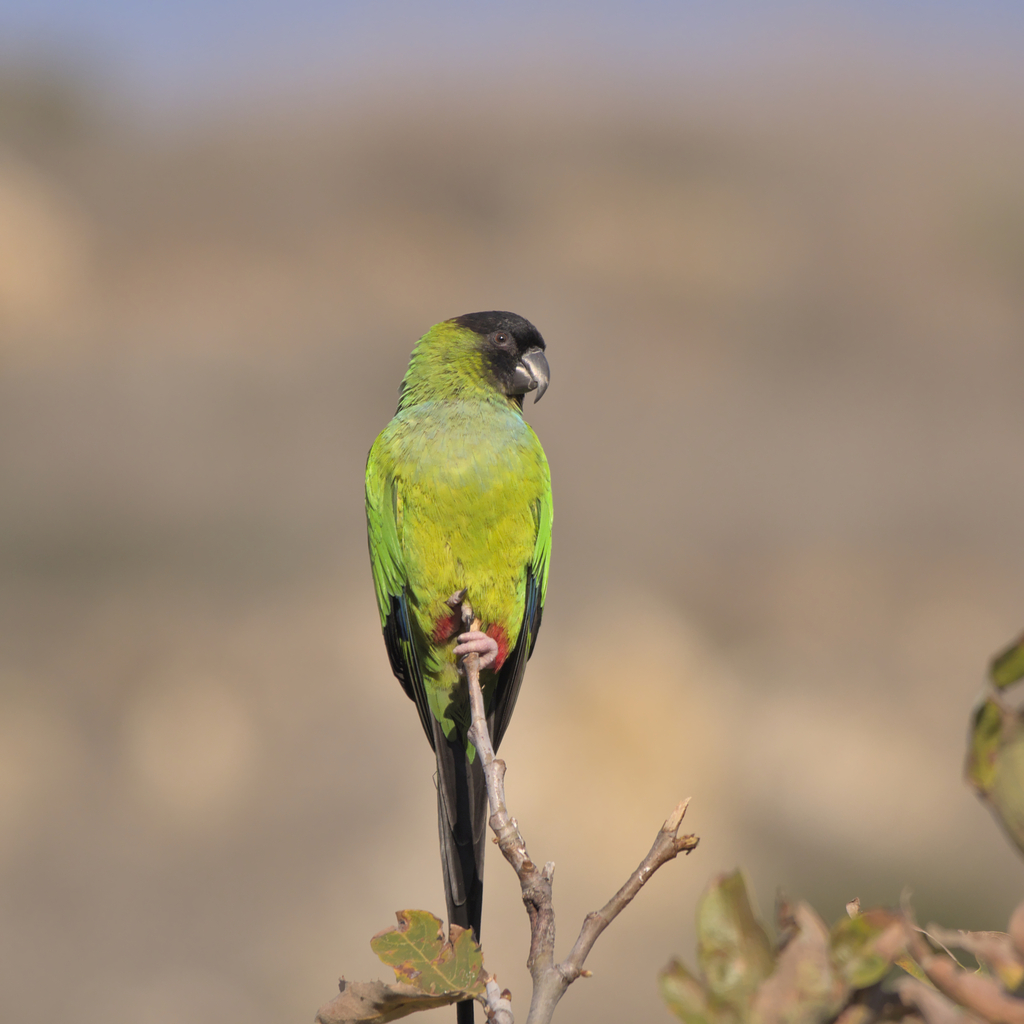
Nanday Parakeet
Photo © Micah Carrick
Photo © Micah Carrick — CC BY 4.0 — Source: iNaturalist photo #248084634Identification
The nanday parakeet is a medium-small parrot measuring 27–30 cm in length and weighing around 140 g. Its most distinctive feature is the bold black facial mask and beak that gives it its common name. The plumage is predominantly green, with the upper chest showing a bluish-green tone that transitions to paler green on the lower chest. Red feathers cover the thighs, while the wings display black trailing flight feathers. The long tail is characteristically edged in blue at the tip, making it recognizable in flight.
Range & Habitat
Native to South America, the nanday parakeet's natural range extends from southeast Bolivia through southwest Brazil, central Paraguay, and into northern Argentina, with populations concentrated in the Pantanal region. The species inhabits open savannah, pastures, and scrub forest, showing a particular preference for forest clearings and areas around human settlements. Escaped cage birds have established self-sustaining feral populations in several regions outside their native range, including Israel, Tenerife in the Canary Islands, and multiple locations in the United States—notably Los Angeles and San Antonio, as well as several counties in Florida.
Behaviour & Diet
These parakeets are social and energetic birds that feed on seeds, fruit, palm nuts, berries, flowers, and buds. In areas where humans have settled, feral populations readily visit bird feeders, and they are sometimes considered agricultural pests in their native range. Nanday parakeets are highly gregarious, typically nesting in tree cavities where females lay three or four eggs. After breeding season, all birds gather into rather large communal roosts, a behaviour that makes them conspicuous and relatively easy to locate for observers.
Best Time & Places to See It
In South America, nanday parakeets can be found in their native Pantanal region and associated savannah habitats. For those unable to travel to their native range, established feral populations in Florida offer reliable viewing opportunities, particularly in counties such as Broward, Miami-Dade, and Palm Beach. The birds' habit of forming large communal roosts after breeding season makes them easier to locate during these periods, and their gregarious nature means they are often seen in small flocks rather than as solitary individuals.
Photography Tips
The nanday parakeet's striking black facial mask provides excellent contrast against its green plumage, making it photogenic even in variable light conditions. Photograph flocking birds during communal roosting periods for dynamic flock compositions. The blue-edged tail and red thigh feathers are distinctive field marks worth capturing in detail. Their energetic, acrobatic behaviour in trees offers opportunities for action shots, though patience and a telephoto lens will be necessary to capture crisp images of these active birds.
Teide National Park
La Orotava, Spain
+83 birds+7 mammals
At nearly 3,900 metres, Spain's highest peak rises from the Canary Islands as a singular volcanic monument, its slopes sweeping through five distinct climate zones in…
VIEW NATIONAL PARKEverglades National Park
Monroe County, United States
+345 birds+22 mammals
Where freshwater marsh meets subtropical sky, the Everglades sprawls across southwestern Florida as one of North America's most expansive wetland ecosystems. Spanning over 13,000 square kilometers,…
VIEW NATIONAL PARKChapada dos Guimarães National Park
Brazil
+450 birds+1 mammals
Where weathered sandstone plateaus rise above the cerrado grasslands of central Brazil, Chapada dos Guimarães National Park protects 624 square kilometres of ecological transition zone that…
VIEW NATIONAL PARKPantanal Matogrossense National Park
Brazil
+322 birds+17 mammals
Where the flooded forests of central Brazil meet vast seasonally inundated grasslands, Pantanal Matogrossense National Park sprawls across nearly 2,900 square kilometers of one of the…
VIEW NATIONAL PARKRío Pilcomayo National Park
Argentina
+271 birds+13 mammals
Where the Río Pilcomayo cuts through northeastern Argentina's subtropical lowlands, a sprawling mosaic of wetlands, grasslands, and seasonally flooded forests creates one of South America's most…
VIEW NATIONAL PARKParque Provincial Pampa del Indio
Laguna Limpia, Argentina
+231 birds+4 mammals
Across the flat horizons of Chaco Province, where the Paraná River system spills into vast wetlands and grasslands, Parque Provincial Pampa del Indio protects one of…
VIEW NATURE RESERVEJ.N. “Ding” Darling National Wildlife Refuge
Sanibel, United States
+277 birds+6 mammals
Mangrove channels and coastal marshlands dominate this 6,400-acre sanctuary on Florida's Gulf coast, where brackish waterways weave between dense stands of red, black, and white mangrove…
VIEW WILDLIFE SANCTUARYChassahowitzka National Wildlife Refuge
Homosassa, United States
+299 birds+14 mammals
Where the Gulf of Mexico's coastal marshes dissolve into brackish tidal flats and mangrove thickets, the Chassahowitzka National Wildlife Sanctuary near Homosassa represents one of Florida's…
VIEW WILDLIFE SANCTUARYNo community photos yet. Log in to add the first one.
No community observations of this species yet.