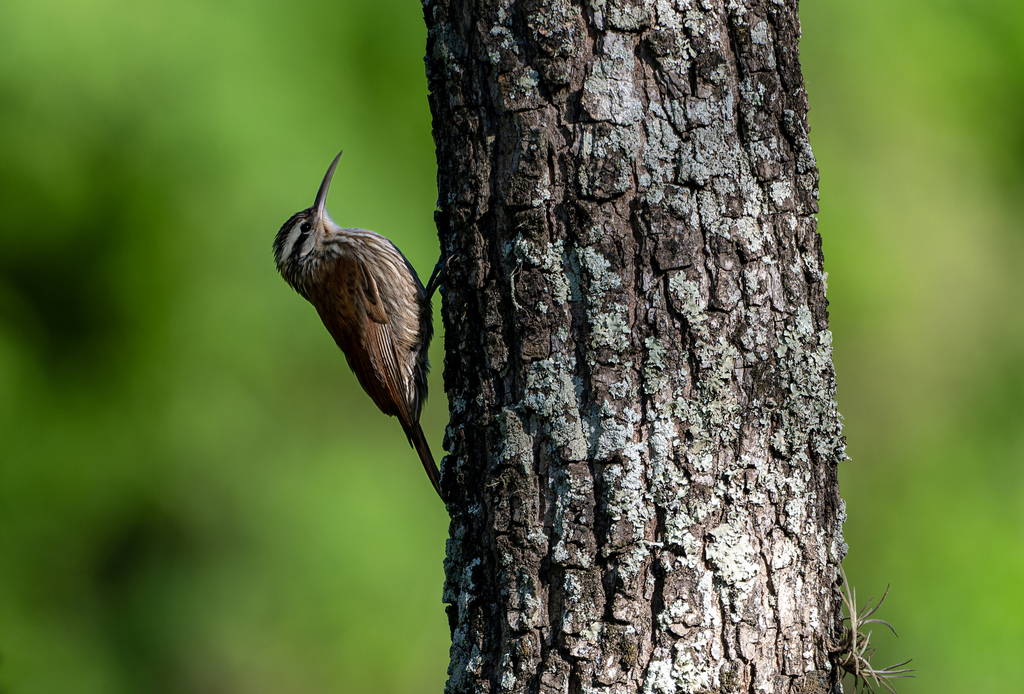
Narrow-billed Woodcreeper
Photo © David F. Belmonte
Photo © David F. Belmonte — CC BY 4.0 — Source: iNaturalist photo #443356112Identification
The narrow-billed woodcreeper is a slim, medium-sized woodcreeper measuring 18 to 22 cm long, with males weighing 23 to 37.5 g and females 21.5 to 33.5 g. Its most distinctive feature is a long, slim, moderately decurved bill. The plumage is similar between sexes, with rufous-chestnut wings and tail, a blackish-brown crown with whitish buff streaks, and a buffy-white supercilium that widens toward the rear. A characteristic black stripe runs behind the eye. The throat and cheeks are plain whitish, while the breast and belly are buffy-white with dusky spots or streaks that fade on the lower belly. The iris is brown to chestnut, and the bill is pale gray to pinkish horn with dusky sides at the base of the mandible. Eight subspecies exist across the range, differing primarily in the tone and streaking of upper and underparts.
Range & Habitat
The narrow-billed woodcreeper is found throughout much of South America, including Argentina, Bolivia, Brazil, Paraguay, Suriname, and Uruguay. The eight subspecies occupy distinct but sometimes overlapping ranges across this vast territory. This species inhabits a variety of semi-open and open landscapes, primarily in tropical zones but reaching subtropical elevations in the eastern Andean foothills. Preferred habitats include deciduous forest, Gran Chaco woodlands and scrublands, gallery forest, secondary forest, caatinga, cerrado, plantations, and open areas in populated regions. It is less frequent in palm swamps. Across most of its range it occurs from lowlands to 1,200 m elevation, though in Bolivia it reaches up to 3,000 m.
Behaviour & Diet
The narrow-billed woodcreeper is a year-round resident throughout its range. Its diet consists mainly of invertebrates, particularly insects and spiders, though it occasionally takes small frogs. It typically forages singly or in pairs, sometimes joining small groups and regularly participating in mixed-species feeding flocks. The bird hitches up tree trunks and branches in a characteristic spiral pattern, usually working from near the ground to the subcanopy. It captures prey by gleaning from surfaces and probing bark crevices, epiphytes, and moss. It sometimes flakes off bark to expose hidden prey and has been observed hunting moths around street lights.
Best Time & Places to See It
The breeding season for this species varies across its range but generally occurs between September and February, making this an excellent time for observing territorial and nesting behaviour. The bird's year-round residency means it can be encountered throughout the year in suitable habitat. Look for it in semi-open woodlands, secondary forests, and gallery forests across its South American range, particularly in Argentina, Paraguay, Bolivia, and central and eastern Brazil. Its preference for foraging on tree trunks and branches in the lower to middle levels of vegetation makes it relatively accessible for observation.
Photography Tips
The narrow-billed woodcreeper's habit of hitching spirally up tree trunks provides excellent photography opportunities, especially with the bird working from near ground level where light is often better. Position yourself to capture its characteristic pose clinging vertically to bark, which showcases the streaked plumage and distinctive supercilium. The black eye-stripe and buff facial markings are key identifying features worth emphasizing in photographs. Early morning in gallery forests and secondary growth areas offers the best light and activity levels. The bird's relatively small size and subtle coloration mean that a moderate telephoto lens and patient waiting are essential for capturing sharp, detailed images.
Tijuca National Park
Brazil
+317 birds+13 mammals
Where the Atlantic forest rises steeply from Rio de Janeiro's urban edge, Tijuca National Park encompasses a landscape of dramatic granite peaks, cascading waterfalls, and closed-canopy…
VIEW NATIONAL PARKEmas National Park
Brazil
+333 birds+23 mammals
Across the high plateaux of central Brazil, where the cerrado grasslands roll toward distant horizons under an immense sky, Emas National Park anchors one of South…
VIEW NATIONAL PARKSerra do Cipó National Park
Brazil
+379 birds+5 mammals
Where granite escarpments rise above the Atlantic Forest transition zone in southeastern Brazil, Serra do Cipó National Park unfolds across a landscape of dramatic ridges, cascading…
VIEW NATIONAL PARKItatiaia National Park
Brazil
+519 birds+12 mammals
Where granite peaks pierce the Atlantic rainforest canopy in southeastern Brazil, Itatiaia National Park rises as one of the country's oldest and most ecologically vital protected…
VIEW NATIONAL PARKSerra da Bocaina National Park
Brazil
+441 birds+5 mammals
Where the escarpment of the Serra da Bocaina rises sharply from the Atlantic coastal plain, tropical rainforest cloaks steep mountainsides that climb toward peaks exceeding 2,000…
VIEW NATIONAL PARKIlha Grande National Park
Brazil
+233 birds
Across the subtropical plateaus and Atlantic forest remnants of southern Brazil, a vast protected landscape spanning nearly 4,600 square kilometers safeguards one of the continent's most…
VIEW NATIONAL PARKSerra do Teixeira National Park
Brazil
+160 birds+5 mammals
Rugged plateaus and deep escarpments define this 3,112-square-kilometre sweep of the Brazilian Northeast, where the crystalline bedrock of the Borborema Plateau rises abruptly from the surrounding…
VIEW NATIONAL PARKSerra da Capivara National Park
Brazil
+156 birds+6 mammals
Across the semi-arid plateaus and deeply incised canyons of northeastern Brazil, where Piauí's ancient sandstone formations rise and fall in weathered waves, Serra da Capivara National…
VIEW NATIONAL PARKSerra dos Órgãos National Park
Brazil
+446 birds+13 mammals
Granite peaks thrust skyward through the Atlantic Forest canopy in the mountains immediately north of Rio de Janeiro, their bare rock faces rising above a landscape…
VIEW NATIONAL PARKSete Cidades National Park
Brazil
+125 birds+1 mammals
Sete Cidades sprawls across 113 square kilometres of northeastern Brazil's interior plateau, where weathered sandstone formations rise dramatically from the cerrado landscape. The park's geology tells…
VIEW NATIONAL PARKChapada dos Guimarães National Park
Brazil
+450 birds+1 mammals
Where weathered sandstone plateaus rise above the cerrado grasslands of central Brazil, Chapada dos Guimarães National Park protects 624 square kilometres of ecological transition zone that…
VIEW NATIONAL PARKChapada dos Veadeiros National Park
Brazil
+324 birds+6 mammals
Where granite plateaus rise above the cerrado savanna in central Brazil, Chapada dos Veadeiros National Park unfolds across 6,665 square kilometres of some of the world's…
VIEW NATIONAL PARKPantanal Matogrossense National Park
Brazil
+322 birds+17 mammals
Where the flooded forests of central Brazil meet vast seasonally inundated grasslands, Pantanal Matogrossense National Park sprawls across nearly 2,900 square kilometers of one of the…
VIEW NATIONAL PARKChapada Diamantina National Park
Brazil
+346 birds+5 mammals
Where granite peaks and sandstone cliffs rise abruptly from the Brazilian interior, Chapada Diamantina National Park sprawls across 4,215 square kilometers of some of Brazil's most…
VIEW NATIONAL PARKSerra do Gandarela National Park
Brazil
+333 birds+3 mammals
Where granite massifs rise through Atlantic Forest in southeastern Brazil's highlands, Serra do Gandarela National Park protects nearly 1,000 square kilometres of montane terrain that few…
VIEW NATIONAL PARKCatimbau National Park
Brazil
+118 birds+6 mammals
Where sandstone plateaus rise from the semi-arid scrublands of northeastern Brazil, Catimbau National Park unfolds across more than 1,000 square kilometres of geological drama and surprising…
VIEW NATIONAL PARKBrasília National Park
Plano Piloto, Brazil
+338 birds+15 mammals
Cerrado grassland and scattered woodland sweep across the central Brazilian plateau where this national park sprawls across more than a thousand square kilometres of the Federal…
VIEW NATIONAL PARKEl Palmar National Park
Distrito Sexto, Argentina
+244 birds+14 mammals
Across the Paraná River floodplain in northeastern Argentina, palms rise from wetland and grassland in a landscape shaped by water and time. El Palmar National Park…
VIEW NATIONAL PARKRío Pilcomayo National Park
Argentina
+271 birds+13 mammals
Where the Río Pilcomayo cuts through northeastern Argentina's subtropical lowlands, a sprawling mosaic of wetlands, grasslands, and seasonally flooded forests creates one of South America's most…
VIEW NATIONAL PARKEl Rey National Park
Municipio de Las Lajitas, Argentina
+317 birds+4 mammals
Where the eastern slopes of the Andes descend into northwestern Argentina's subtropical transition zone, El Rey National Park unfolds across 841 square kilometers of dramatically varied…
VIEW NATIONAL PARKCalilegua National Park
Municipio de Calilegua, Argentina
+288 birds+8 mammals
Where the eastern Andean slopes plunge into northwestern Argentina's humid subtropics, nearly 2,645 square kilometers of steep terrain and luxuriant forest compose one of South America's…
VIEW NATIONAL PARKSierra de las Quijadas National Park
Argentina
+168 birds+5 mammals
Sandstone cliffs and deeply incised canyons define this 1,137-square-kilometre expanse in San Luis Province, where the dry Chacoan landscape of central Argentina reveals an unexpected ecological…
VIEW NATIONAL PARKParque Provincial Pampa del Indio
Laguna Limpia, Argentina
+231 birds+4 mammals
Across the flat horizons of Chaco Province, where the Paraná River system spills into vast wetlands and grasslands, Parque Provincial Pampa del Indio protects one of…
VIEW NATURE RESERVENo community photos yet. Log in to add the first one.
No community observations of this species yet.