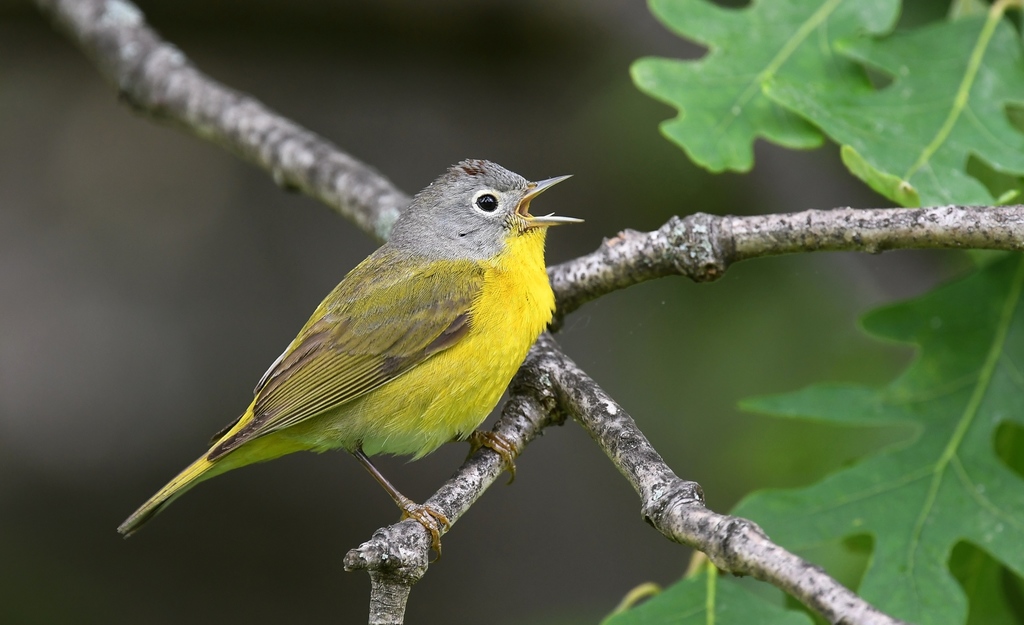
Nashville Warbler
Photo © Chrissy McClarren and Andy Reago
Photo © Chrissy McClarren and Andy Reago — CC0 1.0 — Source: iNaturalist photo #145198249Identification
The Nashville Warbler is a small, active songbird measuring 4.3–5.1 inches in length with a wingspan of 6.7–7.9 inches. Both sexes share a distinctive combination of a gray head, greenish back and wings, yellow throat and breast, and white belly. A complete white eye ring and thin, pointed black bill are diagnostic features. The most striking difference between sexes is that adult males display a rusty-brown patch on the crown—though this is often hidden beneath gray feathers and only raised slightly when the bird is agitated. Females and immature birds show a duller olive-gray head and less vibrant yellow coloring on the throat. Two subspecies occur: the eastern ruficapilla has a highly contrasting olive-green mantle, while the western ridgwayi (also called Calaveras Warbler) displays a more subdued gray-green mantle and frequently bobs its tail.
Range & Habitat
Nashville Warblers breed across two separate regions of North America: the northeastern population ranges from Côte-Nord and Cape Breton Island in eastern Canada to central Alberta, primarily between 52 and 45.5 degrees north, with scattered populations in the Appalachians of Pennsylvania and West Virginia. The western population occupies suitable habitat throughout the western United States. Despite their name, they are only occasional migrants through Nashville itself. In winter, the species retreats to southernmost Texas and California, mid-Mexico, and the northernmost parts of Central America including Guatemala and El Salvador. During breeding season, they favor open mixed woodlands and bog habitats where nesting opportunities and food sources are abundant.
Behaviour & Diet
Nashville Warblers are gleaning foragers that hunt for insects in the lower portions of trees and shrubs, frequently flicking their tails as they move. Their diet consists primarily of insects, supplemented with berries and nectar during winter months. In winter quarters, they are notably social, forming loose flocks and often joining mixed-species feeding aggregations for increased foraging efficiency. Breeding birds conceal their nests on the ground beneath shrubs, constructing open-cup nests from bark strips, leaves, and moss lined with fine materials such as feathers or hair. Females lay typically four or five eggs per clutch and incubate them for 11–12 days while males provision them with food. Young fledge approximately 11 days after hatching.
Best Time & Places to See It
Spring and fall migration periods offer the best opportunities to encounter Nashville Warblers across much of North America. During breeding season, visit open mixed woodlands and bog habitats in the northern United States and southern Canada, particularly in the northeastern states and western regions where they are most abundant. In winter, search suitable habitats in southern Texas, southern California, Mexico, and Central America. Early morning is the optimal time for observation, when males sing actively from open perches on their breeding territories. The eastern subspecies delivers a distinctive rapid seewit-seewit-seewit-ti-ti-ti song, while western birds produce a slightly lower-pitched, richer rendition with a sharper call note.
Photography Tips
The Nashville Warbler's small size and frequent tail-flicking behavior present challenges for field photographers. Position yourself in early morning light to capture the subtle yellow tones of the throat and breast against the contrasting gray head. Watch for males raising their rusty crown patch when agitated—this fleeting display is worth anticipating. Western ridgwayi birds offer more dynamic shooting opportunities due to their frequent tail-bobbing. Photograph birds in open mixed woods where sunlight more easily illuminates plumage details. During migration, patience near shrubby habitats will reward you with close encounters as these warblers forage methodically through lower vegetation.
Acadia National Park
Alaska Maritime National Wildlife Refuge
Algonquin Provincial Park
Alligator River National Wildlife Refuge
Banff National Park
Bear River Migratory Bird Refuge
Bic National Park
Big Bend National Park
Bitter Lake National Wildlife Refuge
Nothing matches these filters.
No community photos yet. Log in to add the first one.
No community observations of this species yet.