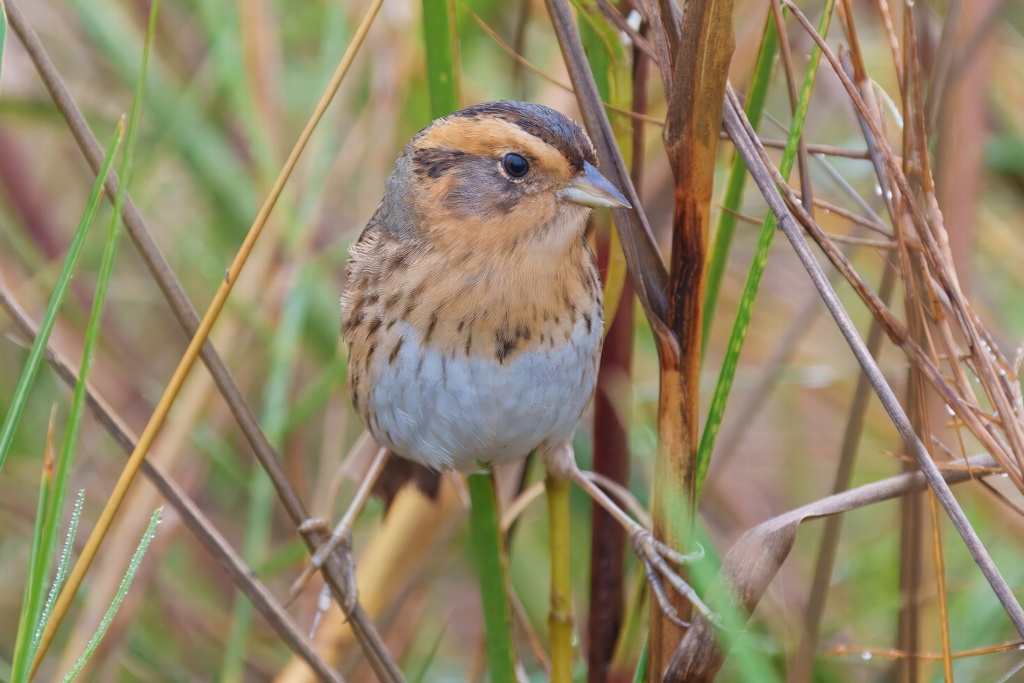
Nelson’s Sparrow
Photo © Brandon Johnson
Photo © Brandon Johnson — CC BY 4.0 — Source: iNaturalist photo #459564553Identification
Nelson's sparrow is a small, compact sparrow measuring 4.3–5.1 inches in length with a wingspan of 6.5–7.9 inches and weighing less than an ounce. Adults are distinctive with brownish upperparts contrasted by a gray crown and nape. The face is striking orange with gray cheeks, while the breast is cream-colored with light or indistinct streaking. The throat and belly are clean white, and the bird sports a characteristically short, pointed tail. This combination of orange facial tones, gray crown, and streaked breast makes Nelson's sparrow readily identifiable among marsh sparrows.
Range & Habitat
Nelson's sparrow breeds in marshes across a broad inland and coastal range, including the Atlantic coast of Canada and Maine, the Canadian Prairies, and a coastal strip along the south of Hudson Bay, extending into the north-central United States. Outside the breeding season, these birds migrate southward to winter along the southeastern coast of the United States. Throughout their range, they are intimately tied to marsh ecosystems, where they spend their lives among grasses and sedges.
Behaviour & Diet
These sparrows forage on the ground and within marsh vegetation, sometimes probing in mud to extract food. Their diet consists mainly of insects, aquatic invertebrates, and seeds. Nelson's sparrow is vocal, with a distinctive raspy trill that is almost mechanical in quality—a sound often likened to a drop of water sizzling on a hot frying pan. During the nesting season, males may give this call in flight. Breeding behavior is notably promiscuous, with males competing for females but not defending territories. Males sometimes assist in feeding the young, and multiple paternity within a single nest is common.
Best Time & Places to See It
The best opportunities to observe Nelson's sparrow are during breeding season in the marshes of Atlantic Canada, Maine, and the Canadian Prairie regions, where males are most vocal and active. During migration and winter months, visit coastal marshes of the southeastern United States. Early morning is ideal for hearing and spotting these birds, when males are most likely to call. Patient observation of marsh edges and open water borders will reward dedicated birders with sightings of this secretive species.
Photography Tips
Photographing Nelson's sparrow requires patience and stealth, as the species is elusive and spends much time concealed in marsh vegetation. The orange face and gray crown provide striking color contrast that rewards close-up shots with good light. Early morning or late afternoon light is ideal for capturing the warm tones of the face. Use a telephoto lens and approach marsh habitat slowly from downwind. Be prepared for long waits, as these birds often skulk low in vegetation. Capturing the bird in flight or perched atop marsh grasses provides excellent compositional opportunities and showcases the distinctive short tail and overall silhouette.
Cape Breton Highlands National Park
Cape Breton Highlands National Park, Canada
+215 birds+18 mammals
Where the Atlantic coast of Nova Scotia rises in weathered cliffs and glacially carved valleys, Cape Breton Highlands National Park spans a landscape where boreal and…
VIEW NATIONAL PARKL’Île-Bonaventure-Et-Du-Rocher-Percé National Park
Le Rocher-Percé, Canada
+214 birds+3 mammals
A dramatic thrust of russet sandstone pierces the Gulf of Saint Lawrence, its weathered arch framing a seascape where cool Atlantic currents sweep past cliffs alive…
VIEW NATIONAL PARKIndiana Dunes National Park
Porter, United States
+304 birds+15 mammals
Along the southern shore of Lake Michigan, where glacial geology meets temperate woodland and open water, sprawls a landscape of extraordinary ecological complexity. The dunes themselves—massive…
VIEW NATIONAL PARKEverglades National Park
Monroe County, United States
+345 birds+22 mammals
Where freshwater marsh meets subtropical sky, the Everglades sprawls across southwestern Florida as one of North America's most expansive wetland ecosystems. Spanning over 13,000 square kilometers,…
VIEW NATIONAL PARKWapusk National Park
Unorganized Division No. 23, Canada
+140 birds+6 mammals
Across the subarctic lowlands of northern Manitoba, where permafrost underlies a mosaic of stunted boreal forest, open muskeg, and coastal tundra, Wapusk National Park sprawls across…
VIEW NATIONAL PARKWaterton Lakes National Park
Improvement District No. 04, Canada
+252 birds+31 mammals
Where the Continental Divide plunges toward the prairies of Alberta, glacier-carved valleys and emerald lakes pierce a landscape where montane forest meets alpine tundra. Waterton Lakes…
VIEW NATIONAL PARKWood Buffalo National Park
Improvement District No. 24, Canada
+187 birds+10 mammals
Across nearly 75,000 square kilometres of boreal forest, wetland and grassland in northern Alberta, the landscape unfolds in a mosaic of spruce and pine woodland interspersed…
VIEW NATIONAL PARKFundy National Park of Canada
Alma Parish, Canada
+217 birds+24 mammals
Where the Bay of Fundy's tidal rhythms sculpt a landscape of dramatic cliffs, forested valleys, and boulder-strewn shorelines, Fundy National Park rises across approximately 345 square…
VIEW NATIONAL PARKBic National Park
Rimouski, Canada
+250 birds+9 mammals
Where the St. Lawrence River meets the Gaspé Peninsula, a rugged coastline of forests, wetlands, and rocky shores unfolds across nearly 95 square kilometres of protected…
VIEW NATIONAL PARKKouchibouguac National Park of Canada
Carleton Parish, Canada
+207 birds+14 mammals
Where the Maritime provinces meet the Atlantic, 591 square kilometres of coastal forest and wetland unfold across New Brunswick's eastern shoulder, a mosaic of boreal woodland,…
VIEW NATIONAL PARKForillon National Park
Gaspé, Canada
+258 birds+16 mammals
Where the Gaspésie Peninsula juts into the Gulf of Saint Lawrence, granite cliffs and coastal headlands frame one of eastern Canada's most dramatic marine-terrestrial boundaries. Forillon…
VIEW NATIONAL PARKPoint Pelee National Park
Leamington, Canada
+296 birds+14 mammals
Where Lake Erie's shallow waters meet the Ontario shoreline, a slender sandy peninsula juts into the Great Lakes like a natural funnel for migrating wildlife. This…
VIEW NATIONAL PARKEl Vizcaíno
Laguna San Ignacio, Mexico
+317 birds+29 mammals
Where the Baja California peninsula thins into a tapestry of salt lagoons and coastal desert, one of Mexico's most biodiverse reserves sprawls across half a million…
VIEW BIOSPHERE RESERVEAcadia National Park
Bar Harbor, United States
+291 birds+27 mammals
Where the Maine coast rises in granite cliffs and spruce-clad headlands, Acadia National Park unfolds across Mount Desert Island and its surrounding waters, a landscape carved…
VIEW NATIONAL PARKChannel Islands National Park
Santa Barbara County, United States
+330 birds+15 mammals
A chain of eight volcanic islands rises from the cold Pacific waters off the California coast, their rugged sea cliffs and windswept terrain shaped by millions…
VIEW NATIONAL PARKCuyahoga Valley National Park
Brecksville, United States
+255 birds+27 mammals
Where the Cuyahoga River carves through a glaciated landscape of Ohio, the valley reveals a temperate deciduous forest ecosystem shaped by four distinct seasons and reliable…
VIEW NATIONAL PARKGrand Canyon National Park
United States
+277 birds+35 mammals
A mile-deep chasm of rust-red rock and purple shadow cuts through the high desert plateau of northern Arizona, revealing nearly two billion years of geological history…
VIEW NATIONAL PARKJ.N. “Ding” Darling National Wildlife Refuge
Sanibel, United States
+277 birds+6 mammals
Mangrove channels and coastal marshlands dominate this 6,400-acre sanctuary on Florida's Gulf coast, where brackish waterways weave between dense stands of red, black, and white mangrove…
VIEW WILDLIFE SANCTUARYMerritt Island National Wildlife Refuge
Brevard County, United States
+341 birds+19 mammals
Brackish marshes and palmetto scrub define this wildlife sanctuary spanning the coastal lowlands of central Florida, where the Atlantic tide meets freshwater systems in a dynamic…
VIEW WILDLIFE SANCTUARYChincoteague National Wildlife Refuge
Chincoteague, United States
+362 birds+16 mammals
Across the barrier islands and salt marshes of Virginia's Eastern Shore, where Atlantic tides sculpt an intricate mosaic of sandy spits and tidal flats, lies one…
VIEW WILDLIFE SANCTUARYFarallon National Wildlife Refuge
San Francisco, United States
+384 birds+16 mammals
Windswept granite peaks rising abruptly from the Pacific, the Farallon Islands form a wildlife sanctuary of extraordinary seabird abundance and ecological significance just twenty-seven miles west…
VIEW WILDLIFE SANCTUARYBombay Hook National Wildlife Refuge
Kent County, United States
+323 birds+15 mammals
Tidal marshes and brackish shallows define this sanctuary on Delaware's Atlantic coast, where the meeting of freshwater and salt creates some of the Mid-Atlantic's most dynamic…
VIEW WILDLIFE SANCTUARYBlackwater National Wildlife Refuge
Fishing Creek, United States
+293 birds+15 mammals
Tidal marshes and brackish waterways define this wildlife sanctuary where the Chesapeake Bay's influence reshapes the landscape with every rise and fall of the water. Shallow…
VIEW WILDLIFE SANCTUARYAlligator River National Wildlife Refuge
Dare County, United States
+288 birds+17 mammals
Where the coastal plain of North Carolina meets the Albemarle Peninsula, a sprawling mosaic of freshwater marshes, pocosins, and swamp forest creates one of the Atlantic…
VIEW WILDLIFE SANCTUARYPea Island National Wildlife Refuge
Dare County, United States
+356 birds+15 mammals
Where the Outer Banks taper toward the Atlantic, a sliver of barrier island creates a microcosm of coastal ecology. Pea Island National Wildlife Sanctuary spans over…
VIEW WILDLIFE SANCTUARYPelican Island National Wildlife Refuge
Windsor, United States
+265 birds+4 mammals
Where Florida's Indian River widens into a brackish estuary, a small island sanctuary commands the attention of waterbirds across the Atlantic Flyway. Pelican Island National Wildlife…
VIEW WILDLIFE SANCTUARYSt. Marks National Wildlife Refuge
Saint Marks, United States
+324 birds+16 mammals
Where the Apalachee Bay begins to define the Florida coastline, salt marshes and freshwater impoundments merge into one of the southeastern United States' most productive wildlife…
VIEW WILDLIFE SANCTUARYCedar Keys National Wildlife Refuge
Levy County, United States
+268 birds+8 mammals
Where the Florida Gulf Coast transitions from mainland to archipelago, Cedar Keys National Wildlife Sanctuary protects a mosaic of salt marshes, shallow estuaries, and maritime hammocks…
VIEW WILDLIFE SANCTUARYChassahowitzka National Wildlife Refuge
Homosassa, United States
+299 birds+14 mammals
Where the Gulf of Mexico's coastal marshes dissolve into brackish tidal flats and mangrove thickets, the Chassahowitzka National Wildlife Sanctuary near Homosassa represents one of Florida's…
VIEW WILDLIFE SANCTUARYNo community photos yet. Log in to add the first one.
No community observations of this species yet.