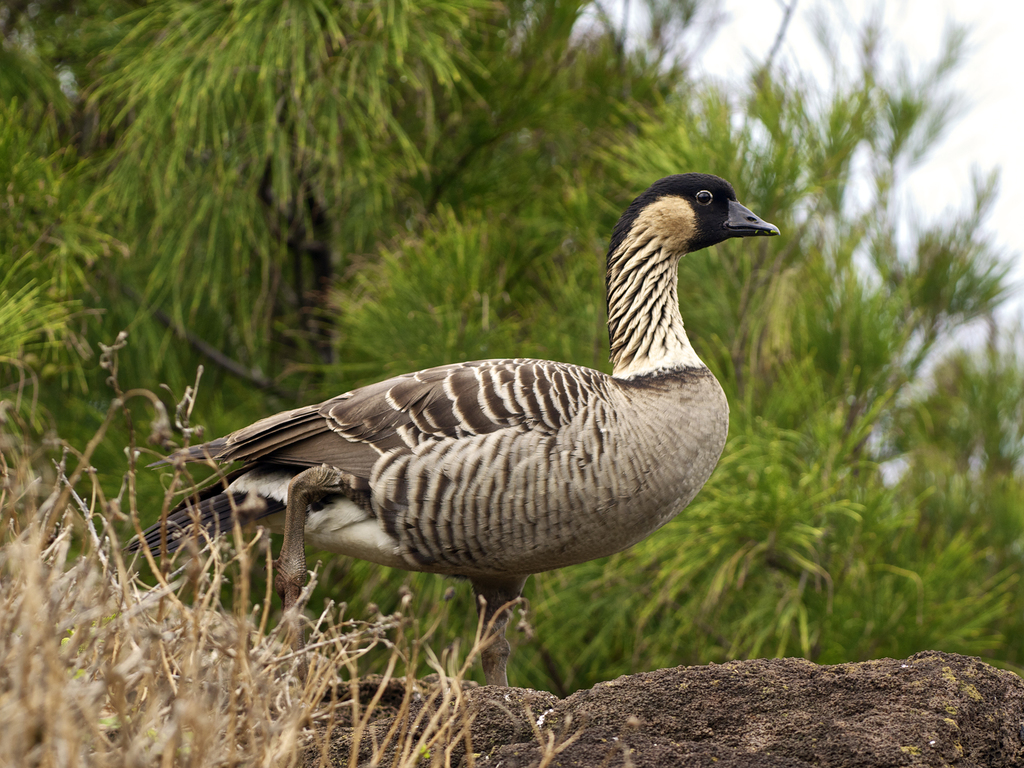
Nene
Photo © Jörg Hempel
Photo © Jörg Hempel — CC BY-SA 4.0 — Source: iNaturalist photo #2657679Identification
The nene is a large goose standing 41 cm (16 in) tall, with males averaging slightly larger than females. Adults are distinctively marked with a black head and hindneck contrasting sharply with buff cheeks. The most striking feature is the heavily furrowed neck bearing bold black and white diagonal stripes. The bill, legs, and feet are black, and soft feathers accent the chin. A unique adaptation to the Hawaiian volcanic landscape is the reduced webbing on its feet, which recedes farther back from the toes than in typical Branta geese, allowing the bird to walk more comfortably on cooled lava. Young goslings resemble adults but are noticeably duller brown with less distinct color demarcation and much-reduced striping and barring.
Range & Habitat
Endemic to the Hawaiian Islands, the nene is today found exclusively in the wild on Maui, Kauaʻi, Molokaʻi, and Hawaiʻi, though a pair recently reestablished on Oʻahu at the James Campbell National Wildlife Refuge. Historically, the species inhabited seven islands. The nene inhabits shrubland, grassland, coastal dunes, and lava plains, as well as anthropogenic habitats such as pasture and golf courses, ranging from sea level to elevations as high as 2,400 m (7,900 ft). Some populations traditionally migrated seasonally between lowland breeding grounds and montane foraging areas.
Behaviour & Diet
Despite spending most of its time on the ground, the nene is capable of flight, with some individuals flying daily between nesting and feeding areas. The species mates on land, unusual among waterfowl. Breeding occurs from August to April—the longest breeding season of any goose—with most eggs laid between November and January. Females build nests in sites of their choosing and lay one to five eggs, incubating them for 29 to 32 days while males stand guard. Precocial goslings can feed themselves and remain with parents until the next breeding season.
The nene is strictly herbivorous, grazing and browsing depending on vegetation availability. Its diet consists of the leaves, seeds, fruit, and flowers of grasses and shrubs.
Best Time & Places to See It
Observers hoping to see nene should visit Maui, Kauaʻi, Molokaʻi, or Hawaiʻi, where the species is now successfully reestablished. Notable reintroduction sites include Haleakalā and Piʻiholo ranches on Maui. Breeding occurs from August to April, making this an excellent period for viewing family groups. The species' use of golf courses and other accessible habitats increases opportunities for encounters.
Photography Tips
The nene's distinctive head and neck markings provide excellent subjects for close-up photography. The black and white striped neck pattern is particularly striking against the buff cheeks. Look for birds on open ground where volcanic habitat provides natural contrast to their plumage. Early morning on grasslands and lava plains offers good lighting. Family groups with goslings during breeding season provide compelling compositions, and the birds' relatively comfortable coexistence with humans on golf courses may offer approachable subjects.
Schleswig-Holsteinisches Wattenmeer National Park
Germany
+378 birds+49 mammals
Where the North Sea ebbs and flows across a vast expanse of exposed mud and sand, the Schleswig-Holsteinisches Wattenmeer National Park reveals one of Europe's most…
VIEW NATIONAL PARKHawaiʻi Volcanoes National Park
Hawaiʻi County, United States
+84 birds+2 mammals
Where volcanic slopes descend toward the Pacific across more than five thousand square kilometers, Hawaiʻi Volcanoes National Park presents one of Earth's most dynamic laboratories of…
VIEW NATIONAL PARKHaleakalā National Park
Maui County, United States
+66 birds+4 mammals
Ascending from sea level to over 10,000 feet across a mere thirty miles, Haleakalā National Park commands one of the Pacific's most dramatic elevation gradients, where…
VIEW NATIONAL PARKKīlauea Point National Wildlife Refuge
Kilauea, United States
+79 birds+1 mammals
At the northernmost tip of Kauai, where the Pacific trades collide with volcanic rock, Kīlauea Point National Wildlife Sanctuary crowns a dramatic headland overlooking one of…
VIEW WILDLIFE SANCTUARYNo community photos yet. Log in to add the first one.
No community observations of this species yet.