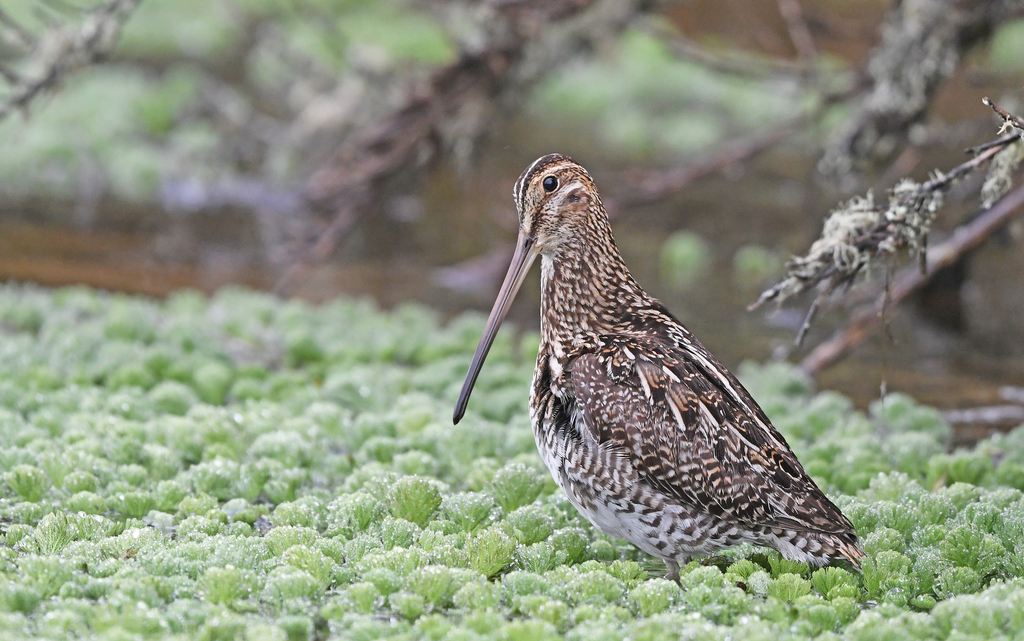
Noble Snipe
Photo © Christoph Moning
Photo © Christoph Moning — CC BY 4.0 — Source: iNaturalist photo #236794360Identification
The Noble Snipe is a compact wader measuring 30–32.5 cm in length, with the stocky build and relatively short legs characteristic of high-altitude snipes. Its most striking feature is the long, straight, horn-coloured bill—notably longer in females than males. The plumage is richly patterned with dark brown and buff streaking across the upperparts, head, and neck, while distinctive gold edges to the feathers create prominent lines running down the back. The belly is white with brown barring on the flanks. Greyish-green legs and feet complete the picture. Immature birds show pale fringes on the wing coverts. The species has a clear, melodious call that aids identification in its remote habitat.
Within its Andean range, the Noble Snipe can be distinguished from similar species: Jameson's Snipe has broader wings, a barred belly, and darker underparts, while the smaller migrant Wilson's and Magellan snipes show more pointed wings and distinctive white trailing edges to the wings.
Range & Habitat
The Noble Snipe is endemic to the Andes, occurring in Colombia, Ecuador, Peru, and Venezuela. It is entirely sedentary, breeding above or just below the treeline and remaining year-round within its mountain range. The species is found in high-altitude wet grassland marshes and swamps between 2,700 and 4,200 metres elevation, occupying some of the most remote and challenging terrain in South America.
Behaviour & Diet
The Noble Snipe is elusive and usually encountered alone or in pairs, making it difficult to observe on the ground despite its sedentary nature. Its cryptic plumage—brown, buff, and streaked—provides superb camouflage when the bird stands motionless amongst marsh vegetation. The species forages by probing its long bill deep into mud and wet soil, seeking insects and worms. During the breeding season (March to July), males perform a spectacular aerial display, flying high in circles before executing a powerful stoop. During this dive, modified outer tail feathers vibrate to produce a distinctive drumming sound, lower-pitched than that of Wilson's Snipe.
Best Time & Places to See It
The breeding season from March to July offers the best opportunity to encounter Noble Snipes, particularly when males perform their aerial displays. The species' sedentary nature means it can be present year-round in suitable habitat, though breeding activity increases detectability. Search high-altitude Andean marshes and swamps in Colombia, Ecuador, Peru, and Venezuela, focusing on areas between 2,700 and 4,200 metres. Early morning visits to wet grasslands near the treeline are most productive, as this is when snipes are most vocal and active.
Photography Tips
Photographing Noble Snipes demands patience and fieldcraft. Use a telephoto lens (at least 500mm) to maintain distance without disturbing this shy, cryptic species. Position yourself before dawn near known marsh habitat and remain motionless; the bird's camouflage makes it nearly invisible until it moves. During breeding season, watch the sky for the spectacular aerial display and attempt to capture the diving male in silhouette against the mountain backdrop. The dramatic Andean landscape provides excellent compositional opportunities to frame the bird within its high-altitude ecosystem. High-speed film or high ISO may be necessary given the often-dim, cloudy conditions of mountain elevations.
Antisana National Park
Cotopaxi National Park
El Tamá National Park
Llanganates National Park
Natural Chingaza National Park
Natural el Cocuy National Park
Natural Pisba National Park
Natural Sumapaz National Park
Puracé National Natural Park
Nothing matches these filters.
No community photos yet. Log in to add the first one.
No community observations of this species yet.