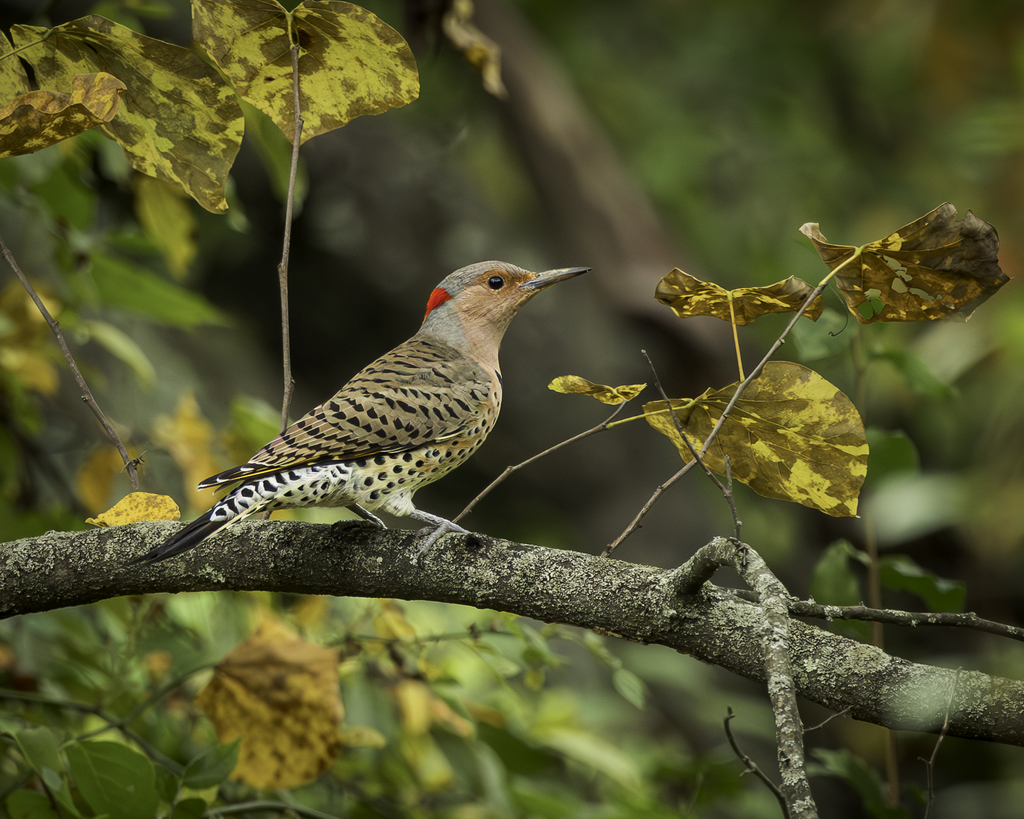
Northern Flicker
Photo © Kristy Morley
Photo © Kristy Morley — CC BY 4.0 — Source: iNaturalist photo #326421846Identification
The northern flicker is a medium-sized woodpecker measuring 28–36 cm in length with a wingspan of 42–54 cm. Adults are brown with black bars on the back and wings. A distinctive necklace-like black patch occupies the upper breast, while the lower breast and belly are beige with black spots. The most striking feature varies by subspecies: eastern birds display yellow under the tail and underwings with yellow shafts on their primaries, while western birds show red in these same areas. Both sexes have a gray or beige cap, though males are distinguished by a mustache mark—black in eastern populations and red in western ones.
Range & Habitat
The northern flicker is native to most of North America, parts of Central America, Cuba, and the Cayman Islands. Nine extant subspecies are distributed across this vast range. The yellow-shafted group inhabits the eastern and northern regions, from Florida and the southeastern United States through central Alaska, Canada, and into Newfoundland and Labrador, with distinct populations in Cuba and Grand Cayman. The red-shafted group occupies western North America, ranging from British Columbia south through the United States into Mexico, with additional populations extending through Central America to Nicaragua. The species is one of the few woodpecker species that migrate, allowing it to inhabit diverse regions seasonally.
Behaviour & Diet
Over 100 common names exist for this species—including yellowhammer, clape, gaffer woodpecker, and wake-up—many derived from attempts to imitate its distinctive calls. The northern flicker's varied vocalizations and active nature make it one of the more conspicuous woodpeckers. Like other members of the woodpecker family, it is adapted for pecking, with a name derived from the Greek verb colapt, meaning "to peck."
Best Time & Places to See It
Travellers can encounter northern flickers across their extensive North American range depending on subspecies and season. Eastern regions offer opportunities to see yellow-shafted birds, while western locations provide views of red-shafted populations. Migratory populations move seasonally, making timing variable by location. The species' vocal and active nature makes it relatively conspicuous compared to other woodpeckers, increasing the likelihood of sightings in suitable habitat.
Photography Tips
Photograph the distinctive field marks clearly: the necklace-like black breast patch and spotted belly are key identifiers. The underwing and tail colors—yellow or red depending on subspecies—provide excellent diagnostic details when the bird is in flight or perched with wings spread. The mustache mark on males offers another reliable identification feature. The bird's relatively active behaviour and vocal nature can help locate individuals in dense woodland, increasing opportunities for productive photography sessions.
Nothing matches these filters.
Tombstone Territorial Park
Acadia National Park
Alaska Maritime National Wildlife Refuge
Algonquin Provincial Park
Alligator River National Wildlife Refuge
Arches National Park
Badlands National Park
Banff National Park
Bear River Migratory Bird Refuge
Nothing matches these filters.
No community photos yet. Log in to add the first one.
No community observations of this species yet.