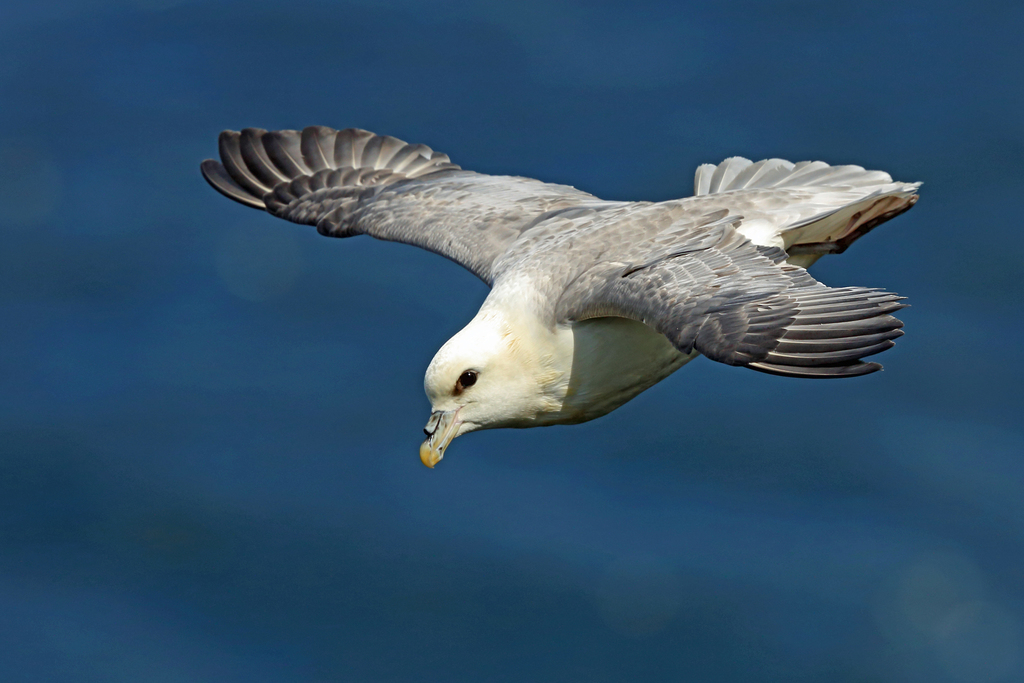
Northern Fulmar
Photo © Nigel Voaden
Photo © Nigel Voaden — CC BY 4.0 — Source: iNaturalist photo #4185949Identification
The northern fulmar is a robust seabird with a wingspan of 102–112 cm and length of 46 cm, weighing 450–1,000 g. At first glance, they may resemble gulls, but fulmars are members of the petrel and shearwater family. They are readily distinguished by their stiff, powerful wing action and bull-necked appearance. The bill is distinctive: pale yellow and notably thick, with bluish legs. Most characteristic are the naricorns—tubelike nasal passages atop the upper bill—which connect to salt glands that help desalinate their bodies.
Fulmars exhibit two primary colour morphs. The light morph displays a white head and body with grey wings and tail, while the dark morph appears uniformly grey. Intermediate plumages are common, particularly in the Pacific. All morphs share pale inner primaries on the upper wings. In the Pacific Ocean population, the tail is contrastingly darker than in Atlantic birds, providing a useful identification feature for regional populations.
Range & Habitat
The northern fulmar is an abundant seabird of subarctic waters in the North Atlantic and North Pacific oceans. Three subspecies occupy distinct regions: the high-arctic glacialis subspecies of the North Atlantic (mostly dark morph); the auduboni subspecies of the low-arctic, boreal, and temperate North Atlantic from Newfoundland to Brittany (predominantly light morph); and the rodgersii subspecies of the North Pacific from eastern Siberia and Alaska to British Columbia, with very small numbers south to Triangle Island. A single confirmed sighting has been recorded in the Southern Hemisphere near New Zealand.
Subspecies show different wintering ranges reflecting their breeding latitudes. High-arctic populations remain at high latitudes in winter, occasionally reaching Great Britain, while temperate Atlantic birds winter south to Delaware and Portugal. Pacific birds range south to Japan and Baja California. These birds are ocean-dwelling and spend most of their lives at sea, returning to land only to breed.
Behaviour & Diet
Northern fulmars are powerful, long-distance fliers with a distinctive stiff wing action that sets them apart from gulls. They are monogamous and long-lived, forming lasting pair bonds and returning to the same nest site year after year. Lifespans of 31 years are not uncommon, with exceptional records exceeding 50 years. They feed on shrimps, fish, squid, plankton, jellyfish, carrion, and refuse, diving to depths of 4 metres to retrieve prey. Like other petrels, their walking ability is limited, but they are supremely adapted to marine life.
Breeding begins in May, with birds starting to breed between six and twelve years old. During breeding season, adults typically remain within 500 km of their colonies rather than ranging thousands of kilometres as they do outside breeding. They nest in large colonies on grassy ledges or ground scrapes lined with vegetation. A single white egg is incubated for 50–54 days by both parents. The altricial chick is brooded for two weeks and fledges after 70–75 days. Fulmars famously produce a foul-smelling stomach oil composed of wax esters and triglycerides, which they can spray as a defence and as a nutrient-rich food source for chicks and themselves during long flights.
Best Time & Places to See It
Northern fulmars are abundant and offer excellent opportunities for viewing during breeding season from May onwards. High-arctic populations can be encountered in the far north year-round, though they occasionally venture south in winter to regions like Great Britain. Atlantic birds breeding from Newfoundland to Brittany disperse widely in winter, with some reaching Delaware and Portugal. In the Pacific, breeding birds range from Siberia to British Columbia, moving south to Japan and Baja California outside the breeding season.
The breeding season (May through late summer) provides the best viewing opportunities, when birds gather in large, noisy colonies on cliff ledges and coastal formations. Recently, populations have begun nesting on rooftops and buildings, making some colonies more accessible to observers. Their long lifespan and faithful return to nest sites ensure stable, predictable colonies year after year.
Photography Tips
The northern fulmar's distinctive pale yellow bill, bluish legs, and characteristic bull-necked silhouette offer excellent subjects for identification photography. Capture the stiff wing action in flight—their powerful, almost mechanical wing beats are quite unlike gulls and worth documenting. When photographing at colonies, light morphs with white bodies and grey wings provide strong contrast, while dark morphs present different compositional challenges against grey seas and cloudy skies.
The tubelike naricorns atop the bill are a diagnostic feature worth highlighting in close-up images. During breeding season, document the birds at nest ledges and on the ground to show their typical nesting behaviour. Capture interactions between monogamous pairs, and if possible, the chicks during the 70–75 day fledging period. Patience at stable colonies will reward photographers with behavioural images, particularly during the birds' defensive displays when threatened.
Arctic Ecology and Ecosystem Conservation Tour
Kosterhavets National Park
Västra Götalands län, Sweden
+211 birds+9 mammals
Where the west coast of Sweden dissolves into an archipelago of granite skerries and pine-clad islands, Kosterhavets National Park emerges as one of northern Europe's most…
VIEW NATIONAL PARKSouth Spitsbergen National Park
Norway
+41 birds+15 mammals
Glaciers and tundra meet in Norway's high Arctic, where South Spitsbergen National Park sprawls across the southernmost reaches of the Svalbard archipelago. Here, massive valley glaciers…
VIEW NATIONAL PARKNorthwest Spitsbergen National Park
Norway
+58 birds+17 mammals
Where the High Arctic converges with the Norwegian mainland, Northwest Spitsbergen National Park sprawls across one of Earth's most extreme and pristine wildernesses. Crowned by jagged…
VIEW NATIONAL PARKNorthern Isfjorden National Park
Norway
+40 birds+12 mammals
Where the Arctic fjord system cuts deep into Svalbard's northwestern coast, Northern Isfjorden National Park protects a landscape of stark geological drama—towering cliff faces, tidewater glaciers,…
VIEW NATIONAL PARKLower Saxon Wadden Sea National Park
Norderney, Germany
+193 birds+12 mammals
Where the North Sea meets the German coast, a vast expanse of tidal mudflats, salt marshes, and shallow waters creates one of Europe's most dynamic estuarine…
VIEW NATIONAL PARKSchleswig-Holsteinisches Wattenmeer National Park
Germany
+378 birds+49 mammals
Where the North Sea ebbs and flows across a vast expanse of exposed mud and sand, the Schleswig-Holsteinisches Wattenmeer National Park reveals one of Europe's most…
VIEW NATIONAL PARKExmoor National Park
Somerset, United Kingdom
+159 birds+32 mammals
Where the Bristol Channel wind scours windswept moorland into rolling open heath, Exmoor rises from the Somerset coast as one of England's most rugged upland landscapes.…
VIEW NATIONAL PARKPembrokeshire Coast National Park
Pembrokeshire, United Kingdom
+250 birds+41 mammals
Where the Cambrian coastline meets the Celtic Sea, cliff-top moorland and hidden coves define a landscape carved by 300 million years of geological drama. Pembrokeshire Coast…
VIEW NATIONAL PARKEryri National Park
Gwynedd, United Kingdom
+199 birds+36 mammals
Where granite peaks rise abruptly from the Snowdonia landscape, Eryri National Park encompasses one of Britain's most dramatic mountain terrain. The park's rugged plateaus, deep glacial…
VIEW NATIONAL PARKNorth York Moors National Park
North Yorkshire, United Kingdom
+234 birds+32 mammals
Across the high moorlands of North Yorkshire, where heather and bilberry sprawl beneath vast skies, the landscape rises and falls in gentle undulation—a patchwork of open…
VIEW NATIONAL PARKSouth Downs National Park
Chichester, United Kingdom
+298 birds+45 mammals
Chalk downland ridges rise and fall across the South Downs, their open grasslands and beech hangers creating a mosaic of habitats that has shaped human settlement…
VIEW NATIONAL PARKSirmilik National Park
Qikiqtaaluk Region, Canada
+58 birds+4 mammals
Where the Canadian Arctic archipelago fractures into a labyrinth of islands, Sirmilik National Park protects one of the High North's most pristine marine and terrestrial ecosystems.…
VIEW NATIONAL PARKL’Île-Bonaventure-Et-Du-Rocher-Percé National Park
Le Rocher-Percé, Canada
+214 birds+3 mammals
A dramatic thrust of russet sandstone pierces the Gulf of Saint Lawrence, its weathered arch framing a seascape where cool Atlantic currents sweep past cliffs alive…
VIEW NATIONAL PARKKenai Fjords National Park
Kenai Peninsula Borough, United States
+164 birds+19 mammals
Granite peaks and tidewater glaciers dominate Alaska's Kenai Peninsula, where nearly 7,900 square kilometers of pristine coastal wilderness descend from the Harding Icefield toward the Gulf…
VIEW NATIONAL PARKKatmai National Park
Lake and Peninsula Borough, United States
+160 birds+19 mammals
Across southwestern Alaska's Lake and Peninsula Borough, nearly 27,000 square kilometers of subarctic wilderness sprawl between volcanic peaks and coastal wetlands, anchored by the confluence of…
VIEW NATIONAL PARKGlacier Bay National Park
Unorganized Borough, United States
+221 birds+15 mammals
Tidewater glaciers calving into fjords of impossible blue, where temperate rainforest rises steeply from the water's edge and alpine peaks pierce the clouds—this is the ecological…
VIEW NATIONAL PARKRedwood National Park
Humboldt County, United States
+343 birds+43 mammals
Where the Pacific fog rolls deep into northern California's coastal valleys, some of the tallest trees on Earth rise from a landscape shaped by tectonic forces…
VIEW NATIONAL PARKOlympic National Park
Jefferson County, United States
+263 birds+35 mammals
Where temperate rainforest meets alpine wilderness, Olympic National Park sprawls across nearly 11,000 square kilometers of the Pacific Northwest's most pristine landscape. The park's three distinct…
VIEW NATIONAL PARKWrangell-Saint Elias National Park
Unorganized Borough, United States
+155 birds+13 mammals
Where granite peaks thrust above 5,400 metres and vast fields of glacial ice dominate the landscape, Wrangell-Saint Elias encompasses one of North America's most extreme wilderness…
VIEW NATIONAL PARKAuyuittuq National Park
Qikiqtaaluk Region, Canada
+14 birds
Where granite peaks pierce the Arctic sky above Baffin Island, Auyuittuq National Park sprawls across roughly 40,000 square kilometres of one of Canada's most unforgiving landscapes.…
VIEW NATIONAL PARKGros Morne National Park
Canada
+180 birds+19 mammals
Where glacier-carved fjords pierce the interior of Newfoundland, Gros Morne National Park unfolds across nearly four thousand square kilometres of some of Canada's most dramatic coastal…
VIEW NATIONAL PARKGwaii Haanas National Park Reserve and Haida Heritage Site
Area E (Moresby Island), Canada
+98 birds+8 mammals
Where temperate rainforest meets the Pacific's edge, the islands of southern Haida Gwaii rise as one of North America's most pristine coastal wilderness areas. Spanning approximately…
VIEW NATIONAL PARKForillon National Park
Gaspé, Canada
+258 birds+16 mammals
Where the Gaspésie Peninsula juts into the Gulf of Saint Lawrence, granite cliffs and coastal headlands frame one of eastern Canada's most dramatic marine-terrestrial boundaries. Forillon…
VIEW NATIONAL PARKUrdaibai Biosphere Reserve
Txatxarramendi, Spain
+268 birds+8 mammals
Where the Pyrenean foothills surrender to the Bay of Biscay, tidal estuaries carve through Basque limestone, creating one of Europe's most ecologically vital wetland complexes. Salt…
VIEW BIOSPHERE RESERVESassen-Bünsow Land National Park
Soere, Norway
+30 birds+10 mammals
Where Arctic tundra sprawls across glaciated plateaus in the remote Svalbard archipelago, a realm of raw geological drama unfolds. Sassen-Bünsow Land National Park encompasses a landscape…
VIEW NATIONAL PARKForlandet National Park
Vera, Norway
+38 birds+12 mammals
Windswept Arctic tundra meets jagged coastal cliffs where the Barents Sea crashes against Norway's northernmost wilderness. This sliver of protected terrain on the Nordkapp Peninsula comprises…
VIEW NATIONAL PARKCairngorms National Park
Muir, United Kingdom
+192 birds+31 mammals
Where ancient granite massifs rise above the Scottish Highlands, a subarctic wilderness unfolds across 1,748 square kilometres of raw, elemental terrain. Windswept plateaus give way to…
VIEW NATIONAL PARKLoch Lomond & the Trossachs National Park
Duchray, United Kingdom
+188 birds+40 mammals
Where ancient woodlands rise from glassy lochs and rugged Highland peaks pierce the lowland horizon, Scotland's most biodiverse landscape unfolds across 720 square kilometres of wild…
VIEW NATIONAL PARKSt. Paul Island
Saint Paul, United States
+255 birds+8 mammals
Windswept tundra rolls across this remote Pribilof island, where volcanic basalt cliffs plunge into the Bering Sea and fog rolls in thick enough to erase the…
VIEW PROTECTED LANDSCAPEIlulissat Icefjord
Ilulissat, Greenland
+26 birds+1 mammals
Where the Arctic's most dynamic glacier meets the sea, colossal icebergs calve with thunderous force into a fjord that transforms daily with the tide. Sermeq Kujalleq,…
VIEW PROTECTED LANDSCAPEDisko Bay
Kitsissuarsuit, Greenland
+46 birds+9 mammals
Where Arctic fjords carve deep into Greenland's western coast, Disko Bay creates a protected landscape of extraordinary ecological complexity. The waters here merge temperate Atlantic currents…
VIEW PROTECTED LANDSCAPEScoresby Sund
Vandreblok, Greenland
+43 birds+9 mammals
Where granite peaks pierce an Arctic sky and the world's largest fjord system carves deep into northeastern Greenland, a primordial landscape unfolds in shades of ice-blue…
VIEW PROTECTED LANDSCAPEKangerlussuaq
Kangerlussuaq, Greenland
+26 birds+4 mammals
Arctic tundra stretches endlessly beneath a crystalline sky where the Søren Kierkegaard fjord carves through a landscape of stunted willow, dwarf birch, and lichen-covered bedrock. This…
VIEW PROTECTED LANDSCAPENuuk Fjord System
Nuuk, Greenland
+54 birds+3 mammals
Where granite peaks plunge directly into the Arctic Ocean, a labyrinth of deep fjords carves through Greenland's southwestern coast, their waters eternally shadowed by towering rock…
VIEW PROTECTED LANDSCAPEEl Vizcaíno
Laguna San Ignacio, Mexico
+317 birds+29 mammals
Where the Baja California peninsula thins into a tapestry of salt lagoons and coastal desert, one of Mexico's most biodiverse reserves sprawls across half a million…
VIEW BIOSPHERE RESERVESkomer Island
Haverfordwest, United Kingdom
+177 birds+5 mammals
Where the Irish Sea crashes against the Welsh coast, wind-scoured cliffs rise dramatically from churning waters, creating one of Britain's most pristine island sanctuaries. Skomer Island's…
VIEW ISLAND & ARCHIPELAGOCabo Peñas
Susacasa, Spain
+303 birds+21 mammals
Where sea cliffs rise sheer from the Bay of Biscay, Susacasa's observation point commands one of Asturias's most dramatic coastal vistas. The landscape here is defined…
VIEW OBSERVATION POINTRussian Arctic National Park
Russia
+23 birds+3 mammals
Across the stark tundra of Russia's northwestern Arctic, where permafrost defines the land and sunlight dictates the rhythm of life, lies a landscape sculpted by ice…
VIEW NATIONAL PARKAcadia National Park
Bar Harbor, United States
+291 birds+27 mammals
Where the Maine coast rises in granite cliffs and spruce-clad headlands, Acadia National Park unfolds across Mount Desert Island and its surrounding waters, a landscape carved…
VIEW NATIONAL PARKChannel Islands National Park
Santa Barbara County, United States
+330 birds+15 mammals
A chain of eight volcanic islands rises from the cold Pacific waters off the California coast, their rugged sea cliffs and windswept terrain shaped by millions…
VIEW NATIONAL PARKLake Clark National Park
United States
+158 birds+11 mammals
Where subarctic tundra meets volcanic terrain and pristine waterways, Lake Clark National Park unfolds across southwestern Alaska as a landscape carved by ice age glaciers and…
VIEW NATIONAL PARKKodiak National Wildlife Refuge
United States
+221 birds+22 mammals
Where temperate rainforest meets subarctic coast, Kodiak National Wildlife Refuge sprawls across Alaska's largest island, a sanctuary defined by steep valleys carved by tidewater glaciers and…
VIEW WILDLIFE SANCTUARYAlaska Maritime National Wildlife Refuge
Alaska, United States
+391 birds+58 mammals
Where the North Pacific collides with Alaska's rugged coastline, a sprawling archipelago of islands, rocky outcrops, and coastal headlands forms one of North America's most remote…
VIEW WILDLIFE SANCTUARYIzembek National Wildlife Refuge
Cold Bay, United States
+138 birds+9 mammals
Where the Aleutian archipelago reaches westward into the Bering Sea, subarctic tundra and shallow coastal waters converge to create one of Alaska's most ecologically vital wildlife…
VIEW WILDLIFE SANCTUARYBecharof National Wildlife Refuge
United States
+146 birds+2 mammals
Across southwestern Alaska's windswept lowlands, where the Bristol Bay watershed spills into vast tidal flats and sedge marshes, lies one of North America's most pristine subarctic…
VIEW WILDLIFE SANCTUARYChincoteague National Wildlife Refuge
Chincoteague, United States
+362 birds+16 mammals
Across the barrier islands and salt marshes of Virginia's Eastern Shore, where Atlantic tides sculpt an intricate mosaic of sandy spits and tidal flats, lies one…
VIEW WILDLIFE SANCTUARYFarallon National Wildlife Refuge
San Francisco, United States
+384 birds+16 mammals
Windswept granite peaks rising abruptly from the Pacific, the Farallon Islands form a wildlife sanctuary of extraordinary seabird abundance and ecological significance just twenty-seven miles west…
VIEW WILDLIFE SANCTUARYPea Island National Wildlife Refuge
Dare County, United States
+356 birds+15 mammals
Where the Outer Banks taper toward the Atlantic, a sliver of barrier island creates a microcosm of coastal ecology. Pea Island National Wildlife Sanctuary spans over…
VIEW WILDLIFE SANCTUARYLindisfarne National Nature Reserve
Holy Island, United Kingdom
+240 birds+13 mammals
Windswept tidal flats and rocky outcrops define this reserve on Holy Island, where the North Sea's relentless rhythm shapes both landscape and wildlife. The terrain shifts…
VIEW NATURE RESERVEHolkham National Nature Reserve
North Norfolk, United Kingdom
+235 birds+11 mammals
Where Norfolk's coastal flatlands meet the North Sea, Holkham National Nature Reserve unfolds across nearly 4,000 hectares of some of England's most dynamic and least predictable…
VIEW NATURE RESERVEThe Lizard National Nature Reserve
Garras, United Kingdom
+120 birds+2 mammals
Where windswept moorlands meet rocky outcrops along Cornwall's dramatic southern coast, the Lizard National Nature Reserve unfolds as one of southwest England's most ecologically distinctive landscapes.…
VIEW NATURE RESERVEHermaness National Nature Reserve
Shetland, United Kingdom
+86 birds+3 mammals
At the northern tip of Unst, the northernmost inhabited island of Shetland, sea cliffs of weathered sandstone and basalt rise dramatically from the North Sea, their…
VIEW NATURE RESERVEDyfi National Nature Reserve
Aberdyfi, United Kingdom
+148 birds+25 mammals
Where the River Dyfi widens into a broad coastal basin, a 2,400-hectare mosaic of saltmarsh, reedbed, mudflat and freshwater wetland spreads across the Cardigan Bay estuary…
VIEW NATURE RESERVEStackpole National Nature Reserve
Bosherston, United Kingdom
+111 birds+4 mammals
Where limestone grasslands meet freshwater lakes and coastal dunes, Stackpole unfolds across the Pembrokeshire peninsula as one of Wales's most ecologically diverse nature reserves. The reserve's…
VIEW NATURE RESERVEGreat Orme National Nature Reserve
Llandudno, United Kingdom
+113 birds+7 mammals
Limestone cliffs rise dramatically from the Irish Sea along the Conwy coast, their windswept summits offering sanctuary to a mosaic of heathland, grassland and rocky outcrops…
VIEW NATURE RESERVESeven Sisters National Nature Reserve
Eastbourne, United Kingdom
+190 birds+15 mammals
Where the South Downs meet the English Channel, the chalk cliffs of Seven Sisters rise in a dramatic sequence of white promontories that have shaped both…
VIEW NATURE RESERVECors Fochno National Nature Reserve
Borth, United Kingdom
+179 birds+27 mammals
Where the Dovey Estuary opens to the Irish Sea, a sprawling wetland mosaic of reedbed, fen and mire transforms the coastal flats of mid-Wales into one…
VIEW NATURE RESERVENo community photos yet. Log in to add the first one.
No community observations of this species yet.