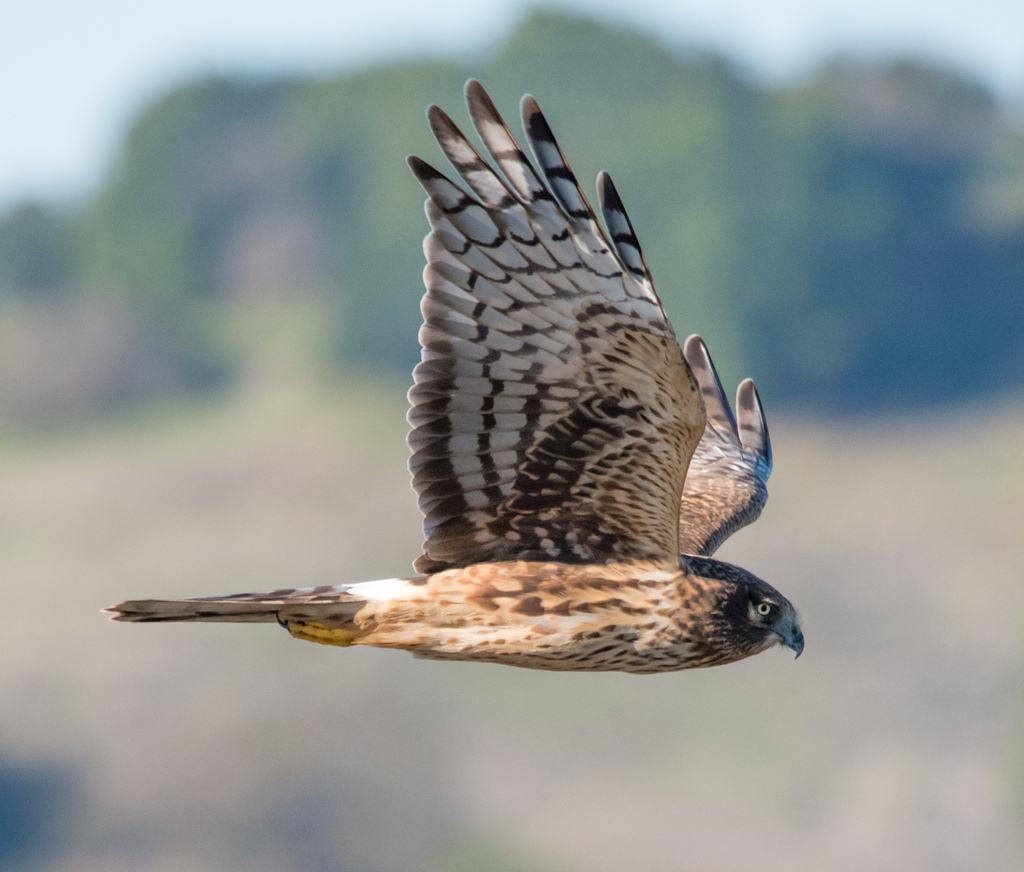
Northern Harrier
Photo © Don Loarie
Photo © Don Loarie — CC BY 4.0 — Source: iNaturalist photo #12134176Identification
The northern harrier is a medium-sized raptor measuring 41–52 cm long with a distinctive wingspan of 97–122 cm, making it relatively long-winged and long-tailed compared to other North American raptors. Sexual dimorphism is striking: males are noticeably smaller, weighing 290–400 g on average, while females are considerably larger at 390–750 g. The adult male's darker grey plumage has earned it the nickname "Grey Ghost," reflecting its striking appearance and spectral quality, while females display darker and more rufous coloring than their northern European cousins, the hen harriers.
Range & Habitat
The northern harrier breeds throughout Canada and the northernmost United States, migrating south in winter to the American South, Mexico, and Central America. However, in the Midwest, mountain west, and north Atlantic states, populations may remain year-round. The species favors open terrain including prairies, marshes, grasslands, moorland, bogs, farmland, coastal prairies, swamps, and other assorted open areas—habitats that provide the wide, unobstructed vistas essential to their hunting strategy.
Behaviour & Diet
Northern harriers are among the few raptors that practice polygyny, with single males occasionally mating with up to five females in a season. Males maintain territories averaging 2.6 km², establishing ground nests lined with grass and leaves where females lay four to eight whitish eggs. Males hunt and provision incubating females, though they spend minimal time with chicks after hatching. Up to 95% of their diet comprises small mammals such as voles, cotton rats, and ground squirrels, supplemented by open-country birds like sparrows and larks, and occasionally amphibians, reptiles, and insects. These vocal hunters employ a distinctive low, V-shaped wing posture while cruising close to the ground, using their exceptional hearing and owl-like facial disc to locate prey.
Best Time & Places to See It
Northern harriers are most reliably observed in their breeding range across Canada and northern United States during spring and summer months. In midwestern, mountain west, and north Atlantic regions, year-round presence makes these areas productive for viewing. Open prairie, marsh, and grassland habitats offer the best opportunities to witness their characteristic low, quartering flight patterns as they hunt across expansive terrain.
Photography Tips
Photographing northern harriers requires positioning yourself in open habitat where you can observe their low-altitude hunting flights without obstruction. The striking plumage contrast between silvery males and rufous females provides excellent photographic subjects. Patience is essential—watch for their characteristic V-shaped wing posture and close hugging of ground contours as they quarter across fields. Early morning activity and calm days often yield the best viewing and shooting opportunities for capturing these graceful hunters in action.
Tombstone Territorial Park
Acadia National Park
Alaska Maritime National Wildlife Refuge
Algonquin Provincial Park
Alligator River National Wildlife Refuge
Arches National Park
Arctic National Wildlife Refuge
Badlands National Park
Banff National Park
Nothing matches these filters.
No community photos yet. Log in to add the first one.
No community observations of this species yet.