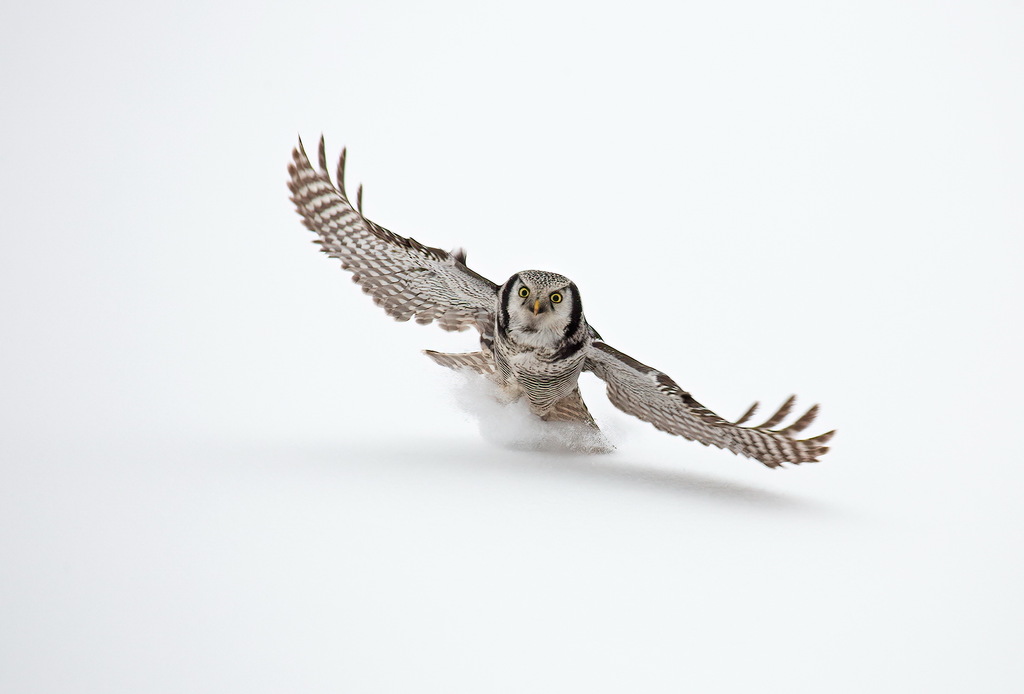
Northern Hawk-Owl
Photo © Вячеслав Юсупов
Photo © Вячеслав Юсупов — CC BY 4.0 — Source: iNaturalist photo #177689606Identification
The Northern Hawk-Owl is a medium-sized owl measuring 35–44.7 cm in length with a wingspan of 69–82 cm. Males weigh around 300 g while females are slightly larger at approximately 340 g. The species has distinctive plumage: relatively dark brown upperparts with off-white spotting, except for a striking black V-shaped pattern on the back of the neck. The underparts are white or off-white with brown banding on the breast and stomach, extending to the toes. A white face with black border, rounded head, yellow eyes, and curved yellow beak complete the portrait. The long tail features brown banding, with rounded tips in adults and pointed tips in first-year birds. In flight, the Northern Hawk-Owl closely resembles a hawk—particularly a Cooper's Hawk in North America—a similarity that may reflect its occupation of a diurnal hunting niche.
Range & Habitat
Three subspecies of Northern Hawk-Owl are distributed across the northern Holarctic. The North American subspecies ranges from eastern Alaska through Canada to Newfoundland, occasionally extending into the northern United States. The Eurasian subspecies occupy northeastern Europe and Siberia, with populations reaching from Central Asia to Xinjiang in China. Though non-migratory and typically resident within breeding ranges, these owls occasionally irrupt southward during winter or following prey explosions, rarely reaching as far south as northern Minnesota, West Virginia, New York, and South Dakota.
Northern Hawk-Owls inhabit the boreal forest, preferring open coniferous forests or mixed coniferous-deciduous woodlands with larch, birch, poplar, and willow. They favour muskegs, clearings, swamp valleys, meadows, and recently burnt areas, generally avoiding dense spruce-fir forests. Winter habitat typically mirrors breeding habitat.
Behaviour & Diet
Unlike most owls, the Northern Hawk-Owl is not strictly nocturnal or crepuscular, often remaining active during daylight hours. Mating rituals typically commence in early March. Males attract mates with a distinctive rolled whistle and calls resembling "tu-wita-wit" from perches at potential nest sites, while females produce less constant, more shrill vocalizations. When threatened, they emit sharp "rike" calls, high-pitched screams followed by yips near the nest, and warning calls to fledglings.
Northern Hawk-Owls nest in the tops of hollow stumps of dead spruce trees or on cliffsides, typically 2–10 m above ground in North America and 4–5 m in Eurasia. Egg-laying begins in late March and extends through June depending on locality, with clutches averaging 3–11 eggs per brood.
Best Time & Places to See It
The Northern Hawk-Owl's daytime activity makes it more observable than strictly nocturnal owls, though locating them requires patience and visits to appropriate habitat. In North America, the boreal forests of Canada, particularly across the eastern provinces to Newfoundland and into Alaska, offer the best opportunities. Eurasian travellers should focus on the extensive boreal forests of Siberia, northeastern Europe, and the woodlands of Scandinavia and Finland. Mating season in early spring (March onwards) presents opportunities to locate calling males at nest sites. Winter irruptions into southern ranges, though unpredictable, occasionally reward birdwatchers in the northern United States.
Photography Tips
The Northern Hawk-Owl's diurnal habits offer a significant advantage for photography compared to nocturnal owls. Look for perched birds in open coniferous forests and recently burnt areas where sightlines are clearer. The distinctive black V-marking on the nape, white facial disc with black border, and yellow eyes are key identifying features worth capturing. During breeding season, positioning near nest sites—typically in dead spruce stumps—may yield images of calling males or adults carrying prey. The species' hawk-like silhouette in flight is distinctive and photogenic, though fast movement and relatively open habitat present technical challenges. Early morning and overcast days should provide optimal lighting conditions for photographing this surprisingly active daytime hunter of the north.
Rago National Park
Nordland, Sweden
+36 birds+2 mammals
Where granite gorges slice through boreal forest in Nordland's remote interior, Rago National Park preserves one of Scandinavia's most dramatic mountain landscapes. The park's deeply incised…
VIEW NATIONAL PARKJunkerdal National Park
Nordland, Sweden
+81 birds+8 mammals
Where deep river gorges slice through the high plateaus of northern Scandinavia, Junkerdal National Park reveals the raw architecture of boreal wilderness. The park's defining feature…
VIEW NATIONAL PARKMuddus / Muttos National Park
Norrbottens län, Sweden
+128 birds+7 mammals
Where boreal forest meets wetland across the high plateaus of Swedish Lapland, Muddus National Park unfolds as one of northern Europe's most pristine wilderness sanctuaries. Vast…
VIEW NATIONAL PARKDovrefjell-Sunndalsfjella National Park
Trøndelag, Norway
+127 birds+17 mammals
Granite peaks and deep valleys carved by ancient glaciers define this vast mountain wilderness straddling the spine of central Norway. Dovrefjell-Sunndalsfjella National Park rises where subalpine…
VIEW NATIONAL PARKØvre Dividal National Park
Troms, Norway
+78 birds+3 mammals
Where granite plateaus rise above the Arctic tundra in northernmost Troms, Øvre Dividal National Park unfolds across a landscape shaped by ice-age geology and subarctic climate.…
VIEW NATIONAL PARKSchleswig-Holsteinisches Wattenmeer National Park
Germany
+378 birds+49 mammals
Where the North Sea ebbs and flows across a vast expanse of exposed mud and sand, the Schleswig-Holsteinisches Wattenmeer National Park reveals one of Europe's most…
VIEW NATIONAL PARKMount Revelstoke National Park
Area B (Shelter Bay/Mica Creek), Canada
+155 birds+8 mammals
Where the Columbia River carves through the western ranges of British Columbia, Shelter Bay and Mica Creek mark the entrance to a wilderness where subalpine meadows…
VIEW NATIONAL PARKBanff National Park
Improvement District No. 9, Canada
+264 birds+33 mammals
Where the Canadian Rockies thrust skyward in a cathedral of limestone and ice, Banff National Park preserves a wilderness of astounding vertical drama. Glacier-carved valleys cradle…
VIEW NATIONAL PARKJasper National Park
Improvement District No. 12, Canada
+235 birds+34 mammals
Where the Canadian Rockies rise in dramatic succession across western Alberta, Jasper National Park spans over 11,000 square kilometres of subalpine and alpine terrain, glaciated valleys,…
VIEW NATIONAL PARKDenali National Park
Denali Borough, United States
+144 birds+18 mammals
Across nearly 31,000 square kilometres of interior Alaska, subarctic boreal forest gives way to alpine tundra, where the raw architecture of mountains—including the continent's tallest peak—shapes…
VIEW NATIONAL PARKPyhä-Luosto National Park
Pelkosenniemi, Finland
+113 birds+6 mammals
Where boreal forest meets fell landscape in Finnish Lapland, Pyhä-Luosto National Park sprawls across 616 square kilometres of terrain that embodies the raw essence of the…
VIEW NATIONAL PARKPallas-Yllästunturi National Park
Muonio, Finland
+137 birds+19 mammals
Where boreal forest meets fell, across the Finnish Arctic frontier, nearly 3,650 square kilometres of pristine subarctic wilderness unfold in a landscape sculpted by glacial epochs…
VIEW NATIONAL PARKPatvinsuo National Park
Lieksa, Finland
+134 birds+1 mammals
Across eastern Finland's borderlands, where boreal forest meets waterlogged terrain, Patvinsuo National Park sprawls across roughly 185 square kilometers of one of northern Europe's most intact…
VIEW NATIONAL PARKUrho Kekkonen National Park
Sodankylä, Finland
+122 birds+11 mammals
Across nearly 2,700 square miles of boreal wilderness in Lapland, where the Arctic Circle's influence shapes every ecosystem, lies a landscape dominated by dense spruce and…
VIEW NATIONAL PARKNuuksio National Park
Espoo, Finland
+135 birds+12 mammals
Across the forested plateaus and rocky shorelines of southern Finland, where granite bedrock pierces through boreal woodland just twenty kilometers northwest of Helsinki, lies a landscape…
VIEW NATIONAL PARKStora Sjöfallet
Norrbotten County, Sweden
+150 birds+10 mammals
Where granite plateaus rise above boreal forest and ice-carved valleys plunge toward rushing rivers, Stora Sjöfallet unfolds across nearly 3,300 square kilometres of pristine subarctic wilderness…
VIEW NATIONAL PARKSarek
Norrbotten County, Sweden
+119 birds+8 mammals
Where granite gorges cut through boreal wilderness and meltwater streams cascade across weathered plateaus, Sarek National Park sprawls across nearly 3,100 square kilometres of Swedish Lapland's…
VIEW NATIONAL PARKPadjelanta
Norrbotten County, Sweden
+119 birds+6 mammals
Where the Scandinavian plateau rises into a landscape of low, rolling fells and vast moorlands, Padjelanta National Park sprawls across 3,435 square kilometres of subarctic wilderness…
VIEW NATIONAL PARKWaterton Lakes National Park
Improvement District No. 04, Canada
+252 birds+31 mammals
Where the Continental Divide plunges toward the prairies of Alberta, glacier-carved valleys and emerald lakes pierce a landscape where montane forest meets alpine tundra. Waterton Lakes…
VIEW NATIONAL PARKYoho National Park
Area A (Kicking Horse/Kinbasket Lake), Canada
+207 birds+19 mammals
Where the Canadian Rockies meet the Columbia River watershed, a vast wilderness of 2,211 square kilometres unfolds across Yoho National Park in British Columbia. The landscape…
VIEW NATIONAL PARKKluane National Park and Reserve
Canada
+171 birds+17 mammals
Where granite peaks thrust through boreal forest to touch the sky, Kluane National Park and Reserve sprawls across southwestern Yukon as one of North America's most…
VIEW NATIONAL PARKLahemaa National Park
Lääne-Viru County, Estonia
+237 birds+25 mammals
Where the Baltic coast meets temperate forest in northwestern Estonia, Lahemaa National Park sprawls across more than 1,300 square kilometers of deeply character-filled terrain. Coastal wetlands…
VIEW NATIONAL PARKLake Clark National Park
United States
+158 birds+11 mammals
Where subarctic tundra meets volcanic terrain and pristine waterways, Lake Clark National Park unfolds across southwestern Alaska as a landscape carved by ice age glaciers and…
VIEW NATIONAL PARKKodiak National Wildlife Refuge
United States
+221 birds+22 mammals
Where temperate rainforest meets subarctic coast, Kodiak National Wildlife Refuge sprawls across Alaska's largest island, a sanctuary defined by steep valleys carved by tidewater glaciers and…
VIEW WILDLIFE SANCTUARYKenai National Wildlife Refuge
United States
+152 birds+16 mammals
Across Alaska's Kenai Peninsula, where glacial valleys descend toward the Cook Inlet and the Gulf of Alaska, lies one of North America's most expansive subarctic wildlife…
VIEW WILDLIFE SANCTUARYYukon Delta National Wildlife Refuge
Bethel, United States
+156 birds+12 mammals
Across the Yukon Delta sprawls one of North America's most expansive coastal wetland sanctuaries, where the boreal subarctic climate strips down existence to essentials. This vast…
VIEW WILDLIFE SANCTUARYNo community photos yet. Log in to add the first one.
No community observations of this species yet.