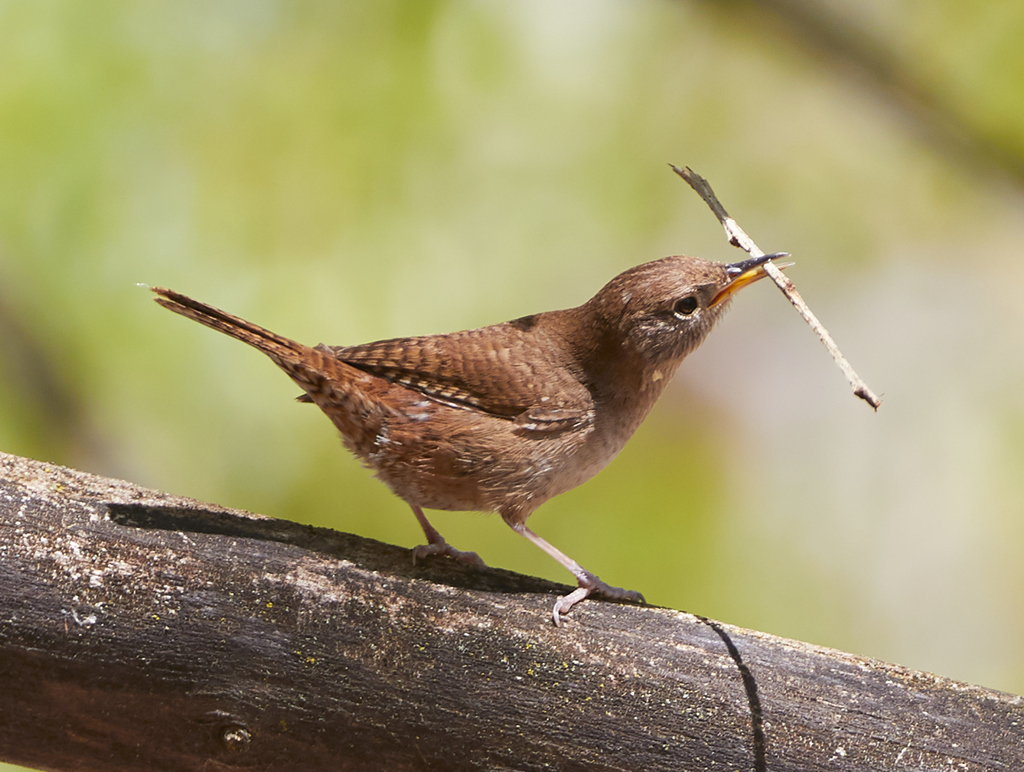
Northern House Wren
Photo © David Bird
Photo © David Bird — CC0 1.0 — Source: iNaturalist photo #196404989Identification
The northern house wren is a diminutive passerine, measuring just 11 to 13 cm in length with a 15 cm wingspan and weighing only 10 to 12 grams. Despite its tiny frame, this wren is unmistakable in the field. The plumage varies considerably among its four subspecies, with upperparts ranging from dull greyish-brown to rich rufescent-brown, while underparts span from brown through buff and pale grey to pure white. All birds display blackish barring on the wings and tail, with some subspecies also showing barring on the flanks. Look for a faint eye-ring and eyebrow stripe, combined with a characteristically long, thin bill featuring a blackish upper mandible and a black-tipped yellowish or pale grey lower mandible. The short tail is typically held in a cocked position, a distinctive feature that aids identification.
Range & Habitat
The northern house wren is found across southern Canada, the United States, and Mexico. It occurs in most suburban areas throughout its range and achieves particularly high densities in floodplain forests of the western Great Plains. These birds are migratory, returning to breeding grounds in late April to May and departing for southern United States and Mexico wintering grounds around September to early October. They readily exploit both natural cavities and man-made nest boxes for breeding.
Behaviour & Diet
True to their scientific name Troglodytes (meaning "hole dweller"), these wrens frequently disappear into crevices while hunting insects or seeking shelter. Northern house wrens actively forage in vegetation, primarily consuming insects including butterfly larvae, beetles, and bugs, supplemented by spiders and snails. The species is notably feisty and pugnacious despite its diminutive size. Males produce a rich, bubbly song during the nesting season with marked variation between individuals, though singing is heard rarely thereafter. Females also sing, and research suggests female song functions in territorial competition and egg defense against conspecifics.
Best Time & Places to See It
Northern house wrens are best observed during the breeding season from late April through August when they are most vocal and active. Suburban gardens, parks, and floodplain forests offer excellent viewing opportunities. The birds' return to breeding grounds in late April makes this an ideal time for locating them. Listen for the distinctive rich, bubbly song to locate individuals, particularly in early morning hours.
Photography Tips
The northern house wren's diminutive size and tendency to forage actively in dense vegetation present challenging photographic subjects. Position yourself near known nest sites or nest boxes where birds are more predictable. Early morning light during the breeding season will best capture the subtle plumage variations among subspecies. The bird's habit of cocking its tail creates characteristic poses worth capturing. Use patient, stationary observation at feeding or nesting areas rather than active pursuit, as these energetic wrens rarely remain still for extended periods.
Acadia National Park
Algonquin Provincial Park
Alligator River National Wildlife Refuge
Arches National Park
Badlands National Park
Banff National Park
Barra del Colorado National Wildlife Refuge
Bear River Migratory Bird Refuge
Bic National Park
Nothing matches these filters.
No community photos yet. Log in to add the first one.
No community observations of this species yet.