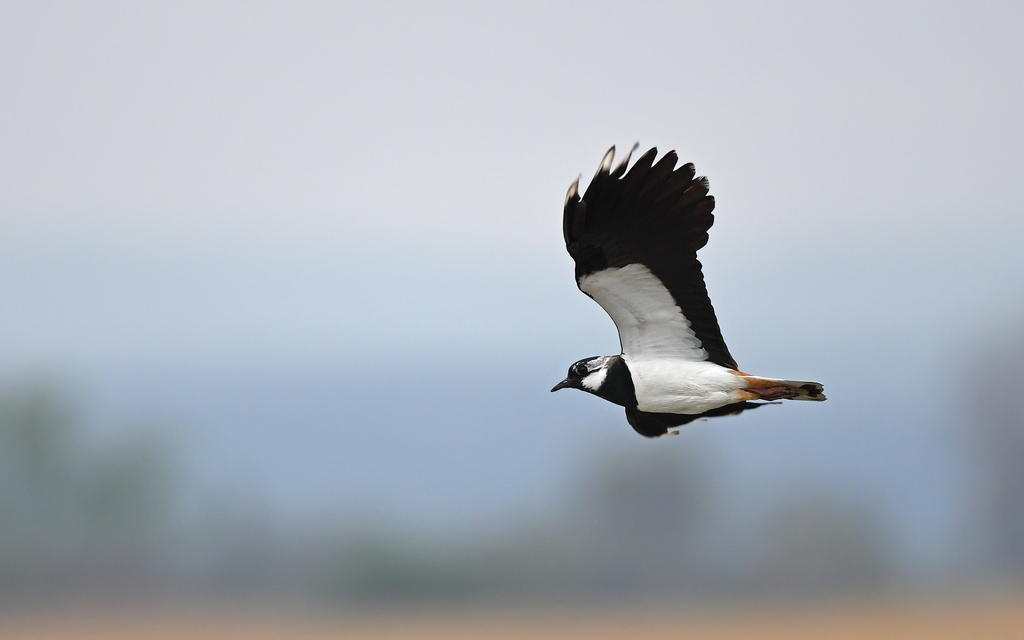
Northern Lapwing
Photo © Christoph Moning
Photo © Christoph Moning — CC BY 4.0 — Source: iNaturalist photo #490183592Identification
The northern lapwing is a distinctive 28–33 cm bird with a 67–87 cm wingspan, recognizable by its striking black and white plumage with a greenish-tinted back. Males are particularly striking with a long crest, black crown, throat and breast contrasting against a white face. Females and young birds have shorter crests and less pronounced head markings, though their overall plumage remains similar. This is the shortest-legged of all lapwings, giving it a characterful appearance as it moves across open ground.
The bird is highly vocal, especially during breeding season. Its characteristic loud, shrill "pee-wit" call gives it one of its alternative names. Displaying males produce a distinctive wheezy "pee-wit, wit wit, eeze wit" during their acrobatic tumbling flight displays, along with squeaking or mewing sounds that add to the drama of their breeding season performance.
Range & Habitat
The northern lapwing is common throughout temperate Eurosiberia. It is highly migratory across most of its range, wintering as far south as North Africa, northern India, Nepal, Bhutan and parts of China, though lowland breeders in western Europe are often resident year-round. The species occasionally appears as a vagrant to North America, particularly after storms.
This wader breeds in cultivated areas and habitats with short vegetation, and in winter forms enormous flocks on open land, particularly arable fields and mud-flats. It nests in simple ground scrapes where both nest and young are fiercely defended against all intruders, including large livestock.
Behaviour & Diet
The northern lapwing is a highly migratory bird that travels mainly by day, often in large flocks. Its diet consists primarily of insects and other small invertebrates. The species employs a fascinating feeding technique known as "worm charming," where it beats the ground with one leg to encourage worms to surface. Interestingly, like golden plovers, northern lapwings prefer to feed at night when there is moonlight, and they often feed in mixed flocks with golden plovers and black-headed gulls, though the latter may rob them of food while also providing some protection against predators.
Best Time & Places to See It
Breeding season offers the most dramatic viewing opportunities, when males perform their characteristic crazed tumbling display flights accompanied by constant vocal displays. In winter, vast flocks congregate on open arable land and mud-flats, making these areas excellent for observing large numbers of birds. The species' migratory patterns mean that sightings vary considerably with season depending on your location within its Eurosiberian range.
Photography Tips
The northern lapwing's striking plumage and dramatic breeding displays make it rewarding to photograph. Males' bold black and white markings and long crests are most prominent during the breeding season when they perform their tumbling flights. Photograph birds against open backgrounds during daylight hours when the green tinting of the back and contrasting black and white of the head and breast are most visible.
Winter flocks on open arable fields offer opportunities for capturing large numbers of birds, while the bird's characteristic posture—being the shortest-legged lapwing—provides distinctive silhouettes. Early morning light will best illuminate the subtle iridescent green of the back, and patience during breeding season may reward you with action shots of the spectacular display flights.
Aggtelek National Park
Alpilles Regional Nature Park
Alta Murgia National Park
Altai Tavan Bogd National Park
Åsnens National Park
Avesnois Regional Nature Park
Baikal National Park
Bannau Brycheiniog National Park
Bardenas Reales
Nothing matches these filters.
No community photos yet. Log in to add the first one.
No community observations of this species yet.