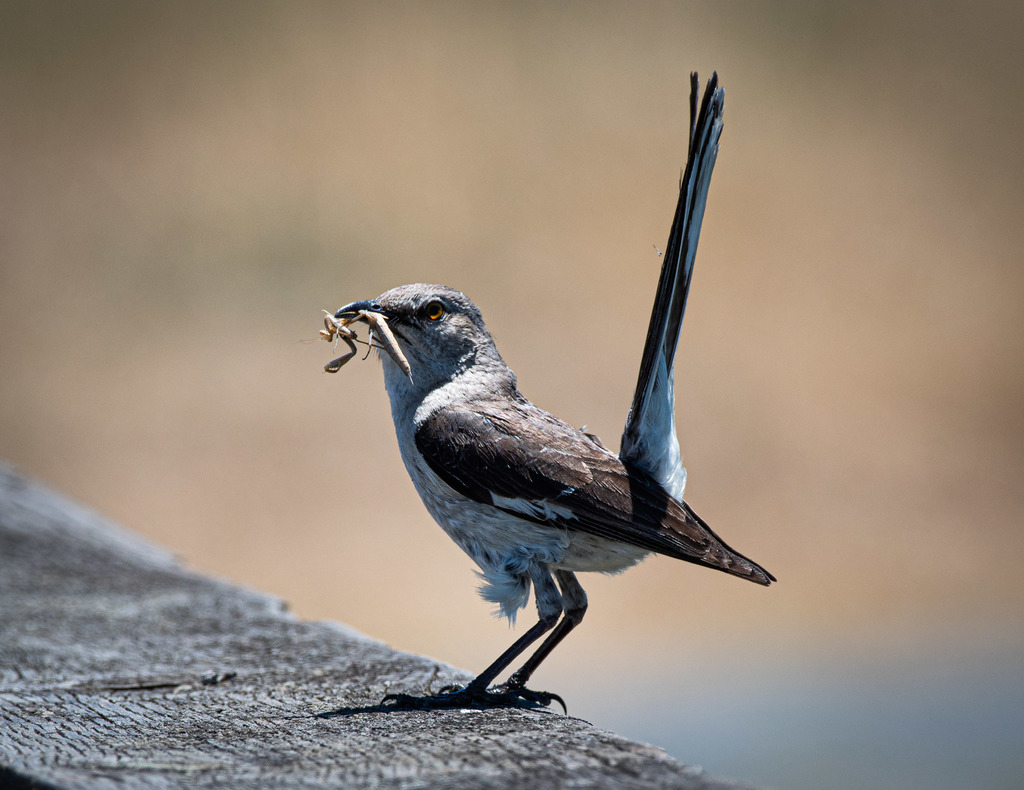
Northern Mockingbird
Photo © Claude Lyneis
Photo © Claude Lyneis — CC0 1.0 — Source: iNaturalist photo #79255714Identification
The Northern Mockingbird is a medium-sized songbird measuring 20.5–28 cm in length, with a notably long tail that is almost as long as its body. Males and females are identical in appearance. The bird displays gray upper parts contrasting with white or whitish-gray underparts. In flight, look for distinctive white patches on the wings and tail, with black central tail feathers and white lateral ones. Parallel wing bars are visible on the wing coverts, creating a striking pattern when the bird takes flight.
The iris is typically light green-yellow or yellow, though orange eyes occasionally occur. The bill is black with a brownish-black base. Juveniles are distinguishable by streaks on the back, spotted and streaked chests, and gray or grayish-green irises. Males tend to be slightly larger than females, with wingspans ranging from 31–38 cm.
Range & Habitat
The Northern Mockingbird breeds from southeastern Canada throughout the continental United States (south of the northern Plains states and Pacific Northwest), through Mexico to the Greater Antilles, and in the Caribbean. The species is typically a permanent resident, though northern populations may move south during winter or harsh weather. Notable range expansions occurred in the 19th and 20th centuries, with the species colonizing regions such as Nova Scotia, Maine, and California.
These adaptable birds thrive in open areas, open woodlands, forest edges, and increasingly in urbanized environments. They have been introduced to Hawaiian Islands, Barbados, St. Helena, the Cayman Islands, and other locations.
Behaviour & Diet
The Northern Mockingbird is famous for its extraordinary ability to mimic bird calls and other sounds, including artificial and electronic noises. Beyond mimicry, research has revealed that these birds can identify individual humans and modify their behavior based on learned threat assessments—a remarkable cognitive ability.
As an omnivore, the mockingbird feeds on fruit, invertebrates, and small vertebrates, allowing it to thrive in diverse habitats. This dietary flexibility and behavioral intelligence have made it one of North America's most successful and culturally significant bird species.
Best Time & Places to See It
The Northern Mockingbird is present year-round across much of its range, making it accessible to birders and wildlife enthusiasts at any season. In northern portions of the range, birds are more reliably present from spring through fall. Look for mockingbirds in open suburban gardens, parks, scrublands, and woodland edges—places where they can find both perches for singing and foraging opportunities.
The species is listed as Least Concern by the International Union for Conservation of Nature, meaning populations remain healthy and abundant. Its boldness around human habitation makes it relatively easy to locate, even in city centers.
Photography Tips
Photograph Northern Mockingbirds in early morning when they are most vocal and active. The bird's long tail and patterned wings are best captured in flight shots that showcase the white patches and wing bars. Position yourself in open areas where the bird has clear flight paths, and use a shutter speed of at least 1/1000s to freeze wing motion.
The gray plumage and white patches can fool exposure meters; meter on the gray back to avoid overexposure of the white belly and wing patches. Mockingbirds often return to favorite perches, allowing you to predict their movements. Their distinctive silhouette—long-tailed and upright—makes them recognizable even in distant shots, rewarding patient observation and positioning.
Acadia National Park
Alaska Maritime National Wildlife Refuge
Algonquin Provincial Park
Alligator River National Wildlife Refuge
Arches National Park
Badlands National Park
Bear River Migratory Bird Refuge
Bic National Park
Big Bend National Park
Nothing matches these filters.
No community photos yet. Log in to add the first one.
No community observations of this species yet.